


If this product has an expiration or retest date, it will be shown on the Certificate of Analysis (COA, CofA). If there is no retest or expiration date listed on the product's COA, we do not have suitable stability data to determine a shelf life. For these products, the only date on the COA will be the release date; a retest, expiration, or use-by-date will not be displayed.
For all products, we recommend handling per defined conditions as printed in our product literature and website product descriptions. We recommend that products should be routinely inspected by customers to ensure they perform as expected.
For products without retest or expiration dates, our standard warranty of 1 year from the date of shipment is applicable.
For more information, please refer to the Product Dating Information document: https://www.sigmaaldrich.com/deepweb/assets/sigmaaldrich/marketing/global/documents/418/501/product-dating-information-06-25-mk.pdf
650447

2-Propanol

99.9%, HPLC Plus, for residue analysis, suitable for gas chromatography (GC), HPLC, suitable for ASTM® 7979 and ASTM® 7968
Sinónimos:
Isopropanol, Alcohol sec-propílico, Alcohol isopropílico, IPA
Seleccione un Tamaño
Acerca de este artículo
gas chromatography (GC): suitable
food and beverages
44 mmHg ( 25 °C)
Saltar a
Nombre del producto
2-Propanol, HPLC Plus, for HPLC, GC, and residue analysis, 99.9%
SMILES string
CC(C)O
InChI key
KFZMGEQAYNKOFK-UHFFFAOYSA-N
InChI
1S/C3H8O/c1-3(2)4/h3-4H,1-2H3
grade
HPLC Plus
agency
suitable for ASTM® 7968
suitable for ASTM® 7979
vapor density
2.1 (vs air)
vapor pressure
33 mmHg ( 20 °C)
44 mmHg ( 25 °C)
assay
99.9%
form
liquid
autoignition temp.
750 °F
expl. lim.
2.0-12.7 %, 93 °C
Quality Level
greener alternative product characteristics
Safer Solvents and Auxiliaries
Learn more about the Principles of Green Chemistry.
sustainability
Greener Alternative Product
technique(s)
HPLC: suitable
gas chromatography (GC): suitable
impurities
≤0.02% water
≤0.5 ppb Fluorescence (quinine) (365 nm)
evapn. residue
≤0.0001%
halogenated residue
≤10 ng/L (as heptachlor epoxide)
refractive index
n20/D 1.377 (lit.)
pH
7.0 (20 °C)
bp
82 °C (lit.)
mp
−89.5 °C (lit.)
solubility
water: soluble
density
0.785 g/mL at 25 °C (lit.)
λ
H2O reference
UV absorption
λ: 245 nm Amax: ≤1.0
λ: 250 nm Amax: ≤0.30
λ: 275-400 nm Amax: ≤0.005
suitability
suitable for residue analysis
application(s)
PFAS testing
food and beverages
greener alternative category
¿Está buscando productos similares? Visita Guía de comparación de productos
Categorías relacionadas
1 of 4
Este artículo | 24137-M | 1.05008 | 91237 |
|---|---|---|---|
| Quality Level 100 | Quality Level 100 | Quality Level 500 | Quality Level 100 |
| technique(s) HPLC: suitable, gas chromatography (GC): suitable | technique(s) - | technique(s) - | technique(s) HPLC: suitable, gas chromatography (GC): suitable |
| assay 99.9% | assay ≥99.5% (GC) | assay ≥99.8% (GC) | assay ≥99.9% (GC) |
| application(s) food and beverages | application(s) - | application(s) pharmaceutical | application(s) cleaning products |
| grade HPLC Plus, for residue analysis | grade - | grade - | grade analytical standard |
| solubility water: soluble | solubility - | solubility - | solubility water: soluble (completely) |
Application
- Aislamiento y determinación cuantitativa de carotenos y xantofilas de extractos del pericarpio de Capsicum annum mediante HPLC.[1]
- Como disolvente en la disolución de Pt y precursores TiO2 para la fabricación de electrodos Pt-TiO2/Ti.[2]
- Como disolvente en la síntesis de biarilos orto di y trisustituidos por la reacción de acoplamiento cruzado de Suzuki-Miyaura.[3]
- Como disolvente alternativo para el benceno en el análisis de los compuestos carbonilo totales en aceites calentados y de fritura.[4]
- Como medio de reacción en la preparación de ureas cíclicas mediante la reacción del CO2 con diaminas en presencia de oxido de cerio puro (CeO2).[5]
General description
Other Notes
Packaging
Como líder mundial en reactivos de laboratorio, buscamos constantemente nuevas formas de optimizar la inocuidad de nuestros productos. El nuevo diseño de botella de disolvente 4 l cuenta con tecnología de precinto avanzada que elimina las fugas para que la manipulación de los disolventes sea más segura y práctica que nunca.
Vea aquí todas las nuevas características
Preparation Note
Legal Information
Features and Benefits
signalword
Danger
hcodes
Hazard Classifications
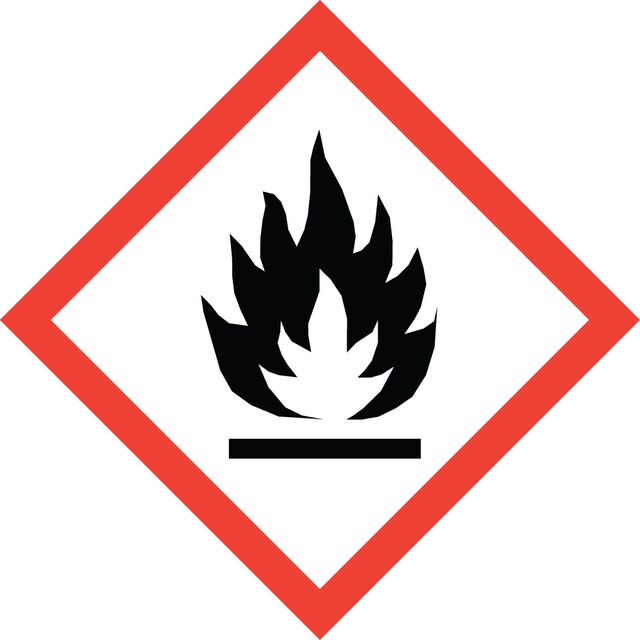
Eye Irrit. 2 - Flam. Liq. 2 - STOT SE 3
target_organs
Central nervous system
Clase de almacenamiento
3 - Flammable liquids
wgk
WGK 1
flash_point_f
53.6 °F - closed cup
flash_point_c
12.0 °C - closed cup
Elija entre una de las versiones más recientes:
¿Ya tiene este producto?
Encuentre la documentación para los productos que ha comprado recientemente en la Biblioteca de documentos.
Artículos
Learn more about our Kava CRM solution for use in quantitative and qualitative analysis of kavalactones and flavokavains in kava products to confirm their potency and authenticity.
Protocolos
A guide to create solvent systems used for the thin-layer chromatography assay of Novabiochem products.
Contenido relacionado
Las PFAS o «productos químicos eternos», persisten en el medio ambiente y pueden suponer un riesgo para la salud humana. Descubra nuestras herramientas de control medioambiental para cuantificación de las PFAS, para apoyar a los investigadores, reguladores y laboratorios en sus análisis de las PFAS.
Les FAS, ou "substances chimiques éternelles", persistent dans l'environnement et présentent des risques pour la santé humaine. Découvrez nos outils de surveillance environnementale pour la quantification des PFAS, qui peuvent aider les chercheurs, les organismes de réglementation et les laboratoires à tester les PFAS.
-
How can I determine the shelf life / expiration / retest date of this product?
1 respuesta-
¿Le ha resultado útil?
-
-
How is shipping temperature determined? And how is it related to the product storage temperature?
1 respuesta-
Products may be shipped at a different temperature than the recommended long-term storage temperature. If the product quality is sensitive to short-term exposure to conditions other than the recommended long-term storage, it will be shipped on wet or dry-ice. If the product quality is NOT affected by short-term exposure to conditions other than the recommended long-term storage, it will be shipped at ambient temperature. As shipping routes are configured for minimum transit times, shipping at ambient temperature helps control shipping costs for our customers. For more information, please refer to the Storage and Transport Conditions document: https://www.sigmaaldrich.com/deepweb/assets/sigmaaldrich/marketing/global/documents/316/622/storage-transport-conditions-mk.pdf
¿Le ha resultado útil?
-
Filtros activos
Nuestro equipo de científicos tiene experiencia en todas las áreas de investigación: Ciencias de la vida, Ciencia de los materiales, Síntesis química, Cromatografía, Analítica y muchas otras.
Póngase en contacto con el Servicio técnico