Skip to Content
Merck

159425

9-Chloroacridine

97%

Synonym(s):

9-Chloroacridine

Sign In to View Organizational & Contract Pricing.

Select a Size

1 G

€63.80

5 G

€243.00

€63.80


Please contact Customer Service for Availability

Request a Bulk Order

About This Item

Empirical Formula (Hill Notation):
C13H8ClN
CAS Number:
Molecular Weight:
213.66
NACRES:
NA.22
PubChem Substance ID:
UNSPSC Code:
12352100
EC Number:
214-895-2
MDL number:

Skip To

Technical Service
Need help? Our team of experienced scientists is here for you.
Let Us Assist

Product Name

9-Chloroacridine, 97%

InChI key

BPXINCHFOLVVSG-UHFFFAOYSA-N

InChI

1S/C13H8ClN/c14-13-9-5-1-3-7-11(9)15-12-8-4-2-6-10(12)13/h1-8H

SMILES string

Clc1c2ccccc2nc3ccccc13

assay

97%

form

solid

mp

116-120 °C (lit.)

functional group

chloro

Quality Level

Compare Similar Items

View Full Comparison

Show Differences

1 of 4

This Item
725188536008734691
assay

97%

assay

97%

assay

97%

assay

97%

Quality Level

100

Quality Level

100

Quality Level

100

Quality Level

100

form

solid

form

powder

form

solid

form

solid

mp

116-120 °C (lit.)

mp

58-63 °C

mp

28-34 °C

mp

60-64 °C

functional group

chloro

functional group

bromo, chloro

functional group

amine, chloro

functional group

chloro

Application

9-Chloroacridine was employed as chromogenic reagent in the spectrophotometric method for the quantitative determination of dapsone.[1] It was also used in the synthesis of:
  • series of novel chalcones bearing acridine moiety attached to the amino group in their ring A[2]
  • new acridine derivatives[3]
  • 9-phenoxyacridine and 4-phenoxyfuro[2,3-b]quinoline derivatives[4]

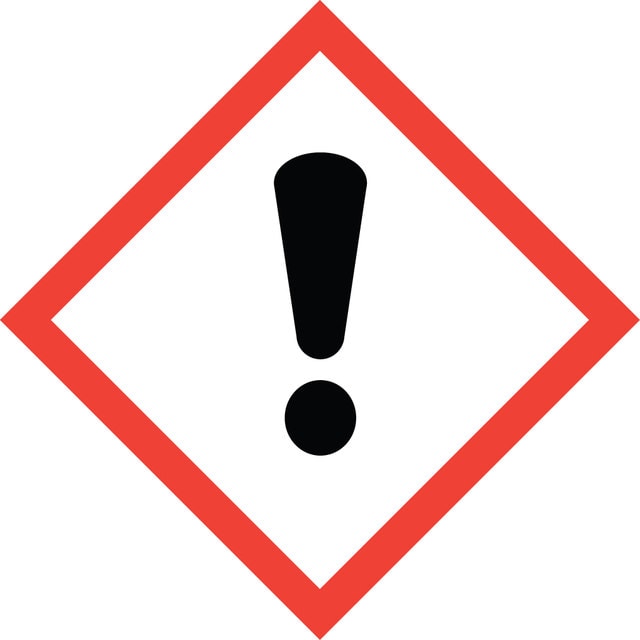
pictograms

Exclamation mark

signalword

Warning

Hazard Classifications

Eye Irrit. 2 - Skin Irrit. 2 - STOT SE 3

target_organs

Respiratory system

Storage Class

11 - Combustible Solids

wgk

WGK 3

flash_point_f

Not applicable

flash_point_c

Not applicable

ppe

dust mask type N95 (US), Eyeshields, Gloves


Choose from one of the most recent versions:

Certificates of Analysis (COA)

Lot/Batch Number

Don't see the Right Version?

If you require a particular version, you can look up a specific certificate by the Lot or Batch number.

Already Own This Product?

Find documentation for the products that you have recently purchased in the Document Library.

Visit the Document Library

I Shoukrallah et al.
Die Pharmazie, 45(9), 675-677 (1990-09-01)
A spectrophotometric method for the quantitative determination of dapsone (1) has been developed through a condensation reaction of 9-chloroacridine as a chromogen and the amino groups of 1. The reaction variables were investigated and optimized. The resultant colored products is
Arumugasamy Elangovan et al.
Organic & biomolecular chemistry, 2(21), 3113-3118 (2004-10-27)
Electrogenerated chemiluminescence (ECL) of six new ethyne-based acridine derivatives (1-6) has been studied. The new acridine derivatives were synthesized by cross-coupling of 9-chloroacridine and corresponding donor-substituted phenylethynes under modified Sonogashira conditions. The donor groups were varied in the order of
V Tomar et al.
European journal of medicinal chemistry, 45(2), 745-751 (2009-12-22)
A series of novel chalcones bearing acridine moiety attached to the amino group in their ring A have been synthesized through noncatalyzed nucleophilic aromatic substitution reaction between various 3'-aminochalcone or 4'-aminochalcones and 9-chloroacridine. The synthesized chalcone derivatives have been characterized
Yeh-Long Chen et al.
Bioorganic & medicinal chemistry, 11(18), 3921-3927 (2003-08-21)
Mast cells, neutrophils and macrophages are important inflammatory cells that have been implicated in the pathogenesis of acute and chronic inflammatory diseases. To explore a novel anti-inflammatory agent, we have synthesized certain 9-phenoxyacridine and 4-phenoxyfuro[2,3-b]quinoline derivatives and evaluated their anti-inflammatory
Jelena Rupar et al.
Bioelectrochemistry (Amsterdam, Netherlands), 135, 107579-107579 (2020-06-14)
The electrochemical behavior of 9-chloroacridine (9Cl-A), a precursor molecule for synthesis of acridine derivatives with cytostatic activity, is a complex, pH-dependent, diffusion-controlled irreversible process. Oxidation of 9Cl-A initiates with the formation of a cation radical monomer, continues via the formation

Questions

Reviews

No rating value

Active Filters

Our team of scientists has experience in all areas of research including Life Science, Material Science, Chemical Synthesis, Chromatography, Analytical and many others.

Contact Technical Service