Skip to Content
Merck

11284932001

Roche

DNase I

from bovine pancreas

Synonym(s):

Dnase

Sign In to View Organizational & Contract Pricing.

Select a Size

100 MG

₪913.00

₪913.00


Please contact Customer Service for Availability


About This Item

UNSPSC Code:
12352204
EC Number:
NACRES:
NA.54

Skip To

Technical Service
Need help? Our team of experienced scientists is here for you.
Let Us Assist

Product Name

DNase I, from bovine pancreas

biological source

bovine pancreas

form

lyophilized

packaging

pkg of 100 mg

manufacturer/tradename

Roche

technique(s)

cell culture | mammalian: suitable

storage temp.

2-8°C

Quality Level

Compare Similar Items

View Full Comparison

Show Differences

1 of 4

This Item
10104159001D4527AMPD1
biological source

bovine pancreas

biological source

bovine pancreas

biological source

bovine pancreas

biological source

-

technique(s)

cell culture | mammalian: suitable

technique(s)

DNA extraction: suitable

technique(s)

DNA extraction: suitable

technique(s)

RT-PCR: suitable

form

lyophilized

form

lyophilized

form

lyophilized powder

form

liquid

storage temp.

2-8°C

storage temp.

2-8°C

storage temp.

−20°C

storage temp.

−20°C

manufacturer/tradename

Roche

manufacturer/tradename

Roche

manufacturer/tradename

-

manufacturer/tradename

-

Quality Level

100

Quality Level

100

Quality Level

300

Quality Level

200

Application

DNase I has been used for tissue dissociation in conjunction with collagenases.[1][2][3]

Biochem/physiol Actions

During tissue dissociation, parts of the cells are lysed resulting in a release of DNA. Monomolecular DNA may cause clumping of cells. Addition of DNase I to the dissociation buffer leads to a degradation of this extracellular DNA, therby avoiding the loss of cells from undesired clumping.[4][5][6]

Features and Benefits

  • Lyophilized
  • Filtered through 0.2 μm pore size membrane before lyophilization
  • Glycoprotein and double-strand-specific endonuclease

General description

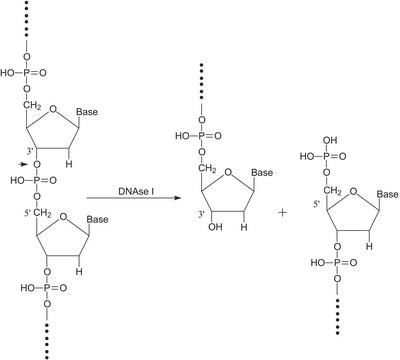
DNase I is a double-strand specific endonuclease that degrades DNA. Bovine pancreatic deoxyribonuclease I (DNase I) is a DNA minor grove-interacting nuclease, which shows relatively low specificity. This protein is composed of two central β sheets, each composed of six β-strands. This structure is surrounded by extensive loop and α-helical regions. This enzyme shares structural similarity to exonuclease III.[7] DNase I is one of the most well characterized endonucleases of mammalian origin.[8]

Other Notes

For life science research only. Not for use in diagnostic procedures.
One unit is the enzyme activity which yields an increase in absorbance of 0.001 per minute under the assay conditions.

Preparation Note

Activator: Bivalent metal ions (Ca2+, Mg2+)
Working concentration: 0.01 to 1 mg/ml
Note: For each cell type the working concentration has to be determined individually. For optimal activity the enzyme needs 5 mM Mg2+.

Reconstitute the lyophylizate in sterile double-distilled water (10 mg/ml); further dilution with PBS (phosphate buffered saline), HBSS (Hank′s Balanced Salt Solution) or medium.

pictograms

Health hazard

signalword

Danger

hcodes

Hazard Classifications

Resp. Sens. 1 - Skin Sens. 1

Storage Class

11 - Combustible Solids

wgk

WGK 1

flash_point_f

does not flash

flash_point_c

does not flash


Choose from one of the most recent versions:

Certificates of Analysis (COA)

Lot/Batch Number

Don't see the Right Version?

If you require a particular version, you can look up a specific certificate by the Lot or Batch number.

Already Own This Product?

Find documentation for the products that you have recently purchased in the Document Library.

Visit the Document Library

Burkhard Steuernagel et al.
Plant physiology, 183(2), 468-482 (2020-03-19)
Disease resistance genes encoding nucleotide-binding and leucine-rich repeat (NLR) intracellular immune receptor proteins detect pathogens by the presence of pathogen effectors. Plant genomes typically contain hundreds of NLR-encoding genes. The availability of the hexaploid wheat (Triticum aestivum) cultivar Chinese Spring
Karoline Möller et al.
Experimental & translational stroke medicine, 4(1), 20-20 (2012-10-04)
The pathophysiology of sterile inflammation following focal ischemic stroke is complex and not fully understood, but there is growing evidence that it offers several therapeutic options beyond the hitherto existing treatment strategies. The identification and quantification of infiltrating inflammatory cells
Yutaka Takeuchi et al.
Biology of reproduction, 81(6), 1055-1063 (2009-07-17)
In a recently established system for intraperitoneal spermatogonial cell transplantation in salmonids, donor type A spermatogonia (type A SG) were microinjected into the peritoneal cavity of newly hatched larvae. Compared with salmonids, the larvae of marine teleosts are small and
Gareth B Kitchen et al.
Proceedings of the National Academy of Sciences of the United States of America, 117(3), 1543-1551 (2020-01-05)
The circadian clock regulates many aspects of immunity. Bacterial infections are affected by time of day, but the mechanisms involved remain undefined. Here we show that loss of the core clock protein BMAL1 in macrophages confers protection against pneumococcal pneumonia.
Fallen Teoh et al.
Environmental microbiology, 22(5), 1816-1828 (2019-11-27)
Marine cyanobacteria genus Synechococcus are among the most abundant and widespread primary producers in the open ocean. Synechococcus strains belonging to different clades have adapted distinct strategies for growth and survival across a range of marine conditions. Clades I and

Related Content

Find protein research tools to prepare, isolate, and analyze proteins. Organized by how to extract, protect, purify, enrich, modify, and quantify proteins.

Our team of scientists has experience in all areas of research including Life Science, Material Science, Chemical Synthesis, Chromatography, Analytical and many others.

Contact Technical Service