Skip to Content
Merck

S1429

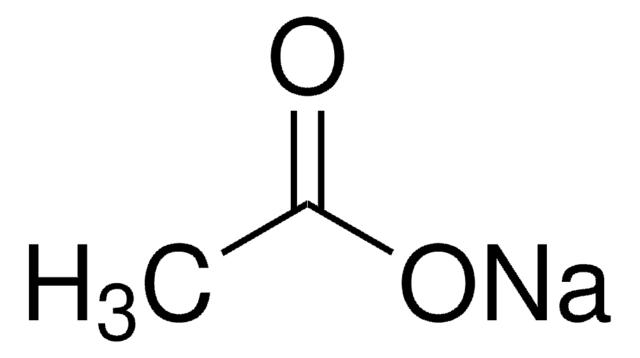
Sodium acetate

meets USP testing specifications, anhydrous

Synonym(s):

Acetic acid sodium salt

Sign In to View Organizational & Contract Pricing.

Select a Size

100 G

₪460.00

1 KG

₪2,635.00

₪460.00


Please contact Customer Service for Availability

Request a Bulk Order

About This Item

Linear Formula:
CH3COONa
CAS Number:
Molecular Weight:
82.03
NACRES:
NA.21
PubChem Substance ID:
eCl@ss:
39021906
UNSPSC Code:
12352300
EC Number:
204-823-8
MDL number:
Beilstein/REAXYS Number:
3595639

Skip To

Technical Service
Need help? Our team of experienced scientists is here for you.
Let Us Assist

Product Name

Sodium acetate, meets USP testing specifications, anhydrous

InChI key

VMHLLURERBWHNL-UHFFFAOYSA-M

InChI

1S/C2H4O2.Na/c1-2(3)4;/h1H3,(H,3,4);/q;+1/p-1

SMILES string

[Na+].CC([O-])=O

grade

anhydrous

agency

USP/NF
meets USP testing specifications

assay

99-101% dry basis

form

solid

autoignition temp.

1112 °F

pH

8.5-9.9 (25 °C, 246 g/L)

pKa 

4.76 (acetic acid)

mp

>300 °C (dec.) (lit.)

solubility

soluble 246 g/L at 20 °C (completely)

application(s)

pharmaceutical (small molecule)

Quality Level

Looking for similar products? Visit Product Comparison Guide

Compare Similar Items

View Full Comparison

Show Differences

1 of 4

This Item
791741S8750908959
assay

99-101% dry basis

assay

≥99.0%

assay

≥99.0%

assay

≥99.0%

grade

anhydrous

grade

ACS reagent, anhydrous

grade

anhydrous

grade

-

Quality Level

200

Quality Level

100

Quality Level

200

Quality Level

-

application(s)

pharmaceutical (small molecule)

application(s)

-

application(s)

-

application(s)

-

form

solid

form

solid

form

solid

form

solid

pH

8.5-9.9 (25 °C, 246 g/L)

pH

7.0-9.2 (25 °C, 5%)

pH

8.5-9.9 (25 °C, 246 g/L)

pH

-

Application

Sodium acetate (SA) has been used to increase hepatic acetyl- coenzyme A in caloric restricted rats.[1]

General description

Sodium acetate (SA) exhibits antimicrobial and antioxidant properties.[2] It is used as an exchange-fluid buffer in hemodialysis.[3] SA acts as an a alkalinizing agent and its continuous intravenous (IV) infusion causes salicylate intoxication.[4]

Storage Class

11 - Combustible Solids

wgk

WGK 1

flash_point_f

Not applicable

flash_point_c

Not applicable

ppe

Eyeshields, Gloves, type N95 (US)


Choose from one of the most recent versions:

Certificates of Analysis (COA)

Lot/Batch Number

Don't see the Right Version?

If you require a particular version, you can look up a specific certificate by the Lot or Batch number.

Already Own This Product?

Find documentation for the products that you have recently purchased in the Document Library.

Visit the Document Library

Sodium Acetate as an Alkalinizing Agent for Salicylate Intoxication: A Case Report
Groke SF, et al.
Journal of Clinical Toxicology (2015)
Enhancement of in-vitro human interleukin-1 production by sodium acetate
Bingel M, et al.
Lancet, 329(8523), 14-16 (1987)
Antimicrobial and antioxidant effects of sodium acetate, sodium lactate, and sodium citrate in refrigerated sliced salmon
Sallam KI, et al.
Food Control, 18(5), 566-575 (2007)
Mechanisms by which a very-low-calorie diet reverses hyperglycemia in a rat model of type 2 diabetes
Perry RJ, et al.
Cell Metabolism, 27(1), 210-217 (2018)
Amanda P De Souza et al.
Journal of experimental botany, 66(14), 4351-4365 (2015-04-25)
The production of bioenergy from grasses has been developing quickly during the last decade, with Miscanthus being among the most important choices for production of bioethanol. However, one of the key barriers to producing bioethanol is the lack of information

Questions

Reviews

No rating value

Active Filters

Our team of scientists has experience in all areas of research including Life Science, Material Science, Chemical Synthesis, Chromatography, Analytical and many others.

Contact Technical Service