Skip to Content
Merck

E1895

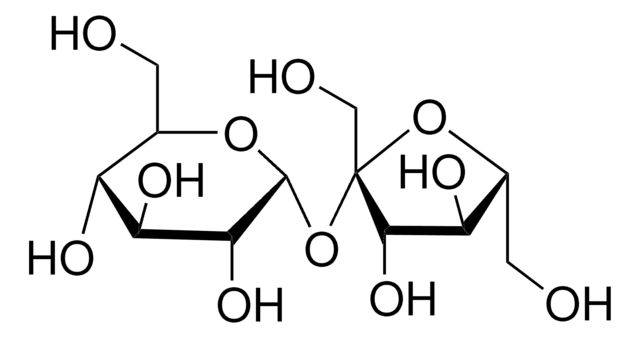
Erlose

≥94% (HPLC)

Synonym(s):

α-D-Glc-(1→4)-α-D-Glc-(1→2)-β-D-Fru, α-Maltosyl β-fructofuranoside

Sign In to View Organizational & Contract Pricing

Select a Size

50 MG

₪2,189.00

₪2,189.00


Please contact Customer Service for Availability

Request a Bulk Order

About This Item

Empirical Formula (Hill Notation):
C18H32O16
CAS Number:
Molecular Weight:
504.44
MDL number:
UNSPSC Code:
12352201
PubChem Substance ID:
NACRES:
NA.25

Skip To

Technical Service
Need help? Our team of experienced scientists is here for you.
Let Us Assist

biological source

plant

Assay

≥94% (HPLC)

form

powder

optical activity

[α]20/D 108.5 to 112.0 °, c = 0.84% (w/v) in water

storage condition

desiccated

impurities

≤12.5% water (Karl Fischer)

color

white to off-white

solubility

H2O: 50 mg/mL, clear to slightly hazy, colorless to faintly yellow

storage temp.

−20°C

SMILES string

OC[C@H]1O[C@H](O[C@H]2[C@H](O)[C@@H](O)[C@H](O[C@@H]2CO)O[C@]3(CO)O[C@H](CO)[C@@H](O)[C@@H]3O)[C@H](O)[C@@H](O)[C@@H]1O

InChI

1S/C18H32O16/c19-1-5-8(23)10(25)12(27)16(30-5)32-14-7(3-21)31-17(13(28)11(14)26)34-18(4-22)15(29)9(24)6(2-20)33-18/h5-17,19-29H,1-4H2/t5-,6-,7-,8-,9-,10+,11-,12-,13-,14-,15+,16-,17-,18+/m1/s1

InChI key

FVVCFHXLWDDRHG-KKNDGLDKSA-N

Compare Similar Items

View Full Comparison

Show Differences

1 of 4

This Item
S4001S8501S5391
biological source

plant

biological source

plant (Stachys tuberifera)

biological source

sugar cane

biological source

sugar cane

assay

≥94% (HPLC)

assay

≥98% (HPLC)

assay

≥99.5% (GC)

assay

≥99.5% (GC)

Quality Level

200

Quality Level

200

Quality Level

300

Quality Level

300

solubility

H2O: 50 mg/mL, clear to slightly hazy, colorless to faintly yellow

solubility

water: 50 mg/mL, clear to very slightly hazy, colorless

solubility

H2O: 0.5 g/mL, clear, colorless to faintly yellow

solubility

H2O: 0.5 g/mL, clear, colorless to faintly yellow

form

powder

form

powder

form

powder

form

powder

storage temp.

−20°C

storage temp.

-

storage temp.

room temp

storage temp.

room temp

Application

Erlose, a triose sugar (trisaccharide), is used in studies on dietary preference and utilization of triose sugars from aphid honeydew by various insects, such as honey bees and ants. Erlose may be used as a reference compound in assays that analyze the sugars of foods such as royal jelly and honey.[1][2]

Other Notes

To gain a comprehensive understanding of our extensive range of Oligosaccharides for your research, we encourage you to visit our Carbohydrates Category page.

Disclaimer

moisture sensitive

Storage Class Code

11 - Combustible Solids

WGK

WGK 3

Flash Point(F)

Not applicable

Flash Point(C)

Not applicable

Personal Protective Equipment

dust mask type N95 (US), Eyeshields, Gloves

Choose from one of the most recent versions:

Certificates of Analysis (COA)

Lot/Batch Number

Don't see the Right Version?

If you require a particular version, you can look up a specific certificate by the Lot or Batch number.

Already Own This Product?

Find documentation for the products that you have recently purchased in the Document Library.

Visit the Document Library

J Peirce Beach et al.
Journal of chemical ecology, 29(5), 1203-1222 (2003-07-15)
The gustatory response of female Anaphes iole wasps to naturally occurring carbohydrates, a commercial food source, and host (Lygus lineolaris) frass was determined. Wasps responded to all 14 of the sugars at the highest concentration tested (2 M). At this
T Taga et al.
Carbohydrate research, 240, 39-45 (1993-02-24)
Erlose [O-beta-D-fructofuranosyl-(1-->2)-O-alpha-D-glucopyranosyl-(1-->4)- alpha-D-glucopyranoside] monohydrate, C18H32O16.H2O, M(r) = 522.45, is orthorhombic, P2(1)2(1)2(1) with a = 30.748 (3), b = 8.757 (1), c = 8.270 (1) A, and Z = 4. The structure was solved by direct methods, and refined to R
Gaëlle Daniele et al.
Food chemistry, 134(2), 1025-1029 (2012-10-31)
A gas chromatographic method was developed to quantify the major and minor sugars of 400 Royal Jellies (RJs). Their contents were compared in relation to the geographical origins and different production methods. A reliable database was established from the analysis
Roberto Consonni et al.
Journal of agricultural and food chemistry, 60(18), 4526-4534 (2012-04-19)
The saccharide profiles of 5 different botanical species in 86 Italian honey samples were investigated by ¹H and ¹H-¹³C NMR spectroscopy. Nineteen saccharides were identified in the aqueous extracts, namely, fructose, glucose, gentiobiose, isomaltose, kojibiose, maltose, maltulose, melibiose, nigerose, palatinose
S Hojo et al.
Infection and immunity, 55(3), 698-703 (1987-03-01)
Resting-cell suspensions of oral microorganisms grown in sucrose were studied for the production of acid from glucosylsucrose and maltosylsucrose. Most oral microorganisms fermented these sugars to only a limited extent. Streptococcus salivarius, however, metabolized glucosylsucrose as well as sucrose. We

Questions

Reviews

No rating value

Active Filters

Our team of scientists has experience in all areas of research including Life Science, Material Science, Chemical Synthesis, Chromatography, Analytical and many others.

Contact Technical Service