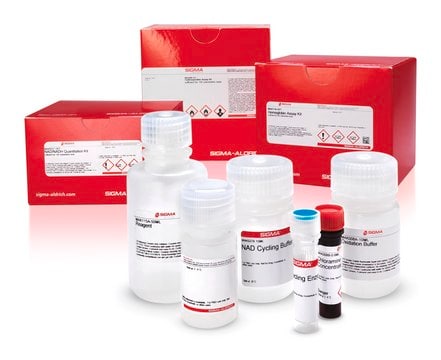
Suitable for the detection of ADP in cells, tissue and other biological samples.
Biochem/physiol Actions
The ADP Assay kit provides a simple and direct procedure for measuring ADP levels in cells and other biological samples. The assay involves two steps. In the first step, the working reagent lyses cells to release ATP and ADP. In the presences of luciferse, ATP immediately reacts with the substrate (D-luciferin) to produce light. The light intensity is a direct measure of the intracellular ATP concentration and is stable over several minutes. Luciferase ATP + D-Luciferin + O2 → oxyluciferin + AMP + PPi + CO2 + light In the second step, the ADP is converted to ATP through an enzyme reaction. This newly formed ATP then reacts with the D-luciferin as in the first step. The second light intensity measured represents the total ADP and ATP concentration in the sample.
General description
Adenosine diphosphate (ADP) is a nucleoside that plays a critical role in energy transfer reactions. ADP is produced from adenosine triphosphate via the action of ATPases. ADP also plays a critical role in platelet function. ADP, stored in plate-dense granules, is released upon platelet activation where it acts on purinergic receptors to mediate intracellular signaling and platelet aggregation.
The ADP Assay kit provides a simple and direct procedure for measuring ADP levels in cells and other biological samples. The assay involves two steps. In the first step, the working reagent lyses cells to release ATP and ADP. In the presences of luciferse, ATP immediately reacts with the Substrate (D-luciferin) to produce light. The light intensity is a direct measure of the intracellular ATP concentration and is stable over several minutes.
In the second step, the ADP is converted to ATP through an enzyme reaction. This newly formed ATP then reacts with the D-luciferin as in the first step. The second light intensity measured represents the total ADP and ATP concentration in the sample.
Neurourology and urodynamics, 39(3), 926-934 (2020-02-13)
To characterize purinergic signaling in overactive bladder (OAB). Mucosal biopsies were taken by flexible cystoscopy from patients with storage symptoms referred to Urology Departments of collaborating hospitals. Immunohistochemistry (n = 12) and Western blot analysis (n = 28) were used to establish the qualitative
Aggregation of blood platelets by adenosine diphosphate and its reversal.
Born G V R
Nature, 194(4832), 927-929 (1962)
The membrane ATPase of Escherichia coli: I. Ion dependence and ATP-ADP exchange reaction.
Roisin M P and Kepes A
Biochimica et Biophysica Acta - Bioenergetics, 275(3), 333-346 (1972)
Molecular and cellular endocrinology, 443, 128-137 (2017-01-17)
To explore the roles of mitochondrial Uncoupling Protein 2 (UCP2) in cumulus cells (CCs), human CCs were cultured in vitro, and the UCP2 was inhibited by treatment with Genipin, a special UCP inhibitor, or by RNA interference targeting UCP2. No significant
Current biology : CB, 31(8), 1606-1615 (2021-02-12)
The ability to resume growth after a dormant period is an important strategy for the survival and spreading of bacterial populations. Energy homeostasis is critical in the transition into and out of a quiescent state. Synechocystis sp. PCC 6803, a
What is the range of concentration the kit is able to measure? Where can the SOP be found?
1 answer
Technical Support
·9 months ago
The standard can be prepared from 0 - 30 µM as described in Table 1 of the product information sheet. The detection range is as low as 0.02 µM ADP that can be quantified. Please access the technical bulletin below for more details.
Our team of scientists has experience in all areas of research including Life Science, Material Science, Chemical Synthesis, Chromatography, Analytical and many others.