Skip to Content
Merck

11189

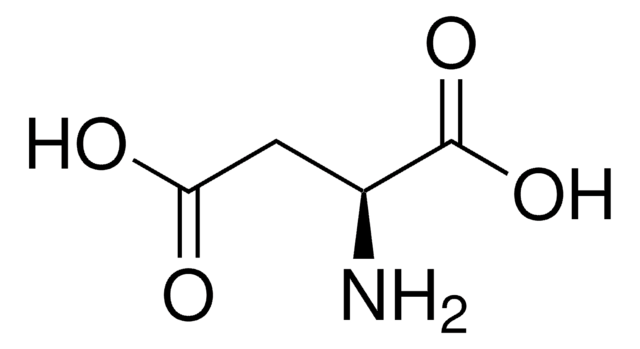
L-Aspartic acid

≥99.5% (T), BioUltra

Synonym(s):

(S)-(+)-Aminosuccinic acid, (S)-Aminobutanedioic acid

Sign In to View Organizational & Contract Pricing.

Select a Size

100 G

₹6,711.50

500 G

₹14,451.38

1 KG

₹35,257.03

₹6,711.50


Available to ship TODAYDetails


Request a Bulk Order

About This Item

Linear Formula:
HO2CCH2CH(NH2)CO2H
CAS Number:
Molecular Weight:
133.10
NACRES:
NA.26
PubChem Substance ID:
eCl@ss:
32160406
UNSPSC Code:
12352209
EC Number:
200-291-6
MDL number:
Beilstein/REAXYS Number:
1723530

Skip To

Technical Service
Need help? Our team of experienced scientists is here for you.
Let Us Assist

Product Name

L-Aspartic acid, BioUltra, ≥99.5% (T)

Quality Level

InChI key

CKLJMWTZIZZHCS-REOHCLBHSA-N

InChI

1S/C4H7NO4/c5-2(4(8)9)1-3(6)7/h2H,1,5H2,(H,6,7)(H,8,9)/t2-/m0/s1

SMILES string

N[C@@H](CC(O)=O)C(O)=O

product line

BioUltra

assay

≥99.5% (T)

form

powder or crystals

optical activity

[α]20/D +24.7±1°, c = 5% in 5 M HCl

impurities

insoluble matter, passes filter test
≤0.3% foreign amino acids

ign. residue

≤0.05% (as SO4)

loss

≤0.1% loss on drying, 110 °C

color

white

mp

>300 °C (dec.) (lit.)

solubility

1 M HCl: 0.5 M at 20 °C, clear, colorless

anion traces

chloride (Cl-): ≤50 mg/kg
sulfate (SO42-): ≤150 mg/kg

cation traces

Al: ≤5 mg/kg
As: ≤0.1 mg/kg
Ba: ≤5 mg/kg
Bi: ≤5 mg/kg
Ca: ≤10 mg/kg
Cd: ≤5 mg/kg
Co: ≤5 mg/kg
Cr: ≤5 mg/kg
Cu: ≤5 mg/kg
Fe: ≤5 mg/kg
K: ≤50 mg/kg
Li: ≤5 mg/kg
Mg: ≤5 mg/kg
Mn: ≤5 mg/kg
Mo: ≤5 mg/kg
NH4+: ≤200 mg/kg
Na: ≤100 mg/kg
Ni: ≤5 mg/kg
Pb: ≤5 mg/kg
Sr: ≤5 mg/kg
Zn: ≤5 mg/kg

λ

0.5 M in 1 M HCl

UV absorption

λ: 260 nm Amax: 0.20
λ: 280 nm Amax: 0.10

Gene Information

human ... CA1(759), CA2(760)
rat ... Grin2a(24409)

Looking for similar products? Visit Product Comparison Guide

Compare Similar Items

View Full Comparison

Show Differences

1 of 4

This Item
A8949A5474PHR1104
form

powder or crystals

form

powder

form

crystalline powder

form

-

assay

≥99.5% (T)

assay

≥99% (HPLC)

assay

≥98.5%

assay

-

product line

BioUltra

product line

BioXtra

product line

-

product line

-

optical activity

[α]20/D +24.7±1°, c = 5% in 5 M HCl

optical activity

-

optical activity

-

optical activity

-

color

white

color

white to off-white

color

-

color

-

solubility

1 M HCl: 0.5 M at 20 °C, clear, colorless

solubility

1 M HCl: 0.5 M, clear, colorless

solubility

1 M HCl: 50 mg/mL

solubility

-

Application

L-Aspartic acid has been used:
  • as a metabolite to study the enzyme–metabolite interactions in the central metabolism of Escherichia coli by nuclear magnetic resonance (NMR)[1]
  • in transmission electron microscopy[2]
  • as a component of complete media for culturing Yeast strain[3]

Biochem/physiol Actions

L-Aspartic acid is associated with protein biosynthesis (proteinogenic) and neurotransmission[4]
Principal neurotransmitter for fast synaptic excitation.

General description

Aspartic acid (Asp) is a non-essential amino acid.[3] It makes up to 5% of the amino acids in a protein.[5] The GAC and GAU codons encode Asp. This is a chiral molecule and occurs in two enantiomers namely L-Asp and D-Asp.[4]

Storage Class

11 - Combustible Solids

wgk

WGK 1

flash_point_f

Not applicable

flash_point_c

Not applicable

ppe

dust mask type N95 (US), Eyeshields, Gloves


Choose from one of the most recent versions:

Certificates of Analysis (COA)

Lot/Batch Number

Don't see the Right Version?

If you require a particular version, you can look up a specific certificate by the Lot or Batch number.

Already Own This Product?

Find documentation for the products that you have recently purchased in the Document Library.

Visit the Document Library

Aspartic Acid
Johnson EC
reference module in biomedical sciences (2017)
Paola Monti et al.
Journal of visualized experiments : JoVE, (150) (2019-08-20)
The finding that the well-known mammalian P53 protein can act as a transcription factor (TF) in the yeast S. cerevisiae has allowed for the development of different functional assays to study the impacts of 1) binding site [i.e., response element
Peptidyl-Asp Metalloendopeptidase
Handbook of Proteolytic Enzymes, 1 (2012)
Tijs Vandoorne et al.
Nature communications, 10(1), 4147-4147 (2019-09-14)
Energy metabolism has been repeatedly linked to amyotrophic lateral sclerosis (ALS). Yet, motor neuron (MN) metabolism remains poorly studied and it is unknown if ALS MNs differ metabolically from healthy MNs. To address this question, we first performed a metabolic
Maren Diether et al.
Molecular systems biology, 15(8), e9008-e9008 (2019-08-30)
Metabolite binding to proteins regulates nearly all cellular processes, but our knowledge of these interactions originates primarily from empirical in vitro studies. Here, we report the first systematic study of interactions between water-soluble proteins and polar metabolites in an entire biological

Questions

Reviews

No rating value

Active Filters

Our team of scientists has experience in all areas of research including Life Science, Material Science, Chemical Synthesis, Chromatography, Analytical and many others.

Contact Technical Service