




If this product has an expiration or retest date, it will be shown on the Certificate of Analysis (COA, CofA). If there is no retest or expiration date listed on the product's COA, we do not have suitable stability data to determine a shelf life. For these products, the only date on the COA will be the release date; a retest, expiration, or use-by-date will not be displayed.
For all products, we recommend handling per defined conditions as printed in our product literature and website product descriptions. We recommend that products should be routinely inspected by customers to ensure they perform as expected.
For products without retest or expiration dates, our standard warranty of 1 year from the date of shipment is applicable.
For more information, please refer to the Product Dating Information document: https://www.sigmaaldrich.com/deepweb/assets/sigmaaldrich/marketing/global/documents/418/501/product-dating-information-06-25-mk.pdf
345547

Hydrogen chloride solution
4.0 M in dioxane
Select a Size
¥12,100
¥35,300
¥42,400
Inquire
About This Item
Skip To
form
liquid
Quality Level
concentration
3.80-4.40 M (by NaOH, titration)
4.0 M in dioxane
density
1.05 g/mL at 25 °C
SMILES string
Cl
InChI
1S/ClH/h1H
InChI key
VEXZGXHMUGYJMC-UHFFFAOYSA-N
Looking for similar products? Visit Product Comparison Guide
Related Categories
1 of 4
This Item | 90964 | 705551 | 1.00327 |
|---|---|---|---|
| concentration 3.80-4.40 M (by NaOH, titration), 4.0 M in dioxane | concentration 3 M in methanol | concentration 2.85-3.30 M (silver nitrate titration), 3 M in cyclopentyl methyl ether (CPME) | concentration - |
| Quality Level 200 | Quality Level 100 | Quality Level 100 | Quality Level 400 |
| form liquid | form liquid | form liquid | form liquid |
| density 1.05 g/mL at 25 °C | density 0.871-0.881 g/mL at 20 °C | density 0.895 g/mL at 25 °C | density 0.90 g/cm3 at 20 °C |
General description
Application
- A reagent for the deprotection of the N-Boc protecting group from various heterocyclic derivatives.[2]
- A reagent for the deprotection of polymer protecting groups. For instance, deprotection of benzyl ether-protected polymer.[3]
- A polymerization initiator in combination with ZnCl2 in the synthesis of formyl terminated poly(ethyl vinyl ether) from ethyl vinyl ether (EVE).[4]
Signal Word
Danger
Hazard Statements
Precautionary Statements
Hazard Classifications
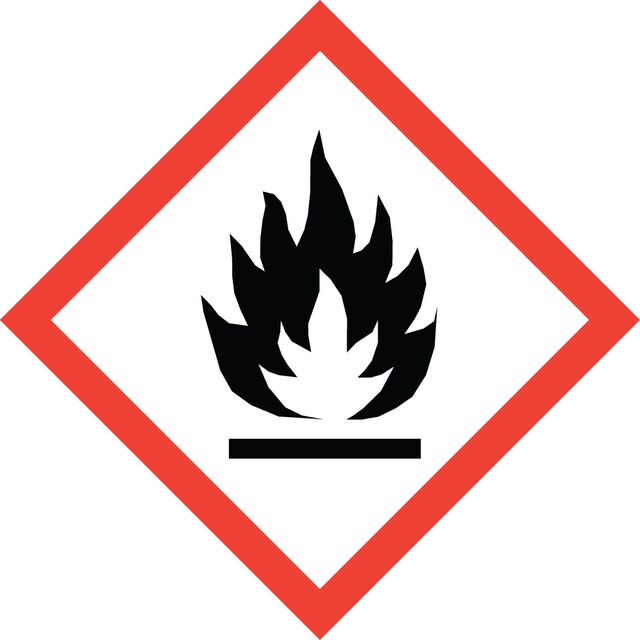
Carc. 1B - Eye Irrit. 2 - Flam. Liq. 2 - Met. Corr. 1 - Skin Irrit. 2 - STOT SE 3
Target Organs
Respiratory system
Supplementary Hazards
Storage Class Code
3 - Flammable liquids
WGK
WGK 3
Flash Point(F)
62.6 °F - closed cup
Flash Point(C)
17 °C - closed cup
Regulatory Listings
Regulatory Listings are mainly provided for chemical products. Only limited information can be provided here for non-chemical products. No entry means none of the components are listed. It is the user’s obligation to ensure the safe and legal use of the product.
PDSCL
Deleterious substance
PRTR
Class I Designated Chemical Substances
FSL
Group 4: Flammable liquids
Type 1 petroleums
Hazardous rank II
Water insoluble liquid
ISHL Indicated Name
Substances Subject to be Indicated Names
ISHL Notified Names
Substances Subject to be Notified Names
JAN Code
345547-2L:4548173138282
345547-4X100ML:
345547-VAR-D:
345547-CH:
345547-800ML:4548173138299
345547-BULK:
345547-20L:
345547-100ML:4548173138275
345547-VAR:
Choose from one of the most recent versions:
Already Own This Product?
Find documentation for the products that you have recently purchased in the Document Library.
-
How can I determine the shelf life / expiration / retest date of this product?
1 answer-
Helpful?
-
-
How is shipping temperature determined? And how is it related to the product storage temperature?
1 answer-
Products may be shipped at a different temperature than the recommended long-term storage temperature. If the product quality is sensitive to short-term exposure to conditions other than the recommended long-term storage, it will be shipped on wet or dry-ice. If the product quality is NOT affected by short-term exposure to conditions other than the recommended long-term storage, it will be shipped at ambient temperature. As shipping routes are configured for minimum transit times, shipping at ambient temperature helps control shipping costs for our customers. For more information, please refer to the Storage and Transport Conditions document: https://www.sigmaaldrich.com/deepweb/assets/sigmaaldrich/marketing/global/documents/316/622/storage-transport-conditions-mk.pdf
Helpful?
-
Active Filters
Our team of scientists has experience in all areas of research including Life Science, Material Science, Chemical Synthesis, Chromatography, Analytical and many others.
Contact Technical Service