


If this product has an expiration or retest date, it will be shown on the Certificate of Analysis (COA, CofA). If there is no retest or expiration date listed on the product's COA, we do not have suitable stability data to determine a shelf life. For these products, the only date on the COA will be the release date; a retest, expiration, or use-by-date will not be displayed.
For all products, we recommend handling per defined conditions as printed in our product literature and website product descriptions. We recommend that products should be routinely inspected by customers to ensure they perform as expected.
For products without retest or expiration dates, our standard warranty of 1 year from the date of shipment is applicable.
For more information, please refer to the Product Dating Information document: https://www.sigmaaldrich.com/deepweb/assets/sigmaaldrich/marketing/global/documents/418/501/product-dating-information-06-25-mk.pdf
1.01040

2-Propanol

≥99.9% (GC), gradient grade, suitable for HPLC, LiChrosolv®
Synonym(s):
sec-Propyl alcohol, IPA, Isopropanol, Isopropyl alcohol
Select a Size
€52.30
€101.00
€172.00
€775.00
About This Item
43 hPa ( 20 °C)
44 mmHg ( 25 °C)
Skip To
Product Name
2-Propanol, gradient grade for liquid chromatography LiChrosolv®
vapor density
2.1 (vs air)
Quality Level
vapor pressure
33 mmHg ( 20 °C)
43 hPa ( 20 °C)
44 mmHg ( 25 °C)
product line
LiChrosolv®
grade
gradient grade
Assay
≥99.9% (GC)
form
liquid
autoignition temp.
750 °F
potency
5045 mg/kg LD50, oral (Rat)
12800 mg/kg LD50, skin (Rabbit)
expl. lim.
2.0-12.7 %, 93 °C
greener alternative product characteristics
Safer Solvents and Auxiliaries
Learn more about the Principles of Green Chemistry.
sustainability
Greener Alternative Product
technique(s)
HPLC: suitable
impurities
≤0.0002 meq/g Acidity
≤0.0002 meq/g Alkalinity
≤0.05% Water
evapn. residue
≤2.0 mg/L
transmittance
220 nm, ≥80% (Checking after purging with N2)
230 nm, ≥90% (Checking after purging with N2)
250 nm, ≥99% (Checking after purging with N2)
refractive index
n20/D 1.377 (lit.)
pH
7 (20 °C)
bp
82 °C (lit.)
mp
−89.5 °C (lit.)
transition temp
flash point 12 °C
density
0.785 g/mL at 25 °C (lit.)
greener alternative category
SMILES string
CC(C)O
InChI
1S/C3H8O/c1-3(2)4/h3-4H,1-2H3
InChI key
KFZMGEQAYNKOFK-UHFFFAOYSA-N
Looking for similar products? Visit Product Comparison Guide
1 of 4
This Item | 1.13350 | 1.00998 | 1.05008 |
|---|---|---|---|
| assay ≥99.9% (GC) | assay ≥99.8% (GC) | assay ≥99.8% (GC) | assay ≥99.8% (GC) |
| technique(s) HPLC: suitable | technique(s) - | technique(s) gas chromatography (GC): suitable | technique(s) - |
| grade gradient grade | grade - | grade - | grade - |
| Quality Level 100 | Quality Level 200 | Quality Level 100 | Quality Level 500 |
| form liquid | form liquid | form liquid | form liquid |
| refractive index n20/D 1.377 (lit.) | refractive index n20/D 1.377 (lit.) | refractive index n20/D 1.377 (lit.) | refractive index n20/D 1.377 (lit.) |
General description
Application
Features and Benefits
Preparation Note
Analysis Note
Identity (IR): conforms
Evaporation residue: ≤ 2.0 mg/l
Water: ≤ 0.05 %
Acidity: ≤ 0.0002 meq/g
Alkalinity: ≤ 0.0002 meq/g
Gradient grade (at 235 nm): ≤ 1.0 mAU
Gradient grade (at 254 nm): ≤ 1.0 mAU
Transmission (Checking after purging with N₂ (at 220 nm)): ≥ 80 %
Transmission (Checking after purging with N₂ (at 230 nm)): ≥ 90 %
Transmission (Checking after purging with N₂ (from 250 nm)): ≥ 99 %
Filtered by 0.2 µm filter
Other Notes
Legal Information
related product
Signal Word
Danger
Hazard Statements
Precautionary Statements
Hazard Classifications
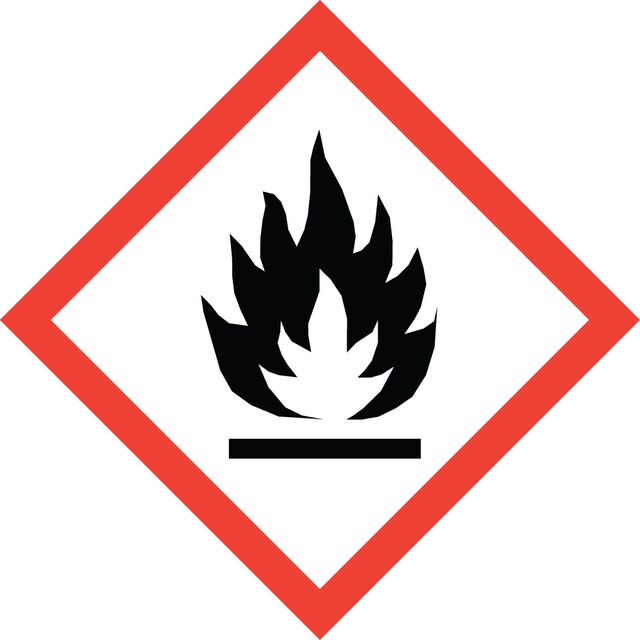
Eye Irrit. 2 - Flam. Liq. 2 - STOT SE 3
Target Organs
Central nervous system
Storage Class Code
3 - Flammable liquids
WGK
WGK 1
Flash Point(F)
53.6 °F - closed cup
Flash Point(C)
12.0 °C - closed cup
Certificates of Analysis (COA)
Search for Certificates of Analysis (COA) by entering the products Lot/Batch Number. Lot and Batch Numbers can be found on a product’s label following the words ‘Lot’ or ‘Batch’.
Already Own This Product?
Find documentation for the products that you have recently purchased in the Document Library.
Articles
Using an Ascentis® Express F5 HPLC column, this study separates 11 β-agonists in pork by LC-MS/MS in under 8 minutes with excellent recovery and precision.
Analyze Xiaoer Chiqiao Qingre granules for geniposide and forsythin using Discovery® HS C18 column and Supelclean™ LC-Alumina-N SPE.
A complete reversed phase HPLC-ELSD workflow, including sample preparation for the analysis of Polysorbate 80 in a monoclonal antibody formulation.
Protocols
The modern thin-layer chromatography (TLC) offers advantages also in the field of cosmetics to quickly and simultaneously analyze samples with densitometric detection.
Thin layer chromatography coupled with mass spectrometry does not require substantial sample preparation. Energy drinks can be applied without dilution directly onto the TLC plate.
HPTLC–MS analysis of quinine in tonic water and caffeine in coffee and cola drinks.
-
How can I determine the shelf life / expiration / retest date of this product?
1 answer-
Helpful?
-
-
How is shipping temperature determined? And how is it related to the product storage temperature?
1 answer-
Products may be shipped at a different temperature than the recommended long-term storage temperature. If the product quality is sensitive to short-term exposure to conditions other than the recommended long-term storage, it will be shipped on wet or dry-ice. If the product quality is NOT affected by short-term exposure to conditions other than the recommended long-term storage, it will be shipped at ambient temperature. As shipping routes are configured for minimum transit times, shipping at ambient temperature helps control shipping costs for our customers. For more information, please refer to the Storage and Transport Conditions document: https://www.sigmaaldrich.com/deepweb/assets/sigmaaldrich/marketing/global/documents/316/622/storage-transport-conditions-mk.pdf
Helpful?
-
Active Filters
Our team of scientists has experience in all areas of research including Life Science, Material Science, Chemical Synthesis, Chromatography, Analytical and many others.
Contact Technical Service