Skip to Content
Merck

H7904

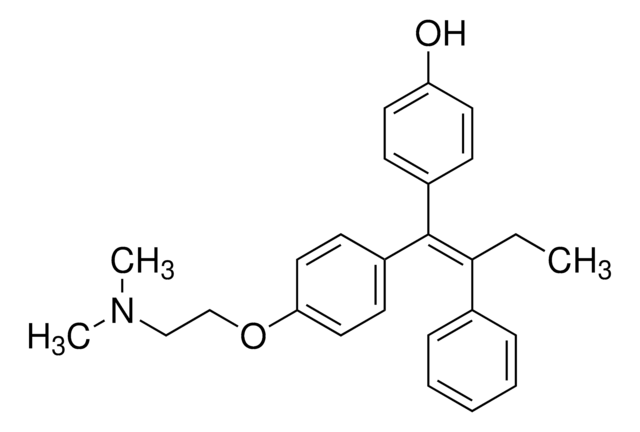
(Z)-4-Hydroxytamoxifen

≥98% (HPLC), powder, estrogen receptor modulator

Synonym(s):

4OH-Tamoxifen, (Z)-4-(1-[4-(Dimethylaminoethoxy)phenyl]-2-phenyl-1-butenyl)phenol, (Z)-4-OHT, trans-4-Hydroxytamoxifen

Sign In to View Organizational & Contract Pricing.

Select a Size

Pricing and availability is not currently available.

About This Item

Empirical Formula (Hill Notation):
C26H29NO2
CAS Number:
Molecular Weight:
387.51
UNSPSC Code:
51111800
PubChem Substance ID:
NACRES:
NA.77
MDL number:

Skip To

Technical Service
Need help? Our team of experienced scientists is here for you.
Let Us Assist

Product Name

(Z)-4-Hydroxytamoxifen, ≥98% Z isomer

form

powder

SMILES string

CC\C(c1ccccc1)=C(/c2ccc(O)cc2)c3ccc(OCCN(C)C)cc3

InChI

1S/C26H29NO2/c1-4-25(20-8-6-5-7-9-20)26(21-10-14-23(28)15-11-21)22-12-16-24(17-13-22)29-19-18-27(2)3/h5-17,28H,4,18-19H2,1-3H3/b26-25-

InChI key

TXUZVZSFRXZGTL-QPLCGJKRSA-N

assay

≥98% (HPLC)

storage condition

desiccated
protect from light

solubility

methanol: 10 mg/mL
ethanol: 20 mg/mL (with heating)

antibiotic activity spectrum

neoplastics

mode of action

enzyme | inhibits

originator

AstraZeneca

storage temp.

2-8°C

Quality Level

Related Categories

Compare Similar Items

View Full Comparison

Show Differences

1 of 4

This Item
H6278E8284T5648
form

powder

form

powder

form

solid

form

-

assay

≥98% (HPLC)

assay

≥98% (HPLC)

assay

≥98% (HPLC)

assay

≥99%

Quality Level

300

Quality Level

300

Quality Level

100

Quality Level

-

storage temp.

2-8°C

storage temp.

2-8°C

storage temp.

2-8°C

storage temp.

2-8°C

solubility

methanol: 10 mg/mL, ethanol: 20 mg/mL (with heating)

solubility

methanol: 10 mg/mL, ethanol: 20 mg/mL (with heating)

solubility

DMSO: >10 mg/mL

solubility

H2O: insoluble <0.1% at 20 °C, chloroform: soluble 50 mg/mL, clear, colorless to faintly yellow, 2-propanol: soluble, DMSO: soluble, ethanol: soluble, methanol: soluble, propylene glycol: soluble

storage condition

desiccated, protect from light

storage condition

desiccated, protect from light

storage condition

desiccated

storage condition

-

Application

(Z)-4-Hydroxytamoxifen has been used:
  • as a media supplement to study the cell viability by WST-1 Assay[1]
  • for inducing deletion of transforming growth factor-β (TGF-β gene in mice[2]
  • to induce Cre recombinase activity in vitro.[3]

Features and Benefits

This compound is featured on the Nuclear Receptors (Steroids) page of the Handbook of Receptor Classification and Signal Transduction. To browse other handbook pages, click here.
This compound was developed by AstraZeneca. To browse the list of other pharma-developed compounds and Approved Drugs/Drug Candidates, click here.

General description

4-Hydroxytamoxifen (4-OHT) is a metabolite of the antiestrogen tamoxifen in humans and other mammals.[4] Both the Z (trans) and E (cis) 4-OHT isomers exhibit antiestrogenic properties in immature rats. Studies on the structure-function relationships of fixed ring systems have revealed that the trans isomer is a potent antiestrogen, while the cis isomer is relatively weaker (about 100 times less potent) as an antiestrogen in T47D breast cancer cells in vitro. 4-OHT binds to estrogen receptors (ER) and estrogen-related receptors (ERR), exerting both estrogenic and anti-estrogenic effects. This compound is a cell-permeable, selective estrogen receptor modulator (SERM). Compared to tamoxifen and its other metabolites, 4-OHT demonstrates a higher affinity for binding to estrogen receptors, resulting in 50 to 100-fold greater potency in inhibiting cell proliferation in normal human breast cells and breast cancer cell lines in culture.[5] Moreover, 4-OHT has been found effective in inhibiting the growth of these cells in the absence of estrogen when cell proliferation was induced by insulin or epidermal growth factor.


signalword

Danger

Hazard Classifications

Acute Tox. 4 Oral - Aquatic Acute 1 - Aquatic Chronic 1 - Carc. 1B - Repr. 1B

Storage Class

6.1C - Combustible acute toxic Cat.3 / toxic compounds or compounds which causing chronic effects

wgk

WGK 3

flash_point_f

Not applicable

flash_point_c

Not applicable

ppe

Eyeshields, Gloves, type P3 (EN 143) respirator cartridges


Choose from one of the most recent versions:

Certificates of Analysis (COA)

Lot/Batch Number

Don't see the Right Version?

If you require a particular version, you can look up a specific certificate by the Lot or Batch number.

Already Own This Product?

Find documentation for the products that you have recently purchased in the Document Library.

Visit the Document Library

Microglia-Specific Expression of Olfml3 Is Directly Regulated by Transforming Growth Factor ?1-Induced Smad2 Signaling
Neidert N, et al.
Frontiers in Immunology, 9, 1728-1728 (2018)
Tamoxifen and hydroxytamoxifen as intramembraneous inhibitors of lipid peroxidation. Evidence for peroxyl radical scavenging activity
Cust'odio JBA, et al.
Biochemical Pharmacology, 47, 1989-1998 (1994)
Formulation of anti-miR-21 and 4-hydroxytamoxifen co-loaded biodegradable polymer nanoparticles and their antiproliferative effect on breast cancer cells
Devulapally R, et al.
J. Mol. Pharmacol., 12, 2080-2092 (2015)
Decreased expression of Yes-associated protein is associated with outcome in the luminal A breast cancer subgroup and with an impaired tamoxifen response
Lehn S, et al.
BMC Cancer, 14, 119-119 (2014)
Pei-Shan Hou et al.
Nature communications, 10(1), 3581-3581 (2019-08-10)
The bimodal requisite for a genetic program and external stimuli is a key feature of sensory circuit formation. However, the contribution of cell-intrinsic codes to directing sensory-specific circuits remains unknown. Here, we identify the earliest molecular program that preselects projection

Articles

Modulation of homology-directed repair (HDR) within the context of CRISPR-genome editing has led to the identification of small molecules that enhance CRISPR-mediated HDR efficiency in various cell types.

Related Content

Instructions

Questions

1–5 of 5 Questions  
  1. What are the solubility and solution stability recommendations for product H7904?

    1 answer
    1. This product is tested for solubility in Ethanol at 20 mg/mL with heating. The material is also soluble in methanol at 10 mg/mL. Solutions may be stored in aliquots, protected from light, at -20 °C up to 6 months.

      Please see the link below to review additional information available in the product Datasheet:

      https://www.sigmaaldrich.com/deepweb/assets/sigmaaldrich/product/documents/238/266/h7904dat.pdf

      Helpful?

  2. What is the (Z)-4-Hydroxytamoxifen (product H7904) solubility in DMSO?

    1 answer
    1. This product has not been tested for solubility in DMSO. However, various external sources indicate the compound is soluble in DMSO up to 100 mM or approximately 39 mg/mL.  This information has not been validated.

      Helpful?

  3. how long can diluted H7904 (e.g. 100μM) be stored at -20 freezer?

    1 answer
    1. Solutions may be stored in aliquots, protected from light, at -20 °C for up to 6 months. Please see the link below to review additional information available in the product Datasheet:
      https://www.sigmaaldrich.com/deepweb/assets/sigmaaldrich/product/documents/238/266/h7904dat.pdf

      Helpful?

  4. when using ethanol to dissolve H7904, what's the heating conditions (how many degrees and how long)? After dissolving it in ethanol to 20mg/ml, can it be further diluted to 100μM in PBS and then stored in a -20 freezer?

    1 answer
    1. Soluble in ethanol at 20 mg/ml with heating and in methanol at 10 mg/ml, producing clear, faint yellow solutions. Solutions should be stored protected from light at –20 °C. This product requires heating for ethanol solubilization at 20 mg/ml. A specific temperature is not used; the powder is heated in the solvent for short time periods with alternate inversion or vortexing to stir it. This process is repeated until the product appears dissolved to prevent overheating. Further dilution in PBS and storage of the solution is not recommended. The stock solution may be added to the final working solution based on the required amount.

      Helpful?

  5. Is there Regulatory Support File available for storing product H7904 outside the recommended temperature range of 2-8°C?

    1 answer
    1. There is no Regulatory Support File (RSF) available for storing product H7904 outside the recommended temperature range of 2-8°C. The product is not produced or offered as a compendial grade product and is strictly for research use only.

      Helpful?

Reviews

No rating value

Active Filters

Our team of scientists has experience in all areas of research including Life Science, Material Science, Chemical Synthesis, Chromatography, Analytical and many others.

Contact Technical Service