

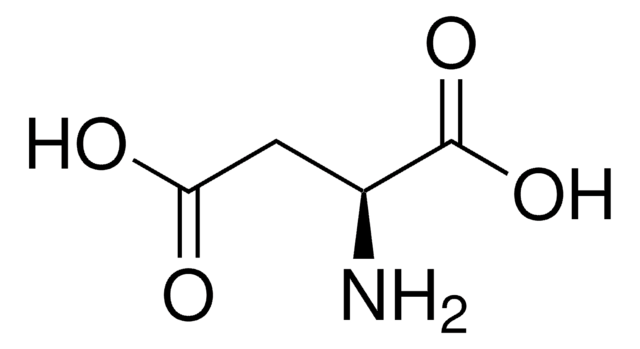


The intended storage temperature for this product is room temperature. A desiccator is not required for storage.
M3262

N-Methyl-D-aspartic acid
≥98% (TLC), suitable for cell culture
Synonym(s):
(R)-2-(Methylamino)succinic acid, NMDA
Sign In to View Organizational & Contract Pricing.
Select a Size
Pricing and availability is not currently available.
About This Item
Empirical Formula (Hill Notation):
C5H9NO4
CAS Number:
Molecular Weight:
147.13
UNSPSC Code:
12352209
eCl@ss:
32160406
PubChem Substance ID:
NACRES:
NA.32
Beilstein/REAXYS Number:
1724431
MDL number:
Skip To
Product Name
N-Methyl-D-aspartic acid, ≥98% (TLC), solid
SMILES string
CN[C@H](CC(O)=O)C(O)=O
InChI
1S/C5H9NO4/c1-6-3(5(9)10)2-4(7)8/h3,6H,2H2,1H3,(H,7,8)(H,9,10)/t3-/m1/s1
InChI key
HOKKHZGPKSLGJE-GSVOUGTGSA-N
assay
≥98% (TLC)
form
solid
technique(s)
cell culture | mammalian: suitable
color
white
mp
189-190 °C
application(s)
cell analysis
Quality Level
Gene Information
human ... GRIN1(2902), GRIN2A(2903), GRIN2B(2904), GRIN2C(2905), GRIN2D(2906), GRINA(2907)
rat ... Gria1(50592), Grik1(29559), Grin2a(24409)
Looking for similar products? Visit Product Comparison Guide
Related Categories
1 of 4
This Item | A7219 | 454575 | G1001 |
|---|---|---|---|
| form solid | form powder | form solid | form powder |
| assay ≥98% (TLC) | assay 98.5-101.0% | assay >95% (TLC) | assay ≥99% (TLC) |
| technique(s) cell culture | mammalian: suitable | technique(s) cell culture | mammalian: suitable | technique(s) - | technique(s) ligand binding assay: suitable |
| Quality Level 200 | Quality Level 300 | Quality Level 100 | Quality Level 200 |
| color white | color white to off-white | color white | color white to off-white |
| mp 189-190 °C | mp >300 °C (dec.) (lit.) | mp - | mp 200-202 °C (subl.) (lit.) |
Application
Biochem/physiol Actions
Excitotoxic amino acid. Prototypic agonist at the NMDA-type glutamate receptor that regulates ion channels; important in long-term potentiation, ischemia, and epilepsy.
General description
N-Methyl-D-aspartic acid (NMDA) is an endogenously generated molecule in rat nervous system and endocrine glands. NMDA is present at low level (nmol/g) in the adenohypophysis, hypothalamus, brain, and testis. NMDA is derived from D-Asp by an S-adenosylmethionine-dependent enzyme also referred to as NMDA synthase.[3]
Storage Class
11 - Combustible Solids
wgk
WGK 3
flash_point_f
Not applicable
flash_point_c
Not applicable
ppe
Eyeshields, Gloves, type N95 (US)
Choose from one of the most recent versions:
Already Own This Product?
Find documentation for the products that you have recently purchased in the Document Library.
Occurrence of D-aspartic acid and N-methyl-D-aspartic acid in rat neuroendocrine tissues and their role in the modulation of luteinizing hormone and growth hormone release.
D'Aniello A
Faseb Journal, 14(5), 699-714 (2000)
Juan Ding et al.
Neural regeneration research, 14(12), 2112-2117 (2019-08-10)
N-methyl-D-aspartate receptor hypofunction is the basis of pathophysiology in schizophrenia. Blocking the N-methyl-D-aspartate receptor impairs learning and memory abilities and induces pathological changes in the brain. Previous studies have paid little attention to the role of the N-methyl-D-aspartate receptor subunit
N-methyl-D-aspartic acid (NMDA) in the nervous system of the amphioxus Branchiostoma lanceolatum.
D'Aniello S
BMC Neuroscience, 8:109 (2007)
Guendalina Olivero et al.
Molecular neurobiology, 56(9), 6142-6155 (2019-02-09)
Mouse hippocampal glutamatergic nerve endings express presynaptic release-regulating NMDA autoreceptors (NMDARs). The presence of GluN1, GluN2A, GluN2B, and GluN3A subunits in hippocampal vesicular glutamate transporter type 1-positive synaptosomes was confirmed with confocal microscopy. GluN2C, GluN2D, and GluN3B immunopositivity was scarcely
Calpain- and caspase-mediated aII-spectrin
and tau proteolysis in rat cerebrocortical
neuronal cultures after ecstasy or
methamphetamine exposure.
and tau proteolysis in rat cerebrocortical
neuronal cultures after ecstasy or
methamphetamine exposure.
Warren MW
The International Journal of Neuropsychopharmacology, 9, 1-11 (2006)
-
How should the powder be stored? At room temperature or at -20 C? Is a desiccator required if storing at room temp?
1 answer-
Helpful?
-
-
How can I determine the shelf life / expiration / retest date of this product?
1 answer-
If this product has an expiration or retest date, it will be shown on the Certificate of Analysis (COA, CofA). If there is no retest or expiration date listed on the product's COA, we do not have suitable stability data to determine a shelf life. For these products, the only date on the COA will be the release date; a retest, expiration, or use-by-date will not be displayed.
For all products, we recommend handling per defined conditions as printed in our product literature and website product descriptions. We recommend that products should be routinely inspected by customers to ensure they perform as expected.
For products without retest or expiration dates, our standard warranty of 1 year from the date of shipment is applicable.
For more information, please refer to the Product Dating Information document: https://www.sigmaaldrich.com/deepweb/assets/sigmaaldrich/marketing/global/documents/418/501/product-dating-information-06-25-mk.pdfHelpful?
-
-
Which liquid storage form is recommended? And how long do you guarantee a stable dissolved product? How should the dissolved product be stored?
1 answer-
This product is soluble in water at 50mg/mL. Following reconstitution, store refrigerated at 2 - 8°C for several days at 4°C. For long term storage, stock solutions may be stored in aliquots at -20°C.
Helpful?
-
-
How is shipping temperature determined? And how is it related to the product storage temperature?
1 answer-
Products may be shipped at a different temperature than the recommended long-term storage temperature. If the product quality is sensitive to short-term exposure to conditions other than the recommended long-term storage, it will be shipped on wet or dry-ice. If the product quality is NOT affected by short-term exposure to conditions other than the recommended long-term storage, it will be shipped at ambient temperature. As shipping routes are configured for minimum transit times, shipping at ambient temperature helps control shipping costs for our customers. For more information, please refer to the Storage and Transport Conditions document: https://www.sigmaaldrich.com/deepweb/assets/sigmaaldrich/marketing/global/documents/316/622/storage-transport-conditions-mk.pdf
Helpful?
-
Active Filters
Our team of scientists has experience in all areas of research including Life Science, Material Science, Chemical Synthesis, Chromatography, Analytical and many others.
Contact Technical Service