
If this product has an expiration or retest date, it will be shown on the Certificate of Analysis (COA, CofA). If there is no retest or expiration date listed on the product's COA, we do not have suitable stability data to determine a shelf life. For these products, the only date on the COA will be the release date; a retest, expiration, or use-by-date will not be displayed.
For all products, we recommend handling per defined conditions as printed in our product literature and website product descriptions. We recommend that products should be routinely inspected by customers to ensure they perform as expected.
For products without retest or expiration dates, our standard warranty of 1 year from the date of shipment is applicable.
For more information, please refer to the Product Dating Information document: https://www.sigmaaldrich.com/deepweb/assets/sigmaaldrich/marketing/global/documents/418/501/product-dating-information-06-25-mk.pdf
S5016

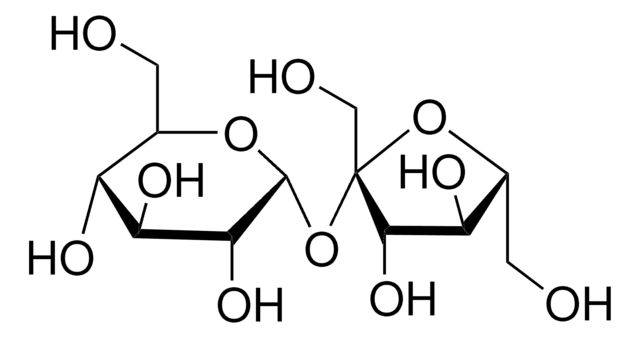
Sucrose
ACS reagent
Synonym(s):
α-D-Glc-(1→2)-β-D-Fru, α-D-Glucopyranosyl β-D-fructofuranoside, β-D-Fructofuranosyl-α-D-glucopyranoside, D(+)-Saccharose, Sugar
Select a Size
| Size/SKU | Availability | Price |
|---|---|---|
25 g | Available to ship TODAY | $87.40 |
500 g | Available to ship TODAY | $83.70 |
1 kg | Available to ship TODAY | $126.00 |
2.5 kg | Available to ship TODAY | $267.00 |
6 x 500 g | Estimated to ship TODAYfromMILWAUKEE | $306.00 |
4 x 2.5 kg | Available to ship TODAY | $858.00 $729.30 |
About This Item
$87.40
Available to ship TODAYDetails
biological source
sugar cane
Quality Segment
grade
ACS reagent
form
powder or crystals
optical activity
[α]25/D +66.3 to +66.8°(lit.)
technique(s)
HPLC: suitable, cryopreservation: suitable, immunohistochemistry: suitable
impurities
≤0.0008 meq/g Titratable acid, ≤0.005% Insoluble matter, ≤0.05% Invert sugar
ign. residue
≤0.01%
loss
≤0.03% loss on drying, 105°C
color
white
useful pH range
5.5-7.5 (25 °C, 342 g/L)
mp
185-187 °C (lit.)
solubility
soluble 342 g/L at 20 °C (completely)
anion traces
chloride (Cl-): ≤0.005%, sulfate, sulfite (as SO42-): ≤0.005%
cation traces
Fe: ≤5 ppm, heavy metals: ≤5 ppm (by ICP-OES)
application(s)
agriculture
cell analysis
life science and biopharma
metabolomics
storage temp.
room temp
SMILES string
OC[C@H]1O[C@H](O[C@]2(CO)O[C@H](CO)[C@@H](O)[C@@H]2O)[C@H](O)[C@@H](O)[C@@H]1O
InChI
1S/C12H22O11/c13-1-4-6(16)8(18)9(19)11(21-4)23-12(3-15)10(20)7(17)5(2-14)22-12/h4-11,13-20H,1-3H2/t4-,5-,6-,7-,8+,9-,10+,11-,12+/m1/s1
InChI key
CZMRCDWAGMRECN-UGDNZRGBSA-N
General description
Application
Biochem/physiol Actions
Features and Benefits
- Suitable for cell biology and biochemical research
- Tested to confirm low levels of heavy metal contamination, ensuring suitability for various applications
- Tested for anion and cation traces
- ACS grade sucrose, sourced from sugar cane
Other Notes
1 of 1
This Item | |||
|---|---|---|---|
| description ACS reagent | description ≥99.5% (GC), BioReagent, suitable for cell culture, suitable for insect cell culture | description ≥99.5% (GC), Grade II, suitable for plant cell culture | description anhydrous, free-flowing, Redi-Dri™, ACS reagent |
| technique(s) HPLC: suitable, immunohistochemistry: suitable, cryopreservation: suitable | technique(s) cell culture | mammalian: suitable, cell culture | insect: suitable | technique(s) cell culture | plant: suitable | technique(s) - |
| grade ACS reagent | grade - | grade - | grade anhydrous, ACS reagent |
| biological source sugar cane | biological source sugar cane | biological source sugar cane | biological source - |
| Quality Level 300 | Quality Level 300 | Quality Level 300 | Quality Level 100 |
| solubility soluble 342 g/L at 20 °C (completely) | solubility H2O: 500 mg/mL | solubility H2O: 0.5 g/mL, clear, colorless to faintly yellow | solubility water: soluble 100 mg/mL (opalescent solution) |
| form powder or crystals | form crystals | form powder | form powder or crystals |
Still not finding the right product?
Explore all of our products under Sucrose
Storage Class
11 - Combustible Solids
WGK
WGK 1
Flash Point (°F)
Not applicable
Flash Point (°C)
Not applicable
PPE (personal protective equipment)
Eyeshields, Gloves, type N95 (US)
Choose from one of the most recent versions:
Already Own This Product?
Find documentation for the products that you have recently purchased in the Document Library.
-
How can I determine the shelf life / expiration / retest date of this product?
1 answer-
Helpful?
-
-
After dilution to approximately 50% w/v and subsequent autoclaving, what is the optimal storage temperature? Should the solution be stored at 4°C (refrigerator) or at room temperature?
1 answer-
Sterile solutions of this product may be stored at room temperature. For such a concentrated solution in a refrigerator or even in a cold laboratory, one might see that some of the sucrose crystallizes out over time; it can be redissolved by warming the solution.
Helpful?
-
-
How is shipping temperature determined? And how is it related to the product storage temperature?
1 answer-
Products may be shipped at a different temperature than the recommended long-term storage temperature. If the product quality is sensitive to short-term exposure to conditions other than the recommended long-term storage, it will be shipped on wet or dry-ice. If the product quality is NOT affected by short-term exposure to conditions other than the recommended long-term storage, it will be shipped at ambient temperature. As shipping routes are configured for minimum transit times, shipping at ambient temperature helps control shipping costs for our customers. For more information, please refer to the Storage and Transport Conditions document: https://www.sigmaaldrich.com/deepweb/assets/sigmaaldrich/marketing/global/documents/316/622/storage-transport-conditions-mk.pdf
Helpful?
-
-
Is this NIST traceable?
1 answer-
This product is not NIST traceable. Currently, a NIST traceable standard is not available.
Helpful?
-