



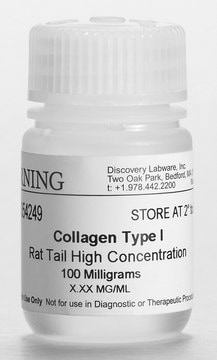
This product is prepared from rat tail tendons by modification of a published procedure. It is supplied as an aqueous solution in 20 mM acetic acid (~100 mg of protein per vial). Protein concentration was estimated by the biuret method. The vial contains approximately 100 mg of protein. Volume per vial: 22–25 mL.
The product ships on wet ice and storage at 2-8°C is recommended. The product may acquire a gel-like appearance. This is expected behaviour. Under such circumstances, it is possible to warm the product gently, in order to reconstitute the product fully, before use. Do not exceed 37°C, as higher temperatures may cause protein denaturation and loss of biological activity. Do not freeze. Optimal conditions for attachment must be determined for each cell line and application.
Note on solution behaviour: C3867 is supplied as an acidic solution in 20 mM acetic acid. In this form, the neat stock will not gel spontaneously at room temperature. However, once diluted into a neutral or near-neutral aqueous solution (e.g. sterile tissue culture grade water), the collagen will gel rapidly at room temperature (~20-25°C). All steps following dilution must therefore be performed on ice.
1. An appropriate volume of the collagen solution should be diluted to a working concentration of 0.01% using sterile, tissue culture grade water. Perform this dilution step on ice. Once diluted, the collagen solution will gel rapidly at room temperature - keep the diluted solution ice-cold at all times until immediately prior to application.
2. Coat dishes with 6-10 µg/cm². Allow the protein to bind for several hours at room temperature or 37°C, or overnight at 2–8°C. Note: Room temperature or 37°C incubation is appropriate at this surface coating stage only, after the diluted solution has been applied directly to the dish. Do not allow the diluted solution to sit at room temperature prior to application.
3. Remove excess fluid from the coated surface and allow it to dry overnight. If sterility has been compromised, the dried, coated surface can be sterilized easily by overnight exposure to UV light in a sterile tissue culture hood.
4. Rinse with sterile tissue culture grade water or a balanced salt solution before introducing cells and medium.