
Z-2143

ZytoLight® SPEC MYB Dual Color Break Apart Probe
green to orange, pkg of 0.2 mL, pkg of 0.05 mL
Synonym(s):
FISH probe, dual color FISH probe
Sign In to View Organizational & Contract Pricing.
Select a Size
Change View
| Size/SKU | Availability | Price |
|---|
Pricing and availability is not currently available.
packaging
pkg of 0.05 mL, pkg of 0.2 mL, pkg of 20 tests, pkg of 5 tests
storage condition
protect from light
color
green to orange
application(s)
research use
storage temp.
2-8°C
General description
The ZytoLight® SPEC MYB Dual Color Break Apart Probe (PL100) is a direct-labeled FISH probe for the qualitative detection of translocations of the human MYB gene at 6q23.3 in cytologic or formalin-fixed, paraffinembedded specimens, using fluorescence in situ hybridization (FISH). The probe is intended for use with ZytoLight FISH Implementation Kits.
ZytoLight® probes enable the precise identification of genetic abnormalities, including translocations, deletions, amplifications, and chromosomal aneuploidies, in formalin-fixed, paraffin-embedded (FFPE) tissue sections or cytology specimens, without the need for additional antibody-based detection.
Components
The ZytoLight SPEC MYB Dual Color Break Apart Probe comprises:
Principle
The fluorescence in situ hybridization (FISH) method enables the identification and visualization of particular nucleic acid sequences within cell samples. DNA fragments labeled with fluorescent dyes, known as FISH probes, are co-denatured with their complementary target DNA strands in the sample and then allowed to hybridize. Following hybridization, non-specific and unbound probe fragments are removed through stringency washes. The DNA is then counterstained with DAPI, and the hybridized probes are detected using a fluorescence microscope equipped with filters matched to the specific fluorochromes used to label the FISH probes.
ZytoLight® probes enable the precise identification of genetic abnormalities, including translocations, deletions, amplifications, and chromosomal aneuploidies, in formalin-fixed, paraffin-embedded (FFPE) tissue sections or cytology specimens, without the need for additional antibody-based detection.
Components
The ZytoLight SPEC MYB Dual Color Break Apart Probe comprises:
- ZyGreen (excitation 503 nm/emission 528 nm) labeled polynucleotides (~10.0 ng/µl), targeting sequences mapping in 6q23.2-q23.3* (chr6:134,840,690-135,483,752) proximal to the MYB breakpoint region;
- ZyOrange (excitation 547 nm/emission 572 nm) labeled polynucleotides (~4.5 ng/µl), targeting sequences mapping in 6q23.3* (chr6:135,728,667-136,390,142) distal to the MYB breakpoint region;
- Formamide based hybridization buffer
Principle
The fluorescence in situ hybridization (FISH) method enables the identification and visualization of particular nucleic acid sequences within cell samples. DNA fragments labeled with fluorescent dyes, known as FISH probes, are co-denatured with their complementary target DNA strands in the sample and then allowed to hybridize. Following hybridization, non-specific and unbound probe fragments are removed through stringency washes. The DNA is then counterstained with DAPI, and the hybridized probes are detected using a fluorescence microscope equipped with filters matched to the specific fluorochromes used to label the FISH probes.
Application
This probe is intended for use in cytologic or formalin-fixed, paraffin-embedded specimens, to qualitatively detect translocations of the human MYB gene at 6q23.3, via FISH.
Analysis Note
Using suitable filter sets, the probe hybridization signals of the appear green near the MYB breakpoint region and orange away from it.
- Normal scenario: in normal cells during interphase or cells without an MYB gene region translocation, two green/orange fusion signals are observed.
- Aberrant scenario: one translocated MYB gene region is shown by one separate green and orange signal each.
Legal Information
ZytoLight is a registered trademark of ZytoVision GmbH in Germany
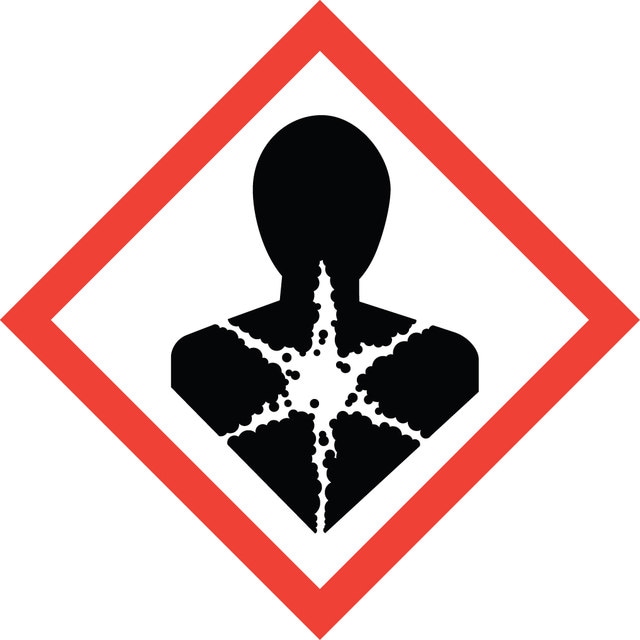
Signal Word
Danger
Hazard Codes
Precautionary Statements
Hazard Classifications
Carc. 2 - Repr. 1B - STOT RE 2 Oral
Target Organs
Blood
Storage Class
6.1C - Combustible acute toxic Cat.3 / toxic compounds or compounds which causing chronic effects
Flash Point (°F)
Not applicable
Flash Point (°C)
Not applicable
Choose from one of the most recent versions:
Already Own This Product?
Find documentation for the products that you have recently purchased in the Document Library.