
84120

Safranin O
suitable for microscopy
Synonym(e):
Basic Red 2, Gossypimin, Safranin T, Safranin Y oder A, Woll-Rot
Größe auswählen
Über diesen Artikel
form
powder or crystals
Quality Segment
technique(s)
titration: suitable
pH
10 (20 °C, 10 g/L)
solubility
methanol: 0.01 g/10 mL, red
εmax
≥1000 at 525-535 nm in 50% ethanol
suitability
suitable for microscopy
application(s)
diagnostic assay manufacturing
hematology
histology
microbiology
storage temp.
room temp
SMILES string
[Cl-].Cc1cc2nc3cc(C)c(N)cc3[n+](-c4ccccc4)c2cc1N
InChI
1S/C20H18N4.ClH/c1-12-8-17-19(10-15(12)21)24(14-6-4-3-5-7-14)20-11-16(22)13(2)9-18(20)23-17;/h3-11H,1-2H3,(H3,21,22);1H
InChI key
OARRHUQTFTUEOS-UHFFFAOYSA-N
General description
Application
- Safranin T wird häufig als mikrobiologisches Färbemittel eingesetzt, insbesondere als Gegenfärbung bei der Gramfärbung zur Unterscheidung von grampositiven und gramnegativen Mikroorganismen und zur Färbung bakterieller Sporen.
- Es wird zum Nachweis von Glykosaminoglykanen bei humanen und tierischen histologischen Proben und Zellkernen verwendet.
- Es ist ein Bestandteil der Benda-Polychromfärbung.
- Es ist eine Komponente verschiedener Polychrome und Lignin-Färbemittel für Färbeanwendungen in der Botanik.
- Es wird auch für den Nachweis von Mastzellen in Cytospin- Präparaten und zur Färbung von chirurgischen gefrorenen Schnitten verwendet.
Biochem/physiol Actions
Features and Benefits
- Color stable
- Reproducible
- Offers sufficient sensitivity to reveal all structural details
Still not finding the right product?
Explore all of our products under Safranin O
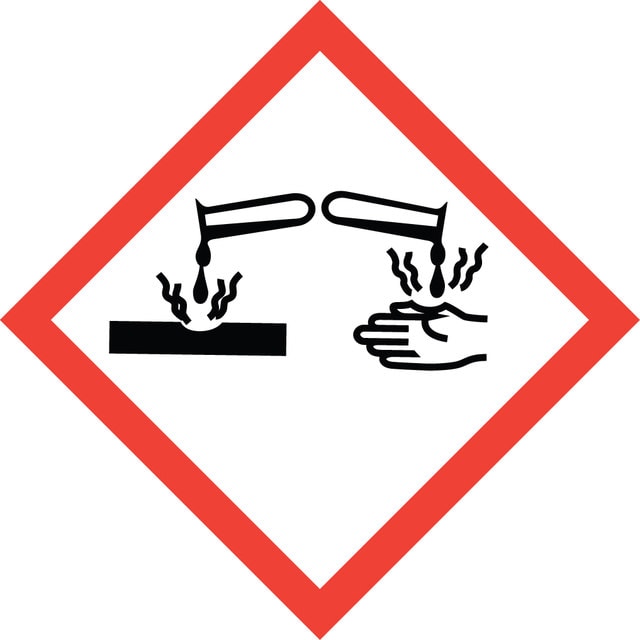
Signalwort
Danger
Gefahrencodes
Sicherheitshinweise
Hazard Classifications
Eye Dam. 1
Lagerklasse
11 - Combustible Solids
WGK
WGK 3
PSA (Persönliche Schutzausrüstung)
dust mask type N95 (US), Eyeshields, Gloves
Hier finden Sie alle aktuellen Versionen:
Besitzen Sie dieses Produkt bereits?
In der Dokumentenbibliothek finden Sie die Dokumentation zu den Produkten, die Sie kürzlich erworben haben.