




This product is not sterilized. However, it can be filter sterilized using a 0.2 m pore size syringe filter.
Fortfahren mit
M3148

2-Mercaptoethanol
Molecular Biology, suitable for electrophoresis, suitable for cell culture, BioReagent, 99% (GC/titration)
Synonym(e):
2-Hydroxyethylmercaptan, BME, Thioethylenglycol, β-Mercaptoethanol
Anmelden zur Ansicht der Organisations- und Vertragspreise.
Größe auswählen
Ansicht ändern
| Größe/SKU | Verfügbarkeit | Preis |
|---|
Über diesen Artikel
Lineare Formel:
HSCH2CH2OH
CAS-Nummer:
Molekulargewicht:
78.13
UNSPSC Code:
12161504
NACRES:
NA.31
PubChem Substance ID:
EC Number:
200-464-6
Beilstein/REAXYS Number:
773648
MDL number:
Preise und Verfügbarkeit sind derzeit nicht verfügbar.
Technischer Dienst
Benötigen Sie Hilfe? Unser Team von erfahrenen Wissenschaftlern ist für Sie da.
Unterstützung erhaltengrade
Molecular Biology
Quality Segment
vapor density
2.69 (vs air)
vapor pressure
1 mmHg ( 20 °C)
product line
BioReagent
assay
99% (GC/titration)
form
liquid
expl. lim.
18 %
reaction suitability
reagent type: reductant
concentration
14.3 M (pure liquid)
technique(s)
cell culture | mammalian: suitable, electrophoresis: suitable
refractive index
n20/D 1.500 (lit.)
pH
4.5-6 (20 °C, 500 g/L)
bp
157 °C (lit.)
solubility
H2O: soluble 1 mL/mL
density
1.114 g/mL at 25 °C (lit.)
foreign activity
DNase, RNase, protease, none detected
storage temp.
2-8°C
SMILES string
OCCS
InChI
1S/C2H6OS/c3-1-2-4/h3-4H,1-2H2
InChI key
DGVVWUTYPXICAM-UHFFFAOYSA-N
Application
Reduktionsmittel
β-Mercaptoethanol oder 2-Mercaptoethanol wurde verwendet:
β-Mercaptoethanol oder 2-Mercaptoethanol wurde verwendet:
BME ist geeignet für die Reduzierung von Protein-Disulfidbindungen vor der Polyacrylamidgel-Elektrophorese und ist für gewöhnlich in einer Konzentration von 5 % in einem Probenpuffer für SDS-PAGE enthalten. Die Aufspaltung intermolekularer Disulfidbindungen (zwischen Untereinheiten) ermöglicht, dass sich die Untereinheiten eines Proteins bei der SDS-PAGE eigenständig voneinander trennen. Die Aufspaltung intramolekularer Disulfidbindungen (innerhalb von Untereinheiten) sorgt dafür, dass die Untereinheiten komplett denaturiert werden, sodass die einzelnen Peptide gemäß ihrer Kettenlänge und nicht in Abhängigkeit ihrer Sekundärstruktur migrieren.
1 of 1
Dieser Artikel | |||
|---|---|---|---|
| description Molecular Biology, suitable for electrophoresis, suitable for cell culture, BioReagent, 99% (GC/titration) | description ≥99.0% | description BioUltra, Molecular Biology, ≥99.0% (GC) | description derivatization grade (HPLC), LiChropur™, ≥99.0% (GC) |
| grade Molecular Biology | grade - | grade Molecular Biology | grade derivatization grade (HPLC) |
| technique(s) electrophoresis: suitable, cell culture | mammalian: suitable | technique(s) - | technique(s) protein extraction: suitable, RNA extraction: suitable | technique(s) HPLC: suitable |
| assay 99% (GC/titration) | assay ≥99.0% | assay ≥99.0% (GC) | assay ≥99.0% (GC) |
| product line BioReagent | product line - | product line BioUltra | product line - |
| Quality Level 200 | Quality Level 200 | Quality Level 200 | Quality Level 100 |
| form liquid | form liquid | form liquid | form liquid |
Still not finding the right product?
Explore all of our products under 2-Mercaptoethanol
Signalwort
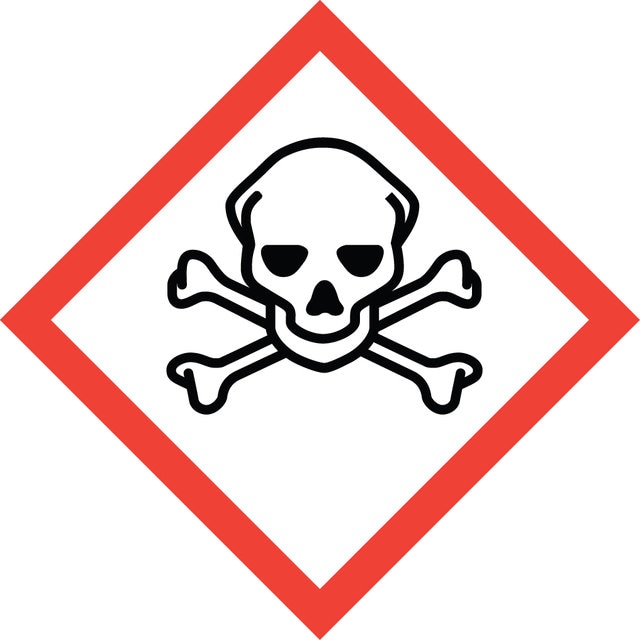
Danger
Gefahrencodes
Hazard Classifications
Acute Tox. 2 Dermal - Acute Tox. 3 Inhalation - Acute Tox. 3 Oral - Aquatic Acute 1 - Aquatic Chronic 2 - Eye Dam. 1 - Repr. 2 - Skin Irrit. 2 - Skin Sens. 1A - STOT RE 2 Oral
Zielorgane
Liver,Heart
Lagerklasse
6.1A - Combustible acute toxic Cat. 1 and 2 / very toxic hazardous materials
PSA (Persönliche Schutzausrüstung)
Faceshields, Gloves, Goggles, type ABEK (EN14387) respirator filter
Flammpunkt (°F)
165.2 °F - closed cup
Flammpunkt (°C)
74 °C - closed cup
Hier finden Sie alle aktuellen Versionen:
Besitzen Sie dieses Produkt bereits?
In der Dokumentenbibliothek finden Sie die Dokumentation zu den Produkten, die Sie kürzlich erworben haben.
-
If it is not sterile, when I add it to the medium, do I need to filter the medium before I use them on cells?
1 answer-
Helpful?
-
-
In which buffer or solvent should 2-Mercaptoethanol be diluted for working solution preparation?
1 answer-
2-Mercaptoethanol is compatible with a wide range of common aqueous buffers, such as Laemmli sample buffer, phosphate-buffered saline, or Tris buffer. Certain buffers, such as Tris, can cause oxidation of 2-mercaptoethanol. In these situations, preparation of the solution is recommended just before use.
Helpful?
-
-
How can I determine the shelf life / expiration / retest date of this product?
1 answer-
If this product has an expiration or retest date, it will be shown on the Certificate of Analysis (COA, CofA). If there is no retest or expiration date listed on the product's COA, we do not have suitable stability data to determine a shelf life. For these products, the only date on the COA will be the release date; a retest, expiration, or use-by-date will not be displayed.
For all products, we recommend handling per defined conditions as printed in our product literature and website product descriptions. We recommend that products should be routinely inspected by customers to ensure they perform as expected.
For products without retest or expiration dates, our standard warranty of 1 year from the date of shipment is applicable.
For more information, please refer to the Product Dating Information document: https://www.sigmaaldrich.com/deepweb/assets/sigmaaldrich/marketing/global/documents/418/501/product-dating-information-06-25-mk.pdfHelpful?
-
-
How is shipping temperature determined? And how is it related to the product storage temperature?
1 answer-
Products may be shipped at a different temperature than the recommended long-term storage temperature. If the product quality is sensitive to short-term exposure to conditions other than the recommended long-term storage, it will be shipped on wet or dry-ice. If the product quality is NOT affected by short-term exposure to conditions other than the recommended long-term storage, it will be shipped at ambient temperature. As shipping routes are configured for minimum transit times, shipping at ambient temperature helps control shipping costs for our customers. For more information, please refer to the Storage and Transport Conditions document: https://www.sigmaaldrich.com/deepweb/assets/sigmaaldrich/marketing/global/documents/316/622/storage-transport-conditions-mk.pdf
Helpful?
-
-
I’ve purchased 25mL bottle and want to use this in my cell culture media at concentration of 50mM. What is the concentration in the 25mL bottle and how to make this to 50mM concentration?
1 answer-
This product is a neat or pure material. The concentration is considered to be 100%. The calculated molarity is 14.3 M as reported in the Properties section of the product page.
To prepare a 50 mM solution, please mix 0.391 g of M3148 with 100 mL solvent. 0.391 g / 78.13 g/mol / 0.1 L = 0.05 = 50 mM.Helpful?
-
-
Hi, What is the concentration of 2-mercaptoethanol in the 100mL bottle?
1 answer-
This product is a neat or pure material. The concentration is considered to be 100%. The calculated molarity is 14.3 M as reported in the Properties section of the product page.
Helpful?
-
-
Hi is this sterile?
1 answer-
This product is not sterile, but can be used in cell culture applications and is DNase, RNase, and protease free.
Helpful?
-