
If this product has an expiration or retest date, it will be shown on the Certificate of Analysis (COA, CofA). If there is no retest or expiration date listed on the product's COA, we do not have suitable stability data to determine a shelf life. For these products, the only date on the COA will be the release date; a retest, expiration, or use-by-date will not be displayed.
For all products, we recommend handling per defined conditions as printed in our product literature and website product descriptions. We recommend that products should be routinely inspected by customers to ensure they perform as expected.
For products without retest or expiration dates, our standard warranty of 1 year from the date of shipment is applicable.
For more information, please refer to the Product Dating Information document: https://www.sigmaaldrich.com/deepweb/assets/sigmaaldrich/marketing/global/documents/418/501/product-dating-information-06-25-mk.pdf
S1888

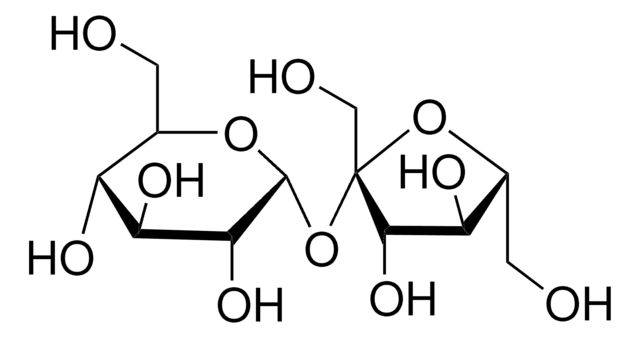
Saccharose
≥99.5% (GC), BioReagent, suitable for cell culture, suitable for insect cell culture
Synonyme(s) :
α-D-Glc-(1→2)-β-D-Fru, α-D-Glucopyranosyl β-D-fructofuranoside, β-D-Fructofuranosyl-α-D-glucopyranoside, D(+)-Saccharose, Sucre
Sélectionner une taille de conditionnement
116,00 €
194,00 €
666,00 €
116,00 €
A propos de cet article
Passer à
Source biologique
sugar cane
Gamme de produits
BioReagent
Essai
≥99.5% (GC)
Forme
crystals
Technique(s)
cell culture | insect: suitable
cell culture | mammalian: suitable
Impuretés
≤5 ppm heavy metals (as lead)
Couleur
white
Plage de pH utile
5.5-7 (25 °C, 342 g/L)
Pf
185-187 °C (lit.)
Solubilité
H2O: 500 mg/mL
Température de stockage
room temp
Chaîne SMILES
OC[C@H]1O[C@H](O[C@]2(CO)O[C@H](CO)[C@@H](O)[C@@H]2O)[C@H](O)[C@@H](O)[C@@H]1O
InChI
1S/C12H22O11/c13-1-4-6(16)8(18)9(19)11(21-4)23-12(3-15)10(20)7(17)5(2-14)22-12/h4-11,13-20H,1-3H2/t4-,5-,6-,7-,8+,9-,10+,11-,12+/m1/s1
Clé InChI
CZMRCDWAGMRECN-UGDNZRGBSA-N
Vous recherchez des produits similaires ? Visite Guide de comparaison des produits
1 of 4
Cet article | 84100 | 1.07651 | S5016 |
|---|---|---|---|
| biological source sugar cane | biological source - | biological source - | biological source sugar cane |
| assay ≥99.5% (GC) | assay ≥99.0% (HPLC) | assay - | assay - |
| technique(s) cell culture | insect: suitable, cell culture | mammalian: suitable | technique(s) - | technique(s) - | technique(s) HPLC: suitable, cryopreservation: suitable, immunohistochemistry: suitable |
| solubility H2O: 500 mg/mL | solubility H2O: 0.1 g/mL, clear, colorless | solubility - | solubility soluble 342 g/L at 20 °C (completely) |
| Quality Level 300 | Quality Level 200 | Quality Level 200 | Quality Level 300 |
| form crystals | form powder | form solid | form powder or crystals |
Description générale
Application
Actions biochimiques/physiologiques
Autres remarques
Produit(s) apparenté(s)
Code de la classe de stockage
11 - Combustible Solids
Classe de danger pour l'eau (WGK)
WGK 1
Point d'éclair (°F)
Not applicable
Point d'éclair (°C)
Not applicable
Équipement de protection individuelle
Eyeshields, Gloves, type N95 (US)
Faites votre choix parmi les versions les plus récentes :
Déjà en possession de ce produit ?
Retrouvez la documentation relative aux produits que vous avez récemment achetés dans la Bibliothèque de documents.
Contenu apparenté
Product Information Sheet
-
How can I determine the shelf life / expiration / retest date of this product?
1 answer-
Helpful?
-
-
How is shipping temperature determined? And how is it related to the product storage temperature?
1 answer-
Products may be shipped at a different temperature than the recommended long-term storage temperature. If the product quality is sensitive to short-term exposure to conditions other than the recommended long-term storage, it will be shipped on wet or dry-ice. If the product quality is NOT affected by short-term exposure to conditions other than the recommended long-term storage, it will be shipped at ambient temperature. As shipping routes are configured for minimum transit times, shipping at ambient temperature helps control shipping costs for our customers. For more information, please refer to the Storage and Transport Conditions document: https://www.sigmaaldrich.com/deepweb/assets/sigmaaldrich/marketing/global/documents/316/622/storage-transport-conditions-mk.pdf
Helpful?
-
Active Filters
Notre équipe de scientifiques dispose d'une expérience dans tous les secteurs de la recherche, notamment en sciences de la vie, science des matériaux, synthèse chimique, chromatographie, analyse et dans de nombreux autres domaines..
Contacter notre Service technique