
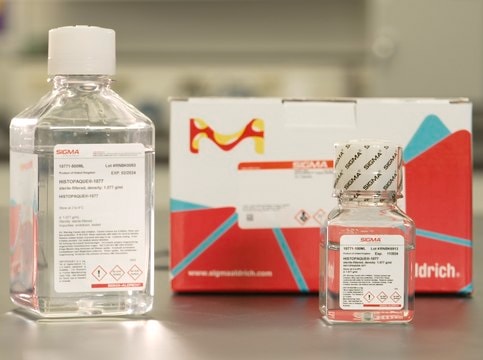


Histopaque 10771 was introduced in the late 1970s or early 1980s. As such, there is a long history of shipping the product when the temperature falls below freezing. It is relatively common for the bottles to freeze during ground shipping during the winter months. The standard advise is to thaw the bottles at either room temperature at a 37°C. Once the bottle has thawed, it will be necessary to invert the bottle multiple times to ensure the gradient is uniform. If the bottle is not inverted multiple times, a gradient in situ will form as freezing is one method of forming gradients. As long as the solution is clear and the bottle has not broken, the product is suitable for use.
10771

Histopaque®-1077
sterile-filtered, density: 1.077
Histopaque®-1077
Iniciar sesión para ver los posibles precios especiales de su organización
Seleccione un Tamaño
En este momento no podemos mostrarle ni los precios ni la disponibilidad
Acerca de este artículo
UNSPSC Code:
12352207
NACRES:
NA.75
Saltar a
Servicio técnico
¿Necesita ayuda? Nuestro equipo de científicos experimentados está aquí para ayudarle.
Permítanos ayudarlesterility
sterile-filtered
form
liquid
shelf life
Expiry date on the label.
technique(s)
cell culture | mammalian: suitable
impurities
endotoxin, tested
density
1.077
application(s)
hematology
histology
storage temp.
2-8°C
1 of 4
Este artículo | 10831 | H8889 | A6929 |
|---|---|---|---|
| technique(s) cell culture | mammalian: suitable | technique(s) cell culture | mammalian: suitable | technique(s) cell culture | hybridoma: suitable, single cell analysis: suitable | technique(s) cell culture | mammalian: suitable |
| density 1.077 | density 1.083 | density 1.077 at 25 °C (relative density)(lit.) | density 1.077 g/mL |
| form liquid | form liquid | form liquid | form solution |
| sterility sterile-filtered | sterility sterile-filtered | sterility sterile-filtered | sterility aseptically filled |
| Quality Level 400 | Quality Level 400 | Quality Level 400 | Quality Level 400 |
| shelf life Expiry date on the label. | shelf life Expiry date on the label. | shelf life - | shelf life Expiry date on the label. |
General description
Histopaque-1077 es un medio estéril, probado para endotoxinas y listo para usar. La composición de Histopaque consiste en polisacarosa y diatrizoato de sodio, ajustados a una densidad de 1,077 g/ml. Este medio listo para usar facilita la recuperación rápida de los linfocitos viables y otras células mononucleares de pequeños volúmenes de sangre completa o médula ósea.
Application
Histopaque-1077 se ha utilizado para:
- la determinación de los antígenos del complejo principal de histocompatibilidad (HLA)
- como etapa inicial del aislamiento antes del recuento de linfocitos T, B y ‘nulos’.
- preparación de suspensiones puras de linfocitos para cultivos celulares y ensayos de citotoxicidad.
- Aislamiento y purificación de células mononucleares de sangre periférica (PBMC) y células mononucleares de médula ósea (BMMC)[1]
- aislamiento de linfocitos humanos[2]
- aislamiento de células tumorales circulantes de cáncer de mama (CTC) en sangre completa[3]
- Histopaque-1077 se utiliza junto con Histopaque-1119 ya que facilita la recuperación rápida de células mononucleares viables y granulocitos de pequeños volúmenes de sangre completa
Biochem/physiol Actions
La sangre anticoagulada se coloca en capas sobre el Histopaque-1077. Durante la centrifugación, la polisacarosa produce agregación de los eritrocitos, que sedimentan rápidamente. Los granulocitos se vuelven ligeramente hipertónicos, lo que aumenta su velocidad de sedimentación y provoca su depósito en el fondo del tubo de centrífuga. Los linfocitos y otras células mononucleares permanecen en la interfaz plasma/Histopaque-1077.
Features and Benefits
Histopaque®-1077 ofrece numerosas ventajas, como:
- Recuperación óptima de las células viables
- Permite la separación selectiva de los tipos de células sanguíneas
- Previene la distorsión celular
- Preserva la viabilidad celular
- Interferencia mínima de células extrañas
- Rendimiento reproducible de lote a lote
- Esterilizado mediante filtración y probado para endotoxinas
- Estable a 2-8°C durante al menos 2 años cuando está protegido de la luz
Legal Information
Histopaque is a registered trademark of Merck KGaA, Darmstadt, Germany
Related product
Referencia del producto
Descripción
Precios
signalword
Danger
hcodes
Hazard Classifications
Resp. Sens. 1 - Skin Sens. 1
Clase de almacenamiento
12 - Non Combustible Liquids
wgk_germany
WGK 3
Elija entre una de las versiones más recientes:
¿Ya tiene este producto?
Encuentre la documentación para los productos que ha comprado recientemente en la Biblioteca de documentos.
Erin E Thacker et al.
Vaccine, 27(50), 7116-7124 (2009-09-30)
Targeting viral vectors encoding tumor-associated antigens to dendritic cells (DCs) in vivo is likely to enhance the effectiveness of immunotherapeutic cancer vaccines. We have previously shown that genetic modification of adenovirus (Ad) 5 to incorporate CD40 ligand (CD40L) rather than
Evaluation of respiration with clark type electrode in isolated mitochondria and permeabilized animal cells.
Silva AM and Oliveira PJ
Methods in Molecular Biology, 810, 7-24 (2012)
Ana C Leal et al.
Scientific reports, 7(1), 6438-6438 (2017-07-27)
Cancer patients are at an increased risk of developing thromboembolic complications. Several mechanisms have been proposed to explain cancer-associated thrombosis including the release of tumor-derived extracellular vesicles and the activation of host vascular cells. It was proposed that neutrophil extracellular
Romain A Colas et al.
Journal of immunology (Baltimore, Md. : 1950), 197(11), 4444-4452 (2016-11-02)
Maresin 1 (MaR1) is an immunoresolvent that governs resolution of acute inflammation, and its local metabolism in the context of infectious inflammation is of interest. In this study, we investigated the MaR1 metabolome in infectious exudates and its bioactions in
Maria Björkqvist et al.
The Journal of experimental medicine, 205(8), 1869-1877 (2008-07-16)
Huntington's disease (HD) is an inherited neurodegenerative disorder characterized by both neurological and systemic abnormalities. We examined the peripheral immune system and found widespread evidence of innate immune activation detectable in plasma throughout the course of HD. Interleukin 6 levels
Artículos
Centrifugation enables the separation of particles by sedimentation. Learn how to separate particles using a centrifuge and how to use Stokes' law to calculate the velocity of sedimentation.
Protocolos
This troubleshooting guide addresses the most common sources of error observed when using Histopaque but is not meant to be a comprehensive list.
Ficoll 400® is a non-ionic polymer with high hydrophilicity and water solubility, suitable for various biological applications.
Contenido relacionado
-
Hello, we had a problem with the refrigerator temperature dropping below 4 degrees Celsius for over the weekend. Can the Histopaque-1077 stored in this refrigerator still be used?
1 answer-
Helpful?
-
-
Hello, we had a problem with the refrigerator leading the temperature increasing to 44 degrees Celsius for over the 2 days of weekend, so can our Histopaque-1077 stored in this refrigerator can be used anymore?
1 answer-
This product ships at ambient temperature and is stable for relatively short periods at room temperature. There is a 1 - 2 week allowance for transit time. A storage temperature excursion of 2 days is not expected to impact the quality or performance of this material.
Helpful?
-
-
Does Histopaque®-1077 work for mouse blood, or is Ficoll®-Paque Premium 1.084 a better choice?
1 answer-
While Histopaque 10771 can be used, it is important to note that quality control testing for Histopaque 10771 does not include testing with mouse blood. The preferred products for isolating mononuclear cells from rat and mouse blood are Ficoll Paque Premium 1084 (GE17-5446-02) or Histopaque 10831. These products are specifically formulated for rats, mice, and other small mammals for the higher percentage of cell recovery.
Helpful?
-
-
Is Histopaque 10771 the recommended density for isolating or separating PBMCs in llama blood?
1 answer-
Yes, Histopaque 1077 (catalog number 10771) is the recommended density for mammalian cells.
Helpful?
-
-
Can Histopaque 10771 be placed in a 37°C water bath to bring it to room temperature after being taken out of the refrigerator?
1 answer-
Histopaque 10771 is normally stored at 2-8°C for long-term storage. However, it can be shipped at ambient temperature, suggesting that it is not easily affected by short-term storage conditions. Therefore, warming it up to 37°C is unlikely to have any detrimental effects on the product.
Helpful?
-
-
What is the percentage of peripheral blood mononuclear cells (PBMCs) recovered from human blood?
1 answer-
Generally, Histopaque recoveries typically range from 50% to 80%. The percentage of recovery varies significantly depending on the total white cell count of the patient. Higher white cell counts typically have the best recovery rates. Yields are also generally higher with fresh blood and lower with older blood.
Helpful?
-
-
Can histopaque-1077 be used to isolate live tumor cells in suspension from dead cells/cell debris?
1 answer-
Histopaque 10771 is primarily intended for isolating mononuclear cells from human blood and bone marrow. It is also utilized in cell culture to eliminate dying cells from hybridomas. However, the effectiveness of Histopaque 10771 or Histopaque 10831 in purifying live cells from deceased liver cells remains untested. Percoll and OptiPrep are common alternative methods.
Helpful?
-
-
What is the efficacy and reliability of using Histopaque®-1077 for separating low-density neutrophils (LDN) and normal-density neutrophils (NDN) from high-density neutrophils?
1 answer-
The Histopaque 1077 procedure is not designed to purify low-density or high-density neutrophils. Instead, Histopaque 10771 is intended for purifying Peripheral Blood Mononuclear Cells (PBMCs). When using Histopaque 10771, it is expected that the collected mononuclear cells would contain 5% or less of neutrophils, likely in the form of low-density neutrophils.
Helpful?
-
-
Can Histopaque 10771 be utilized to separate tumor cells from monocytes?
1 answer-
Histopaque 10771 is unlikely to be suitable for separating tumor cells from monocytes. It is designed to separate monocytes and lymphocytes from human blood. Unless the density of your specific tumor cells significantly differs from 1.077 g/ml, there is a possibility that tumor cells may be collected within the mononuclear cell band. Alternatives such as Percoll, Percoll Plus, or OptiPrep could be better options.
Helpful?
-
-
Can we use a ratio of blood to separation media of 4:3 with Histopaque-1077? Also, can Histopaque-1077 be used to dilute the blood up to 1:2 before layering with separation media with HBSS buffer, and then wash the cells too.
1 answer-
Histopaque 10771/H8889 and Ficoll Paque solutions are produced with similar reagents. As Histopaque has a slightly lower density range, yields might be slightly lower. Therefore, it is a mixed bag and yields with Histopaque might be slightly lower. When observing a very high white cell count, dilution is recommended. The standard dilution for peripheral blood is generally 1:2. For bone marrow, a 1:2 or 1:4 dilution are more commonly used. The expectation is that cell recovery should be almost the same.
Helpful?
-
Active Filters
Nuestro equipo de científicos tiene experiencia en todas las áreas de investigación: Ciencias de la vida, Ciencia de los materiales, Síntesis química, Cromatografía, Analítica y muchas otras.
Póngase en contacto con el Servicio técnico