
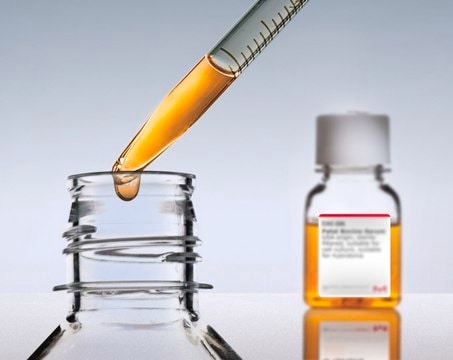
Heat inactivation is required based on the specific application or protocol. It is typically necessary for hybridoma cultures or immunological studies that require the inactivation of complement proteins. However, heat inactivation is not required for all applications.
F2442

Suero fetal bovino
USA origin, sterile-filtered, suitable for cell culture, suitable for hybridoma
Sinónimos:
FBS, FCS, Suero, sueros
Iniciar sesión para ver los posibles precios especiales de su organización
Seleccione un Tamaño
En este momento no podemos mostrarle ni los precios ni la disponibilidad
Acerca de este artículo
Biological source:
bovine fetus
Origin:
USA origin
Sterility:
sterile-filtered
Shipped in:
dry ice
Saltar a
Servicio técnico
¿Necesita ayuda? Nuestro equipo de científicos experimentados está aquí para ayudarle.
Permítanos ayudarlebiological source
bovine fetus
sterility
sterile-filtered
product line
FBS Classic
composition
Bovine IgG, ≤1 mg/mL
Hemoglobin, ≤20 mg/dL
origin
USA origin
technique(s)
cell culture | hybridoma: suitable
cell culture | mammalian: suitable
impurities
≤10 EU/mL endotoxin
shipped in
dry ice
storage temp.
−20°C
¿Está buscando productos similares? Visita Guía de comparación de productos
1 of 4
Este artículo | 12103C | F4135 | F0679 |
|---|---|---|---|
| origin USA origin | origin USA origin | origin USA origin | origin non-USA origin |
| sterility sterile-filtered | sterility - | sterility sterile-filtered | sterility γ-irradiated, sterile-filtered |
| biological source bovine fetus | biological source bovine fetus | biological source bovine fetus | biological source bovine fetus |
| technique(s) cell culture | hybridoma: suitable, cell culture | mammalian: suitable | technique(s) cell culture | mammalian: suitable | technique(s) cell culture | hybridoma: suitable, cell culture | insect: suitable, cell culture | mammalian: suitable | technique(s) cell culture | mammalian: suitable |
| shipped in dry ice | shipped in dry ice | shipped in dry ice | shipped in dry ice |
| impurities ≤10 EU/mL endotoxin | impurities ≤10 EU/mL endotoxin | impurities ≤10 EU/mL endotoxin | impurities ≤10 EU/mL endotoxin |
General description
El suero bovino fetal (FBS) es una mezcla compleja con biomoléculas de bajo y alto peso molecular que presentan funciones óptimas de potenciación y supresión del crecimiento. EL FBS contiene moléculas, como factores de crecimiento, proteínas, vitaminas, oligoelementos, hormonas, etc. Estas moléculas son importantes para el crecimiento y el mantenimiento de las células. Es un suplemento común para los medios de cultivo celular.[1][2] EL FBS procede de la sangre de ternera. Carece de fibrina y factores de coagulación. La inactivación térmica del FBS bloquea el sistema de complemento.[3] El FBS procedente de sangre coagulada es el suplemento indefinido más ampliamente utilizado en cultivos de células eucariotas, en especial de mamíferos.[4][5] Suele utilizarse con los medios clásicos que se desarrollaron en las décadas de 1950 y 1960, entre ellos muchos medios populares como el medio mínimo esencial (MEM),[6] los medios de Eagle modificados por Dulbecco (DME, DMEM); el medio de Eagle modificado por Iscove (IMDM),[7] el medio M199[8] y del Instituto Roswell Park Memorial, RPMI-1640.[6]
Application
El suero bovino fetal también se ha utilizado como componente de:
Biochem/physiol Actions
El FBS sigue siendo un complemento popular para los medios porque aporta una amplia gama de funciones al cultivo celular. El FBS aporta nutrientes, factores de crecimiento y de unión y protege a las células del daño oxidativo y la apoptosis mediante mecanismos que son difíciles de reproducir en los sistemas de medios sin suero (SFM).
Analysis Note
- Analizada la presencia de endotoxinas y hemoglobina
- Se ha estudiado la presencia de bacterias, virus y micoplasmas
- Filtrado triple con membrana de 0,1 micra bajo condiciones asépticas
Other Notes
Se ha analizado la presencia de bacterias, virus, micoplasmas y endotoxinas, y el contenido de hemoglobina Triple filtración con membrana de 0,1 micras en condiciones asépticas
related product
Referencia del producto
Descripción
Precios
Clase de almacenamiento
10 - Combustible liquids
wgk_germany
WGK 3
flash_point_f
Not applicable
flash_point_c
Not applicable
ppe
Eyeshields, Gloves
Elija entre una de las versiones más recientes:
¿Ya tiene este producto?
Encuentre la documentación para los productos que ha comprado recientemente en la Biblioteca de documentos.
Inhibiting tyrosine phosphorylation of protein kinase Cd (PKCd) protects the salivary gland from radiation damage.
Wie SM et al.
The Journal of Biological Chemistry, 289, 10900-10900 (2014)
MENT, a heterochromatin protein that mediates higher order chromatin folding, is a new serpin family member.
Grigoryev SA et al.
The Journal of Biological Chemistry, 274, 5626-5626 (1999)
Axenic Procyclic Culture of L. tropica and L. donovani in Culture of FBS-free Medium
Mosa FM, et al.
Ife Journal of Science, 4B, 3088-3093 (2015)
Optimization of chemically defined cell culture media--replacing fetal bovine serum in mammalian in vitro methods.
van der Valk J et al.
Toxicology in vitro, 24, 1053-1053 (2010)
Cunzhi Yu et al.
Frontiers in pharmacology, 8, 832-832 (2017-12-07)
Low solubility, tissue accumulation, and toxicity are chief obstacles to developing triptolide derivatives, so a better understanding of the pharmacokinetics and toxicity of triptolide derivatives will help with these limitations. To address this, we studied pharmacokinetics and toxicity of (5R)-5-hydroxytriptolide
Artículos
High titer lentiviral particles for LC3 variants used for live cell analysis of cellular autophagy.
Millicell® hanging cell culture inserts for staining and microscopic analysis directly from the insert. Learn to utilize hanging cell culture inserts in barrier measurements.
Protocolos
Learn how to perform cell migration assays in vitro using Millicell® hanging cell culture inserts and the suspension T-cell lines Jurkat and primary CD4+ cells. Monitor migration by flow cytometry and EZ-MTT assays.
Protect your investment with best practices for storing and thawing FBS and other sera. Sample FBS for validation in your cell culture protocol.
Detailed procedure for how to perform a lentiviral transduction of MISSION shRNA lentiviral particles to achieve a stable long term silencing and phenotypic change.
Contenido relacionado
Explore nuestra gama de suero bovino fetal (FBS) y determine el FBS adecuado para sus requisitos y presupuesto de laboratorio. Solicite una muestra de suero.
Our broad range of the most trusted tools for cell culture includes stringently sourced and tested FBS, established media formulations, and sterile labware. Cutting-edge techniques using stem cells and 3D matrices are enabled by organoids, hydrogels, culture scaffolds, and bioinks for 3D bioprinting.
Products and support for mpox research, offering world-class reagents for immunoassay and molecular assay development.
Step-by-step protocol for generating apical-out human gut organoids for microbiome, ADME/Tox, viral and gastrointestinal related disease research. See the complete organoid culture protocol.
-
is heat inactivation necessary?
1 answer-
Helpful?
-
-
How to heat inactivate this serum Fetal Bovine Serum USA origin,(Cat Log - F2442)
1 answer-
Heat inactivation occurs when serum is heated to 56°C for a period of 30 minutes.
Here's a protocol for heat inactivation:
1. Allow serum containers to come to room temperature. Swirl bottles of serum immediately before adding to the water bath.
2. A water-filled control bottles (T1) should be placed in a 56 °C water bath. Place the containers in the water bath up to the serum line. Do not completely submerge the containers. When the temperature of T1 reaches 56 °C, start the timer set for 30 minutes. Do not allow temperatures to exceed 56 °C. Higher temperatures will denature the proteins, gel the serum or alter the performance of the serum.
3. Gently swirl the bottles every 5 to 10 minutes while in the water bath and check the temperature in the control bottle. It is not uncommon for plastic containers to bow slightly after heat treatment. This is not harmful to the serum.
4. At the end of 30 minutes remove the serum bottles from the water bath. Aliquot the serum into smaller volumes and freeze. Sigma-Aldrich does not recommend repeated thaw-freeze cycles.Helpful?
-
-
is this Heat Inactivate FBS?
1 answer-
This product has not been heat inactivated.
Helpful?
-
-
can F2442 FBS be used for culturing peritoneal macrophages? what is the suitable one?
1 answer-
This product is tested for suitability in mammalian cell culture. While it is not specifically tested on macrophages, it is subject to stringent specifications, including low endotoxin, and should perform well. Please see the link below to review a sample Certificate of Analysis:
https://www.sigmaaldrich.com/coa/SIGMA/F2442/23A317Helpful?
-
-
Can this f2442 fbs be used for culture expansion of mesenchymal stem cells? Please confirm Thanks
1 answer-
Fetal Bovine Serum (Cat. no.: F2442) is suitable for use in mammalian cell culture. However, it is not tested specifically in mesenchymal stem cell culture. There is some evidence in the literature that this product would be suitable. See the link below for a relevant reference:
https://www.ncbi.nlm.nih.gov/pmc/articles/PMC4545441/Helpful?
-
-
There is a precipitate in my serum. Is my serum contaminated?
1 answer-
Precipitates in serum can often appear as large round bodies, even as doublets per microscopic exam. This can be mistaken as a yeast contamination. Brownian motion may be mistaken for motility. These are lipid aggregates that will be readily dissolved when exposed to lipase. Also, these particles will not gram stain or show any growth in culture on aerobic, anaerobic, or fungal media and culture conditions. The performance of the material is not effected. Centrifugation or filtration of small volumes will remove these particles.
Helpful?
-
-
What is the difference between Fetal Bovine Serum F2442 and 12103C?
1 answer-
Product No. 12103C meets most of the specifications of F2442. Both products are from the same raw material suppliers and undergo the same stringent testing prior to release. However, the F2442 has been use-tested in hybridoma culture, whereas 12103C has not.
Helpful?
-
-
Is Fetal Bovine Serum, Product F2442, available as a charcoal stripped, de-lipidated serum?
1 answer-
We offer Product No. F6765 (Fetal Bovine Serum, charcoal stripped). The charcoal stripping decreases the levels of hormones; it may also decrease the levels of lipids. If further reduction of lipid levels is required, you may need to treat the serum with fumed silica (e.g. Product No. S5130). Use 20 grams of S5130 per Liter of serum (not plasma). It is mixed for 3-4 hours, then centrifuged in 1 L containers for about 15 minutes at 2000 xg. The supernatant can then be decanted, and filtered if desired. NOTE: Silica is extremely fluffy, and care must be taken not to inhale its dust. Allow for about 15% loss of the serum due to adsorption.
Helpful?
-
-
How is Fetal Bovine Serum, Product F2442, cell culture tested?
1 answer-
Biological performance is assessed using Sigma cell culture medium supplemented with the serum and tested at a final concentration of 10%. Seeding efficiency, doubling time, and final cell density are measured on appropriate cell lines. Growth studies are carried through two subculture generations and cell growth is plotted as a logarithmic function of time in culture. During the testing period, cultures are examined microscopically for atypical morphology and evidence of cytotoxicity. Hybridoma -tested serum has been shown to support mouse myeloma cells and hybridoma cells in culture.
Helpful?
-
-
Does Sigma-Aldrich offer fetal bovine serum (FBS) that is antibiotic-free?
1 answer-
FBS can be tested for the presence of antibiotics. Products F2442, F0926, and F6178, Fetal Bovine Serum are routinely tested for Tetracycline (by far the most commonly used antibiotic in animals) and the results are reported on the lot specific Certificate of Analysis.Per the USDA, Antibiotics may be given to prevent or treat disease in cattle. A "withdrawal" period is required from the time antibiotics are administered until it is legal to slaughter the animal. This is so residues can exit the animal's system. FSIS randomly samples cattle at slaughter and tests for residues. Data from this Monitoring Plan have shown a very low percentage of residue violations.The USDA does random sampling of all cattle submitted for slaughter in USDA inspected facilities for antibiotics. The mandatory withdrawal period is 24 hours. Based on withdrawal periods required by the USDA, animal testing at slaughter and finished product testing, our serum is antibiotic free.
Helpful?
-
Active Filters
Nuestro equipo de científicos tiene experiencia en todas las áreas de investigación: Ciencias de la vida, Ciencia de los materiales, Síntesis química, Cromatografía, Analítica y muchas otras.
Póngase en contacto con el Servicio técnico