




If this product has an expiration or retest date, it will be shown on the Certificate of Analysis (COA, CofA). If there is no retest or expiration date listed on the product's COA, we do not have suitable stability data to determine a shelf life. For these products, the only date on the COA will be the release date; a retest, expiration, or use-by-date will not be displayed.
For all products, we recommend handling per defined conditions as printed in our product literature and website product descriptions. We recommend that products should be routinely inspected by customers to ensure they perform as expected.
For products without retest or expiration dates, our standard warranty of 1 year from the date of shipment is applicable.
For more information, please refer to the Product Dating Information document: https://www.sigmaaldrich.com/deepweb/assets/sigmaaldrich/marketing/global/documents/418/501/product-dating-information-06-25-mk.pdf
L4524

Lipopolysaccharides from Escherichia coli O55:B5
purified by ion-exchange chromatography, TLR ligand tested
Sinónimos:
LPS
Seleccione un Tamaño
$390.000
$679.000
$1.370.000
Acerca de este artículo
Saltar a
biological source
Escherichia coli (O55:B5)
Quality Level
form
lyophilized powder
purified by
ion-exchange chromatography
impurities
<1% Protein
<1% RNA
color
white to yellow cast
solubility
water: soluble
shipped in
ambient
storage temp.
2-8°C
¿Está buscando productos similares? Visita Guía de comparación de productos
1 of 4
Este artículo | L4005 | L2762 | L5418 |
|---|---|---|---|
| biological source Escherichia coli (O55:B5) | biological source Escherichia coli (O55:B5) | biological source Escherichia coli (O26:B6) | biological source Escherichia coli (O55:B5) |
| solubility water: soluble | solubility water: soluble | solubility water: 4.90-5.10 mg/mL, cloudy to hazy, colorless to faintly yellow | solubility water: 4.90-5.10 mg/mL, faintly hazy to hazy, colorless to faintly yellow |
| Quality Level 200 | Quality Level 200 | Quality Level 200 | Quality Level 200 |
| form lyophilized powder | form lyophilized powder | form lyophilized powder | form aqueous solution |
| storage temp. 2-8°C | storage temp. 2-8°C | storage temp. 2-8°C | storage temp. 2-8°C |
| impurities <1% Protein, <1% RNA | impurities 1-10% Protein (Lowry) | impurities <5% Protein | impurities - |
General description
Application
Biochem/physiol Actions
Preparation Note
Other Notes
related product
signalword
Danger
hcodes
Hazard Classifications
Acute Tox. 2 Oral
Clase de almacenamiento
6.1A - Combustible acute toxic Cat. 1 and 2 / very toxic hazardous materials
wgk_germany
WGK 3
flash_point_f
Not applicable
flash_point_c
Not applicable
Elija entre una de las versiones más recientes:
¿Ya tiene este producto?
Encuentre la documentación para los productos que ha comprado recientemente en la Biblioteca de documentos.
Artículos
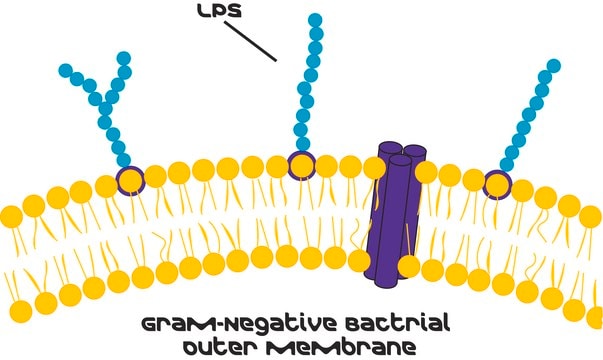
Explore the structure, function, and diverse applications of Lipopolysaccharides. Discover their role in bacteria, serological specificity, and research potential.
Contenido relacionado
Lipopolysaccharide (LPS) is a major component of Gram-negative bacteria, important for microbiological research.
-
How can I determine the shelf life / expiration / retest date of this product?
1 answer-
Helpful?
-
-
How is shipping temperature determined? And how is it related to the product storage temperature?
1 answer-
Products may be shipped at a different temperature than the recommended long-term storage temperature. If the product quality is sensitive to short-term exposure to conditions other than the recommended long-term storage, it will be shipped on wet or dry-ice. If the product quality is NOT affected by short-term exposure to conditions other than the recommended long-term storage, it will be shipped at ambient temperature. As shipping routes are configured for minimum transit times, shipping at ambient temperature helps control shipping costs for our customers. For more information, please refer to the Storage and Transport Conditions document: https://www.sigmaaldrich.com/deepweb/assets/sigmaaldrich/marketing/global/documents/316/622/storage-transport-conditions-mk.pdf
Helpful?
-
Active Filters
Nuestro equipo de científicos tiene experiencia en todas las áreas de investigación: Ciencias de la vida, Ciencia de los materiales, Síntesis química, Cromatografía, Analítica y muchas otras.
Póngase en contacto con el Servicio técnico