
1.70316

Erbium ICP standard
traceable to SRM from NIST Er2O3 in HNO3 2-3% 1000 mg/l Er Certipur®
Skip To
grade
certified reference material
Quality Level
product line
Certipur®
concentration
1000 mg/L Er in 2-3% HNO3
technique(s)
ICP: suitable
pH
0.5 (20 °C in H2O)
density
1.013 g/cm3 at 20 °C
application(s)
industrial qc
pharmaceutical
format
single component solution
Related Categories
1 of 4
This Item | 1.70358 | 1.70317 | 1.70346 |
|---|---|---|---|
| grade certified reference material | grade certified reference material | grade certified reference material | grade certified reference material |
| technique(s) ICP: suitable | technique(s) ICP: suitable | technique(s) ICP: suitable | technique(s) ICP: suitable |
| format single component solution | format single component solution | format single component solution | format single component solution |
| application(s) industrial qc | application(s) industrial qc | application(s) industrial qc | application(s) industrial qc |
| product line Certipur® | product line Certipur® | product line Certipur® | product line Certipur® |
| concentration 1000 mg/L Er in 2-3% HNO3 | concentration 1000 mg/L Tb in 2-3% HNO3 | concentration 1000 mg/L Eu in 2-3% HNO3 | concentration 1000 mg/L Rb in 2-3% HNO3 |

General description
Please visit ISO certificates and Site Quality Self-Assessments to access the current certificates of accreditation.
Download your certificate at http://www.sigma-aldrich.com to view certified values, including uncertainty, date of expiry, and detailed information about trace impurities.
Application
It may be used as standard solution to determine the chemical purity of the sample by Inductively Coupled Plasma Optical Emission Spectroscopy (ICP-OES) during production of radionuclidically pure 169Er isotope[1].
Analysis Note
Other Notes
Legal Information
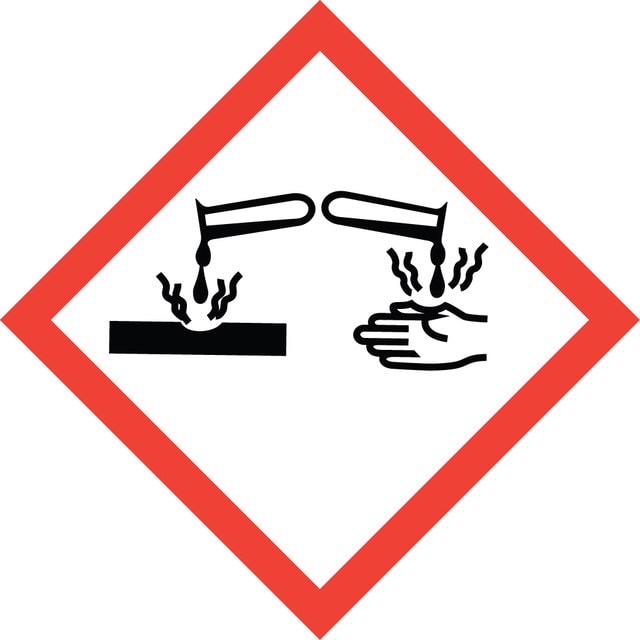
Signal Word
Warning
Hazard Statements
Precautionary Statements
Hazard Classifications
Eye Irrit. 2 - Met. Corr. 1 - Skin Irrit. 2
Storage Class Code
8A - Combustible corrosive hazardous materials
WGK
nwg
Certificates of Analysis (COA)
Search for Certificates of Analysis (COA) by entering the products Lot/Batch Number. Lot and Batch Numbers can be found on a product’s label following the words ‘Lot’ or ‘Batch’.
Already Own This Product?
Find documentation for the products that you have recently purchased in the Document Library.
Active Filters
Our team of scientists has experience in all areas of research including Life Science, Material Science, Chemical Synthesis, Chromatography, Analytical and many others.
Contact Technical Service