

If this product has an expiration or retest date, it will be shown on the Certificate of Analysis (COA, CofA). If there is no retest or expiration date listed on the product's COA, we do not have suitable stability data to determine a shelf life. For these products, the only date on the COA will be the release date; a retest, expiration, or use-by-date will not be displayed.
For all products, we recommend handling per defined conditions as printed in our product literature and website product descriptions. We recommend that products should be routinely inspected by customers to ensure they perform as expected.
For products without retest or expiration dates, our standard warranty of 1 year from the date of shipment is applicable.
For more information, please refer to the Product Dating Information document: https://www.sigmaaldrich.com/deepweb/assets/sigmaaldrich/marketing/global/documents/418/501/product-dating-information-06-25-mk.pdf
1.00456

Nitric acid
65%, for analysis EMSURE® Reag. Ph Eur,ISO
Synonim(y):
Nitric acid solution
Wybierz wielkość
| Rozmiar/SKU | Dostępność | Cena netto |
|---|---|---|
1 L | Skontaktuj się z Obsługą Klienta, aby uzyskać informacje na temat dostępności | 130,00 zł |
Skontaktuj się z Obsługą Klienta, aby uzyskać informacje na temat dostępności | 156,00 zł | |
Skontaktuj się z Obsługą Klienta, aby uzyskać informacje na temat dostępności | 255,00 zł | |
2.5 L | Skontaktuj się z Obsługą Klienta, aby uzyskać informacje na temat dostępności | 255,00 zł |
2.5 L | Skontaktuj się z Obsługą Klienta, aby uzyskać informacje na temat dostępności | 267,00 zł |
Skontaktuj się z Obsługą Klienta, aby uzyskać informacje na temat dostępności | 273,00 zł | |
25 L | Skontaktuj się z Obsługą Klienta, aby uzyskać informacje na temat dostępności | 2030,00 zł |
180 L | Skontaktuj się z Obsługą Klienta, aby uzyskać informacje na temat dostępności | 11 280,00 zł |
Informacje o tej pozycji
130,00 zł
Nazwa produktu
Kwas azotowy 65%, for analysis EMSURE® Reag. Ph Eur,ISO
Quality Segment
agency
reag. ISO, reag. Ph. Eur.
vapor pressure
9.4 hPa ( 20 °C)
product line
EMSURE®
assay
≥65.0% (alkalimetric)
form
liquid
concentration
(>= 65 - < 70%)
SMILES string
O[N+]([O-])=O
impurities
≤0.010 ppm Ag (Silver), ≤0.010 ppm As (Arsenic), ≤0.010 ppm Ba (Barium), ≤0.010 ppm Be (Beryllium), ≤0.010 ppm Cd (Cadmium), ≤0.010 ppm Co (Cobalt), ≤0.010 ppm Cu (Copper), ≤0.010 ppm Li (Lithium), ≤0.010 ppm Mn (Manganese), ≤0.010 ppm Mo (Molybdenum), ≤0.010 ppm Pb (Lead), ≤0.010 ppm Sr (Strontium), ≤0.010 ppm V (Vanadium), ≤0.020 ppm Bi (Bismuth), ≤0.020 ppm Cr (Chromium), ≤0.020 ppm Ge (Germanium), ≤0.020 ppm In (Indium), ≤0.020 ppm Ni (Nickel), ≤0.020 ppm Ti (Titanium), ≤0.020 ppm Tl (Thallium), ≤0.020 ppm Zn (Zinc), ≤0.020 ppm Zr (Zirconium), ≤0.050 ppm Al (Aluminium), ≤0.050 ppm Au (Gold), ≤0.050 ppm Ga (Gallium), ≤0.050 ppm Mg (Magnesium), ≤0.100 ppm Ca (Calcium), ≤0.100 ppm Fe (Iron), ≤0.100 ppm K (Potassium), ≤0.100 ppm Pt (Platinum), ≤0.2 ppm Chloride (Cl), ≤0.2 ppm Heavy metals (as Pb), ≤0.2 ppm Phosphate (PO4), ≤0.200 ppm Na (Sodium), ≤0.5 ppm Sulfate (SO4)
ign. residue
≤3 ppm (as SO4)
color
APHA: ≤10
pH
<1 (20 °C in H2O, strongly acid)
bp
121 °C/1013 hPa
mp
-32 °C
density
1.39 g/cm3 at 20 °C
storage temp.
2-30°C
InChI
1S/HNO3/c2-1(3)4/h(H,2,3,4)
InChI key
GRYLNZFGIOXLOG-UHFFFAOYSA-N
Application
- Porównanie pierwiastków niezbędnych i toksycznych w tkankach pacjentów z rakiem przełyku, płuc, jamy ustnej i pęcherza moczowego z grupą kontrolną...: W badaniu wykorzystano 65% kwas azotowy w procesie trawienia próbki do oznaczania pierwiastków śladowych w tkankach pacjentów z rakiem przy użyciu spektrometrii absorpcji atomowej (Kazi et al., 2015).
- Interakcja między rakotwórczymi i antyrakotwórczymi pierwiastkami śladowymi w próbkach włosów ze skóry głowy różnych typów pakistańskich pacjentek zrakiem...: W badaniu tym zastosowano 65% kwas azotowy do trawienia próbek włosów ze skóry głowy, analizując pierwiastki śladowe za pomocą spektrometrii absorpcji atomowej (Wadhwa et al., 2015).
Analysis Note
Tożsamość: pozytywny wynik testu
Wygląd: pozytywny wynik testu
Kolor (Hazen): ≤ 10 Hazen
Gęstość (d 20/20): 1,384 - 1,416
Chlorek (Cl): ≤ 0.2 ppm
Fosforan (PO₄): ≤ 0,2 ppm
Siarczan (SO₄): ≤ 0,5 ppm
Metale ciężkie (jak Pb): ≤ 0,2 ppm
Ag (Srebro): ≤ 0,010 ppm
Al (Aluminium): ≤ 0.050 ppm
As (Arsen): ≤ 0.010 ppm
Au (Złoto): ≤ 0.050 ppm
Ba (Bar): ≤ 0.010 ppm
Be (Beryl): ≤ 0.010 ppm
Bi (Bizmut): ≤ 0.020 ppm
Ca (Wapń): ≤ 0,100 ppm
Cd (Kadm): ≤ 0,010 ppm
Co (Kobalt): ≤ 0,010 ppm
Cr (Chrom): ≤ 0,020 ppm
Cu (Miedź): ≤ 0,010 ppm
Fe (Żelazo): ≤ 0.100 ppm
Ga (Gal): ≤ 0.050 ppm
Ge (Germanium): ≤ 0.020 ppm
In (Indium): ≤ 0.020 ppm
K (Potassium): ≤ 0.100 ppm
Li (Lithium): ≤ 0.010 ppm
Mg (Magnez): ≤ 0.050 ppm
Mn (Mangan): ≤ 0.010 ppm
Mo (Molibden): ≤ 0.010 ppm
Na (Sód): ≤ 0.200 ppm
Ni (Nikiel): ≤ 0.020 ppm
Pb (Ołów): ≤ 0.010 ppm
Pt (Platyna): ≤ 0,100 ppm
Sr (Stront): ≤ 0,010 ppm
Ti (Tytan): ≤ 0,020 ppm
Tl (Tal): ≤ 0,020 ppm
V (Wanad): ≤ 0.010 ppm
Zn (cynk): ≤ 0,020 ppm
Zr (cyrkon): ≤ 0,020 ppm
Pozostałość po zapaleniu (jako SO₄): ≤ 3 ppm
Data ważności: patrz etykieta produktu
Odczynnik ISO
Legal Information
Still not finding the right product?
Explore all of our products under Kwas azotowy 65%
Słowo ostrzegawcze
Danger
Kody zagrożeń
Hazard Classifications
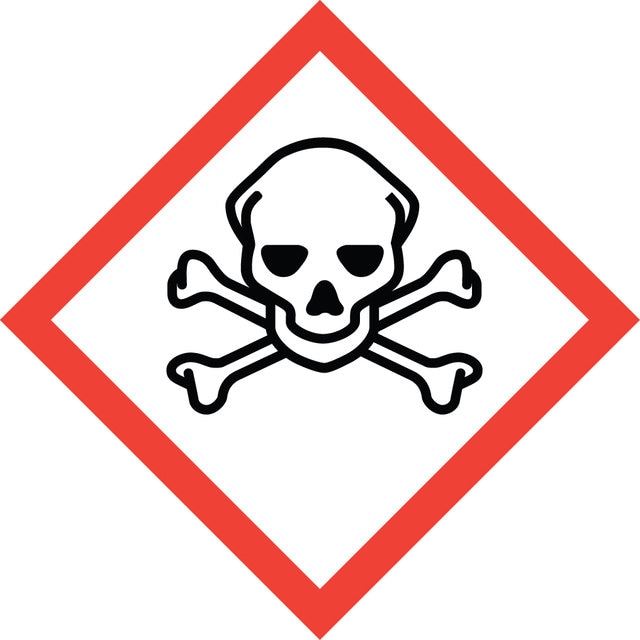
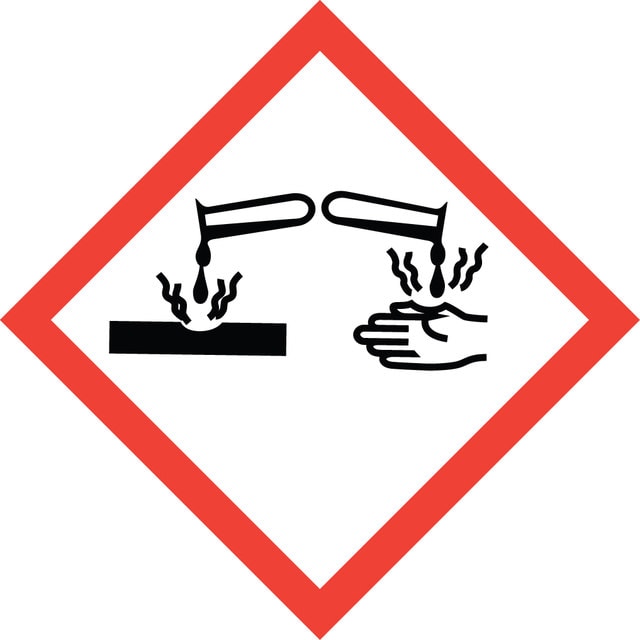
Acute Tox. 3 Inhalation - Eye Dam. 1 - Met. Corr. 1 - Ox. Liq. 3 - Skin Corr. 1A
supp_hazards
Klasa składowania
5.1B - Oxidizing hazardous materials
Temperatura zapłonu (°F)
Not applicable
Temperatura zapłonu (°C)
Not applicable
Wykazy regulacyjne
Wykazy regulacyjne dotyczą głównie produktów chemicznych. Można w nich podawać ograniczoną liczbę informacji na temat produktów niechemicznych. Brak wpisu oznacza, że żaden ze składników nie znajduje się w wykazie. Użytkownik odpowiada za zagwarantowanie bezpiecznego i zgodnego z prawem stosowania produktu.
7697-37-2
Wybierz jedną z najnowszych wersji:
Masz już ten produkt?
Dokumenty związane z niedawno zakupionymi produktami zostały zamieszczone w Bibliotece dokumentów.
-
What is the emission factor (CO2e) for this chemical (Nitric acid)? I need it to calculate the process of leaching I used it for. Thanks
1 answer -
How can I determine the shelf life / expiration / retest date of this product?
1 answer-
Helpful?
-
-
How is shipping temperature determined? And how is it related to the product storage temperature?
1 answer-
Products may be shipped at a different temperature than the recommended long-term storage temperature. If the product quality is sensitive to short-term exposure to conditions other than the recommended long-term storage, it will be shipped on wet or dry-ice. If the product quality is NOT affected by short-term exposure to conditions other than the recommended long-term storage, it will be shipped at ambient temperature. As shipping routes are configured for minimum transit times, shipping at ambient temperature helps control shipping costs for our customers. For more information, please refer to the Storage and Transport Conditions document: https://www.sigmaaldrich.com/deepweb/assets/sigmaaldrich/marketing/global/documents/316/622/storage-transport-conditions-mk.pdf
Helpful?
-
-
Warum werden zu diesem Produkt Gehaltsangaben in % oder ppm gemacht, ohne den Bezug dieser Quotienten (Masse, Volumen, ...) anzugeben? IUPAC, ISO, BIPM raten von solchen Angaben ab. Warum nicht eindeutig als Massenanteil oder Massenkonzentration benennen?
1 answer-
These content or product details are reported as such for practical purposes. All of the units reported for this product can be used directly in calculations related to product usage.
For example, the nitric acid is 65% by assay of a 1 Liter bottle. It means that 650 mL equals nitric acid. The literature density of Nitric acid is 1.51g/mL. Thus the mass of nitric acid in that bottle is 1.51g/mL * 650mL = 981.5g
Helpful?
-