
1.06887

Papanicolaou′s solution 2b Orange II solution
for cytology
Wybierz wielkość
| Rozmiar/SKU | Dostępność | Cena netto |
|---|---|---|
500 mL | Skontaktuj się z Obsługą Klienta, aby uzyskać informacje na temat dostępności | 278,00 zł |
2.5 L | Skontaktuj się z Obsługą Klienta, aby uzyskać informacje na temat dostępności | 1100,00 zł |
Informacje o tej pozycji
278,00 zł
Quality Segment
form
liquid
IVD
for in vitro diagnostic use
technique(s)
microbe id | staining: suitable
pH
7.0-7.5 (20 °C in H2O)
transition temp
flash point 17 °C
density
0.83 g/cm3 at 20 °C
application(s)
clinical testing
cytology
diagnostic assay manufacturing
hematology
histology
storage temp.
15-25°C
General description
In the first step, the cell nuclei are stained either progressively or regressively with a hematoxylin solution, (Hematoxylin solution modified acc.to Gill II, (Product number 1.05175),
Papanicolaou′s solution 1a Harris hematoxylin solution, (Product number 1.09253) or Papanicolaou′s solution 1b Hematoxylin solution S, (Product number 1.09254). Nuclei are stained blue to dark violet. In the progressive hematoxylin staining method, staining is carried out to the endpoint, after which the slide is blued in tapwater. With the regressive method the material is over-stained and the excess of staining solution is removed by acid rinsing steps, followed by the bluing step. The structures of nuclei are more differentiated and better visible by the regressive method. The second staining step is cytoplasmic staining by orange staining solution, (Papanicolaou′s solution 2b Orange II solution, (Product number 1.106887) or Papanicolaou′s solution 2a Orange G solution (OG6), (Product number 1.06888)), especially for demonstration of mature and keratinized cells. The target structures are stained orange in different intensities. In the third staining step is used the so-called polychrome solution, a mixture of eosin, light green SF and Bismarck brown, Papanicolaou′s solution 3a polychromatic solution EA 31, (Product number 1.09271), Papanicolaou′s solution 3b polychromatic solution EA 50, (Product number 1.09272), Papanicolaou′s solution 3c polychromatic solution EA 65, (Product number 1.09270), or Papanicolaou′s solution 3d polychromatic solution EA 65, (Product number 1.09269). The polychrome solution is used for demonstration of differentiation of squamous cells. Papanicolaou′s solution 2b Orange II solution gives a more intense reddish staining result with mature and keratinized squamous cells than Papanicolaou′s solution 2a Orange G solution (OG6) - for cytology.
The 500 ml bottle provides 1500 - 2000 stainings. For more details, please see instructions for use (IFU). This product is registered as IVD and CE marked.
Analysis Note
Nuclei: blue to dark violet
Cyanophilic cytoplasm: blue-green
Eosinophilic cytoplasm: pink
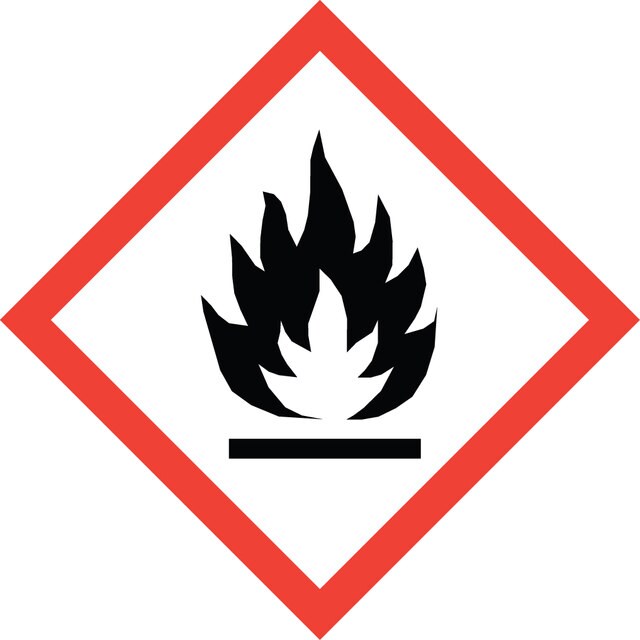


Słowo ostrzegawcze
Danger
Kody zagrożeń
Hazard Classifications
Acute Tox. 4 Dermal - Acute Tox. 4 Inhalation - Acute Tox. 4 Oral - Eye Irrit. 2 - Flam. Liq. 2 - STOT SE 1
Klasa składowania
3 - Flammable liquids
WGK
WGK 2
Temperatura zapłonu (°F)
62.6 °F
Temperatura zapłonu (°C)
17 °C
Narządy docelowe
Eyes,Central nervous system
Wykazy regulacyjne
Wykazy regulacyjne dotyczą głównie produktów chemicznych. Można w nich podawać ograniczoną liczbę informacji na temat produktów niechemicznych. Brak wpisu oznacza, że żaden ze składników nie znajduje się w wykazie. Użytkownik odpowiada za zagwarantowanie bezpiecznego i zgodnego z prawem stosowania produktu.
67-56-1
Wybierz jedną z najnowszych wersji:
Masz już ten produkt?
Dokumenty związane z niedawno zakupionymi produktami zostały zamieszczone w Bibliotece dokumentów.