


The differences between the various EA solutions primarily lie in the dye concentrations for Light Green or Fast Green FCF, along with some other stain ingredients. Older formulations typically used Light Green, while EA65 formulations typically use Fast Green FCF. However, it's not possible to provide a detailed explanation of the differences due to the proprietary nature of dye concentrations as regarded by the division that manufactured product 1092710500 and the discontinued EA36. It is known, though, that EA36 and EA50 are generally considered to have the same basic formulation, and these formulations are typically used to stain PAP smears.
1.09271

Papanicolaou′s solution 3a polychromatic solution EA 31
for cytology
Zaloguj się, aby wyświetlić ceny organizacyjne i kontraktowe.
Wybierz wielkość
Zmień widok
| Rozmiar/SKU | Dostępność | Cena netto |
|---|---|---|
500 mL | Skontaktuj się z Obsługą Klienta, aby uzyskać informacje na temat dostępności | 274,00 zł |
2.5 L | Skontaktuj się z Obsługą Klienta, aby uzyskać informacje na temat dostępności | 1090,00 zł |
Informacje o tej pozycji
NACRES:
NA.77
UNSPSC Code:
41116121
274,00 zł
Skontaktuj się z Obsługą Klienta, aby uzyskać informacje na temat dostępności
Pomoc techniczna
Potrzebujesz pomocy? Nasz zespół doświadczonych naukowców chętnie Ci pomoże.
Pozwól nam pomócQuality Segment
form
liquid
IVD
for in vitro diagnostic use
pH
5.0-5.5 (20 °C in H2O)
transition temp
flash point 17 °C
density
0.82 g/cm3 at 20 °C
storage temp.
20-25°C
General description
Papanicolaou′s solution 3a polychromatic solution EA 31 - for cytology, is a ready-to-use solution used for human-medical cell diagnosis and serve the purpose of the cytological investigation of sample material of human origin, for example, gynecological and clinico-cytological specimen materials. Papanicolaou′s technique is the most used staining procedure for cytological specimen is and is intended for the the staining of exfoliative cells in cytological specimens. In the first step, the cell nuclei are stained either progressively or regressively with a hematoxylin solution, (Hematoxylin solution modified acc.to Gill II, (Product number 1.05175), Papanicolaou′s solution 1a Harris hematoxylin solution, (Product number 1.09253) or Papanicolaou′s solution 1b Hematoxylin solution S, (Product number 1.09254)). Nuclei are stained blue to dark violet. In the progressive hematoxylin staining method, staining is carried out to the endpoint, after which the slide is blued in tapwater. With the regressive method the material is over-stained and the excess of staining solution is removed by acid rinsing steps, followed by the bluing step. The structures of nuclei are more differentiated and better visible by the regressive method. The second staining step is cytoplasmic staining by orange staining solution (Papanicolaou′s solution 2b Orange II solution, Product number 1.106887 or Papanicolaou′s solution 2a Orange G solution (OG6), Product number 1.06888), especially for demonstration of mature and keratinized cells. The target structures are stained orange in different intensities. In the third staining step is used the so-called polychrome solution, a mixture of eosin, light green SF and Bismarck brown, (Papanicolaou′s solution 3a polychromatic solution EA 31, (Product number 1.09271), Papanicolaou′s solution 3b polychromatic solution EA 50, (Product number 1.09272), Papanicolaou′s solution 3c polychromatic solution EA 65 (Product number 1.09270), o Papanicolaou′s solution 3d polychromatic solution EA 65, (Product number 1.09269). The polychrome solution is used for demonstration of differentiation of squamous cells. Papanicolaou′s solution 3a polychromatic solution EA 31 gives a blue-green to green staining result with clinical material.
The 500 ml bottle provides 1500 - 2000 stainings. This product is registered as IVD and CE marked. For more details, please see instructions for use (IFU). The IFU can be downloaded from this webpage.
The 500 ml bottle provides 1500 - 2000 stainings. This product is registered as IVD and CE marked. For more details, please see instructions for use (IFU). The IFU can be downloaded from this webpage.
Application
Used to demonstrate the differentiation of squamous cells in gynecological cytology
Analysis Note
Suitability for microscopy (Vaginal smear):passes test
Nuclei:blue to dark violet
Cyanophilic cytoplasm:blue-green to green
Eosinophilic cytoplasm:pink
Nuclei:blue to dark violet
Cyanophilic cytoplasm:blue-green to green
Eosinophilic cytoplasm:pink
Ta strona może zawierać tekst przetłumaczony maszynowo.
Słowo ostrzegawcze
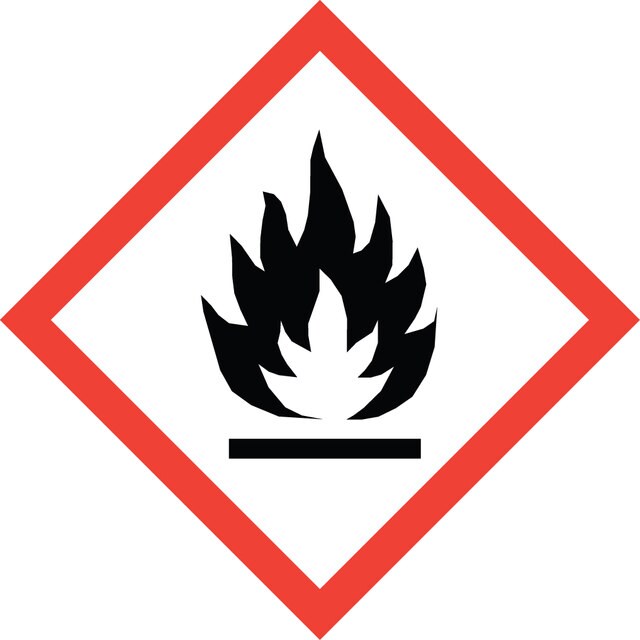
Danger
Klasa składowania
3 - Flammable liquids
Co się dzieje?
WGK 2
Temperatura zapłonu (°F)
62.6 °F
Temperatura zapłonu (°C)
17 °C
Narządy docelowe
Eyes,Central nervous system
Kody zagrożeń
Hazard Classifications
Acute Tox. 4 Dermal - Acute Tox. 4 Inhalation - Acute Tox. 4 Oral - Eye Irrit. 2 - Flam. Liq. 2 - Skin Sens. 1 - STOT SE 1
Wykazy regulacyjne
Wykazy regulacyjne dotyczą głównie produktów chemicznych. Można w nich podawać ograniczoną liczbę informacji na temat produktów niechemicznych. Brak wpisu oznacza, że żaden ze składników nie znajduje się w wykazie. Użytkownik odpowiada za zagwarantowanie bezpiecznego i zgodnego z prawem stosowania produktu.
67-56-1
CAS No.
Wybierz jedną z najnowszych wersji:
Masz już ten produkt?
Dokumenty związane z niedawno zakupionymi produktami zostały zamieszczone w Bibliotece dokumentów.
-
What are the differences between Papanicolaou EA-31, EA-36, and EA-50?
1 answer-
Helpful?
-