
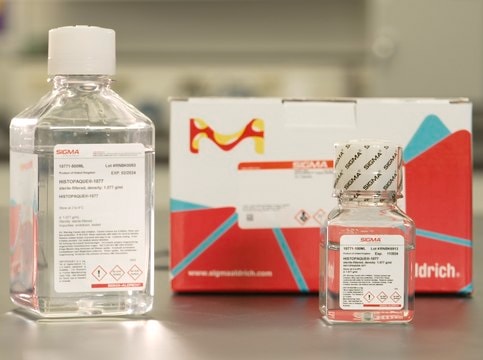



Histopaque 10771 was introduced in the late 1970s or early 1980s. As such, there is a long history of shipping the product when the temperature falls below freezing. It is relatively common for the bottles to freeze during ground shipping during the winter months. The standard advise is to thaw the bottles at either room temperature at a 37°C. Once the bottle has thawed, it will be necessary to invert the bottle multiple times to ensure the gradient is uniform. If the bottle is not inverted multiple times, a gradient in situ will form as freezing is one method of forming gradients. As long as the solution is clear and the bottle has not broken, the product is suitable for use.
Przejdź do
10771

Histopaque®-1077
sterile-filtered, density: 1.077
1 of 2 reviewers received a sample product or took part in a promotion
Zaloguj się, aby wyświetlić ceny organizacyjne i kontraktowe.
Wybierz wielkość
Zmień widok
| Rozmiar/SKU | Dostępność | Cena netto |
|---|
Informacje o tej pozycji
NACRES:
NA.75
UNSPSC Code:
12352207
Informacje o cenach i dostępności nie są obecnie dostępne.
Pomoc techniczna
Potrzebujesz pomocy? Nasz zespół doświadczonych naukowców chętnie Ci pomoże.
Pozwól nam pomócsterility
sterile-filtered
Quality Segment
form
liquid
shelf life
Expiry date on the label.
technique(s)
cell culture | mammalian: suitable
impurities
endotoxin, tested
density
1.077
application(s)
hematology
histology
storage temp.
2-8°C
General description
Histopaque-1077 is a sterile, endotoxin tested, ready-to-use medium. The Histopaque composition includes polysucrose and sodium diatrizoate, adjusted to a relative density of 1.077g/mL. This ready-to-use medium facilitates rapid recovery of viable lymphocytes and other mononuclear cells from small volumes of whole blood or bone marrow.
Application
Histopaque-1077 has been used for:
- human lymphocyte antigen (HLA) typing
- initial isolation step prior to the enumeration of T, B, and ‘null’ lymphocytes.
- preparation of pure lymphocyte suspensions for cell culture and cytotoxicity assays.
- isolation and purification of peripheral blood mononuclear cells (PBMCs) and bone marrow mononuclear cells (BMMCs)
- isolation of human lymphocytes
- isolation of breast cancer circulating tumor cells (CTCs) from the whole blood
- Histopaque-1077 is used in conjunction with Histopaque-1119 as it facilitates the rapid recovery of viable mononuclear cells and granulocytes from small volumes of whole blood
Biochem/physiol Actions
Anticoagulated blood is layered onto Histopaque-1077. During centrifugation, erythrocytes are aggregated by polysucrose and rapidly sediment. Granulocytes become slightly hypertonic, which increases their sedimentation rate, resulting in pelleting at the bottom of the centrifuge tube. Lymphocytes and other mononuclear cells remain at the plasma/ Histopaque-1077 interface.
Features and Benefits
Histopaque®-1077 offers numerous advantages, such as:
- Optimal recovery of viable cells
- Permits selective separation of blood cell types
- Prevents cell distortion
- Preserves cell viability
- Minimal extraneous cell interference
- Reproducible performance from batch to batch
- Sterile-filtered and endotoxin-tested
- Stable at 2-8°C for at least 2 years when protected from light
Legal Information
Histopaque is a registered trademark of Merck KGaA, Darmstadt, Germany
Ta strona może zawierać tekst przetłumaczony maszynowo.
1 of 1
Ta pozycja | |||
|---|---|---|---|
| description sterile-filtered, density: 1.077 | description sterile-filtered, density: 1.077 g/mL | description sterile-filtered, density: 1.077 g/mL | description sterile-filtered, density: 1.077 g/mL |
| sterility sterile-filtered | sterility aseptically filled | sterility aseptically filled | sterility aseptically filled |
| technique(s) cell culture | mammalian: suitable | technique(s) cell culture | mammalian: suitable | technique(s) cell culture | mammalian: suitable | technique(s) cell culture | mammalian: suitable |
| form liquid | form solution | form solution | form solution |
| density 1.077 | density 1.077 g/mL | density 1.077 g/mL | density 1.077 g/mL |
| Quality Level 400 | Quality Level 400 | Quality Level 400 | Quality Level 400 |
| storage temp. 2-8°C | storage temp. 2-8°C | storage temp. 2-8°C | storage temp. - |
Słowo ostrzegawcze
Danger
Kody zagrożeń
Hazard Classifications
Resp. Sens. 1 - Skin Sens. 1
Klasa składowania
12 - Non Combustible Liquids
Wybierz jedną z najnowszych wersji:
Masz już ten produkt?
Dokumenty związane z niedawno zakupionymi produktami zostały zamieszczone w Bibliotece dokumentów.
-
Hello, we had a problem with the refrigerator temperature dropping below 4 degrees Celsius for over the weekend. Can the Histopaque-1077 stored in this refrigerator still be used?
1 answer-
Helpful?
-
-
Hello, we had a problem with the refrigerator leading the temperature increasing to 44 degrees Celsius for over the 2 days of weekend, so can our Histopaque-1077 stored in this refrigerator can be used anymore?
1 answer-
This product ships at ambient temperature and is stable for relatively short periods at room temperature. There is a 1 - 2 week allowance for transit time. A storage temperature excursion of 2 days is not expected to impact the quality or performance of this material.
Helpful?
-
-
What impact does freezing Histopaque or Ficoll solutions have on PBMC purification? Will the freeze/thaw cycle affect product performance in assays, or will it continue to function as expected?
1 answer-
It is recommended to avoid freezing Histopaque or Ficoll Paque solutions. Thawing can be achieved by leaving the bottles at room temperature, followed by gentle inversion to mix the solution after thawing.If the solution is clear, particle-free, and the bottle is intact, the product is suitable for use. However, if the bottle is cracked or broken, it should be replaced.
Helpful?
-
-
If Histopaque-1077 is brought to room temperature, how long can it be left at that temperature before use? Specifically, will leaving it for a few hours cause any issues?
1 answer-
Ficoll Paque has a storage temperature range of 4°C to 30°C for unopened bottles, while opened bottles should be stored at 4°C to 8°C. However, Histopaque can be stored at room temperature for short periods.
Helpful?
-
-
Do you have a recommended protocol for purifying PBMCs from larger volumes using Histopaque 1077 in 50 mL tubes instead of 15 mL tubes?
1 answer-
For PBMCs, the catalog numbers for Histopaque 10771, H8889, and 10831 are applicable. The Instructions For Use indicate that a 15 ml centrifuge tube with 3 ml of Histopaque 10771 is recommended. This procedure can also be used for a 50 ml centrifuge tube, considering that the height of both tubes is comparable while their diameter differs. To accommodate a 50 ml centrifuge tube, it is advised to use 15 ml of Histopaque 10771. No alterations are needed for the centrifugation time and washing steps. It is sufficient to wash the isolated cells with isotonic PBS or cell culture media.
Helpful?
-
-
Is Histopaque 10771 the recommended density for isolating or separating PBMCs in llama blood?
1 answer-
Yes, Histopaque 1077 (catalog number 10771) is the recommended density for mammalian cells.
Helpful?
-
-
What is the efficacy and reliability of using Histopaque®-1077 for separating low-density neutrophils (LDN) and normal-density neutrophils (NDN) from high-density neutrophils?
1 answer-
The Histopaque 1077 procedure is not designed to purify low-density or high-density neutrophils. Instead, Histopaque 10771 is intended for purifying Peripheral Blood Mononuclear Cells (PBMCs). When using Histopaque 10771, it is expected that the collected mononuclear cells would contain 5% or less of neutrophils, likely in the form of low-density neutrophils.
Helpful?
-
-
Does Histopaque®-1077 work for mouse blood, or is Ficoll®-Paque Premium 1.084 a better choice?
1 answer-
While Histopaque 10771 can be used, it is important to note that quality control testing for Histopaque 10771 does not include testing with mouse blood. The preferred products for isolating mononuclear cells from rat and mouse blood are Ficoll Paque Premium 1084 (GE17-5446-02) or Histopaque 10831. These products are specifically formulated for rats, mice, and other small mammals for the higher percentage of cell recovery.
Helpful?
-
-
What is the percentage of peripheral blood mononuclear cells (PBMCs) recovered from human blood?
1 answer-
Generally, Histopaque recoveries typically range from 50% to 80%. The percentage of recovery varies significantly depending on the total white cell count of the patient. Higher white cell counts typically have the best recovery rates. Yields are also generally higher with fresh blood and lower with older blood.
Helpful?
-
-
Can histopaque-1077 be used to isolate live tumor cells in suspension from dead cells/cell debris?
1 answer-
Histopaque 10771 is primarily intended for isolating mononuclear cells from human blood and bone marrow. It is also utilized in cell culture to eliminate dying cells from hybridomas. However, the effectiveness of Histopaque 10771 or Histopaque 10831 in purifying live cells from deceased liver cells remains untested. Percoll and OptiPrep are common alternative methods.
Helpful?
-