



A stock solution of 1 mg/ml or greater may be stored frozen in aliquots. Avoid freeze-thaw cycles. When the solution gets a pink cast, the product has degraded.
Przejdź do
A7257

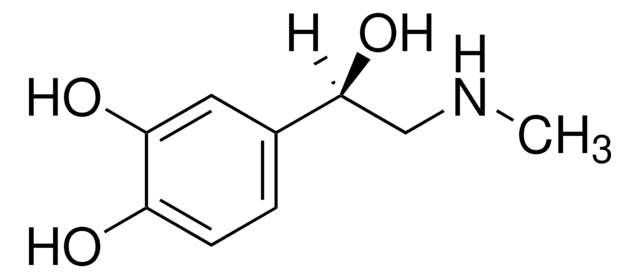
(−)-Norepinephrine
≥98% (TLC), crystalline, adrenergic neurotransmitter
Synonim(y):
(R)-4-(2-Amino-1-hydroxyethyl)-1,2-benzenediol, L-Arterenol, L-Noradrenaline, Levarterenol
Zaloguj się, aby wyświetlić ceny organizacyjne i kontraktowe.
Wybierz wielkość
Zmień widok
| Rozmiar/SKU | Dostępność | Cena netto |
|---|---|---|
500 mg | Skontaktuj się z Obsługą Klienta, aby uzyskać informacje na temat dostępności | 1430,00 zł |
1 g | Skontaktuj się z Obsługą Klienta, aby uzyskać informacje na temat dostępności | 1810,00 zł |
5 g | Skontaktuj się z Obsługą Klienta, aby uzyskać informacje na temat dostępności | 6510,00 zł |
Informacje o tej pozycji
Wzór empiryczny (zapis Hilla):
C8H11NO3
Numer CAS:
Masa cząsteczkowa:
169.18
NACRES:
NA.77
PubChem Substance ID:
UNSPSC Code:
12352200
EC Number:
200-096-6
MDL number:
Beilstein/REAXYS Number:
2804840
Assay:
≥98%
Form:
crystalline
1430,00 zł
Skontaktuj się z Obsługą Klienta, aby uzyskać informacje na temat dostępności
Pomoc techniczna
Potrzebujesz pomocy? Nasz zespół doświadczonych naukowców chętnie Ci pomoże.
Pozwól nam pomócNazwa produktu
(−)-Norepinephrine, ≥98%, crystalline
Quality Segment
assay
≥98%
form
crystalline
color
off-white to tan
storage temp.
−20°C
SMILES string
NC[C@H](O)c1ccc(O)c(O)c1
InChI
1S/C8H11NO3/c9-4-8(12)5-1-2-6(10)7(11)3-5/h1-3,8,10-12H,4,9H2/t8-/m0/s1
InChI key
SFLSHLFXELFNJZ-QMMMGPOBSA-N
Gene Information
human ... ADRA1A(148), ADRA1B(147), ADRA1D(146), ADRA2A(150), ADRA2B(151), ADRA2C(152), ADRB1(153), ADRB2(154), ADRB3(155)
rat ... Adra1a(29412), Adra1d(29413), Adra2a(25083), Adrb1(24925), Adrb2(24176), Drd1a(24316), Drd2(24318)
General description
Norepinephrine is a neurotransmitter found in both the peripheral and central nervous systems. It triggers effects associated with the ′fight or flight′ response and is mediated by the family of adrenergic receptors. Structurally, it is a catecholamine due to the presence of the catechol moiety (consisting of two hydroxyl groups on a benzene ring) and an amine (NH2) group. Norepinephrine exhibits pharmacologic effects on α1 and β1 adrenoceptors. It does not elevate heart rate. The primary advantage of norepinephrine is to improve organ perfusion by increasing vascular tone. Compared to dopamine, norepinephrine is more effective at achieving targeted endpoints, less metabolically active than epinephrine, and reduces serum lactate levels. Moreover, it notably enhances renal perfusion and splanchnic blood flow in sepsis, especially when used alongside dobutamine. Norepinephrine is used in the treatment of hypotension, depression, schizophrenia, and attention deficit/hyperactivity disorders.
Application
(−)-Norepinephrine has been used:
- as anαand β-AR agonist to stimulate mouse organoids to study the pathways that are activated upon intestinal epithelial adrenergic receptor (AR) stimulation,
- to measure the monoamine levels in various limbic regions of mouse brains by high-performance liquid chromatography (HPLC) coupled with an electrochemical equipped with an auto-sampler,
- as a dispersal agent in biofilm dispersion assay to study its effects on the dispersal of Mannheimia haemolytica biofilms
Features and Benefits
This compound is a featured product for Neuroscience research. Click here to discover more featured Neuroscience products. Learn more about bioactive small molecules for other areas of research at sigma.com/discover-bsm.
Ta strona może zawierać tekst przetłumaczony maszynowo.
1 of 1
Ta pozycja | |||
|---|---|---|---|
| description ≥98%, crystalline | description - | description meets USP testing specifications | description solid |
| assay ≥98% | assay - | assay - | assay - |
| form crystalline | form - | form solid | form solid |
| Quality Level 200 | Quality Level 200 | Quality Level 200 | Quality Level 200 |
| storage temp. −20°C | storage temp. 2-8°C | storage temp. - | storage temp. 2-8°C |
| color off-white to tan | color - | color - | color white |
| Gene Information human ... ADRA1A(148), ADRA1B(147), ADRA1D(146), ADRA2A(150), ADRA2B(151), ADRA2C(152), ADRB1(153), ADRB2(154), ADRB3(155) | Gene Information human ... ADRA1A(148), ADRA1B(147), ADRA1D(146), ADRA2A(150), ADRA2B(151), ADRA2C(152), ADRB1(153), ADRB2(154), ADRB3(155) | Gene Information - | Gene Information human ... ADRA1A(148), ADRA1B(147), ADRA1D(146), ADRA2A(150), ADRA2B(151), ADRA2C(152), ADRB1(153), ADRB2(154), ADRB3(155) |
Słowo ostrzegawcze
Danger
Kody zagrożeń
Hazard Classifications
Acute Tox. 1 Inhalation - Acute Tox. 2 Dermal - Acute Tox. 2 Oral
Klasa składowania
6.1B - Non-combustible acute toxic Cat. 1 and 2 / very toxic hazardous materials
Co się dzieje?
WGK 3
PPE (środki ochrony indywidualnej)
Eyeshields, Faceshields, Gloves, type P3 (EN 143) respirator cartridges
Wybierz jedną z najnowszych wersji:
Masz już ten produkt?
Dokumenty związane z niedawno zakupionymi produktami zostały zamieszczone w Bibliotece dokumentów.
-
How long is a solution of Product A7257, (-)-Norepinephrine, stable?
1 answer-
Helpful?
-
-
How should Product A7257, (-)-Norepinephrine, be dissolved?
1 answer-
This product is soluble in 0.5M HCl at a concentration of 50mg/mL, yielding a clear faint yellow solution.
Helpful?
-
-
What is the Department of Transportation shipping information for this product?
1 answer-
Transportation information can be found in Section 14 of the product's (M)SDS.To access the shipping information for this material, use the link on the product detail page for the product.
Helpful?
-
-
What are the differences between Product No. A7257, (-)-Norepinephrine and Product No. A0937, (±)-Norepinephrine (+)-bitartrate salt?
1 answer-
Product No. A7257, is the free base form of the (-) isomer; it is not water soluble. Product No. A0937 is the bitartrate salt of the racemic (+/-) mixture; it is soluble in water at a concentration of 50 mg/mL.
Helpful?
-