
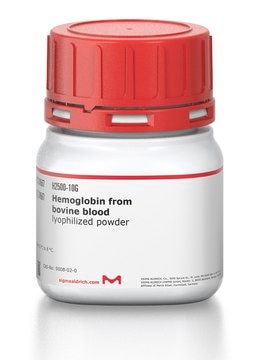


The solubility of this product has been tested in water at a concentration of 20 mg/mL, resulting in dark brown-red solutions. Unfortunately, we have not tested this product in colorimetric assays and can provide no recommendations on this.
Przejdź do
H2500

Hemoglobin from bovine blood
lyophilized powder
Synonim(y):
Bovine hemoglobin, Hb, Methemoglobin
Zaloguj się, aby wyświetlić ceny organizacyjne i kontraktowe.
Wybierz wielkość
Zmień widok
| Rozmiar/SKU | Dostępność | Cena netto |
|---|---|---|
1 g | Skontaktuj się z Obsługą Klienta, aby uzyskać informacje na temat dostępności | 295,00 zł |
5 g | Skontaktuj się z Obsługą Klienta, aby uzyskać informacje na temat dostępności | 1130,00 zł |
10 g | Skontaktuj się z Obsługą Klienta, aby uzyskać informacje na temat dostępności | 1370,00 zł |
25 g | Skontaktuj się z Obsługą Klienta, aby uzyskać informacje na temat dostępności | 2560,00 zł |
Informacje o tej pozycji
Form:
lyophilized powder
Biological source:
bovine blood
Mol wt:
Mr ~64500
295,00 zł
Skontaktuj się z Obsługą Klienta, aby uzyskać informacje na temat dostępności
Pomoc techniczna
Potrzebujesz pomocy? Nasz zespół doświadczonych naukowców chętnie Ci pomoże.
Pozwól nam pomócbiological source
bovine blood
Quality Segment
form
lyophilized powder
mol wt
Mr ~64500
technique(s)
MALDI-TOF: suitable
storage temp.
2-8°C
Gene Information
General description
Hemoglobin is the major component of red blood cells, and is responsible for their red color. Its normal concentration in erythrocytes is 34%. Hemoglobin is a globular protein with α and β chains with each 141 and 146 amino acids, respectively. It exists as a tetramer with each monomer having heterocyclic porphyrin ring with iron constituting the heme.
Application
The solubility of α-elastin has been applied to construction of elastin-mimetic biomaterials.
Hemoglobin from bovine blood has been used in:
- standard curve generation for the quantification intraparenchymal hemorrhage and parenchymal hemorrhage in spinal cord homogenate using Drabkin′s assay, Quadrupole-Ion Mobility-Time-of-Flight mass spectrometery
- the generation of molecularly imprinted polymers (MIPs) to mimic high molecular-weight polyethylene glycol (PEG) in crystallization studies
Biochem/physiol Actions
Oxygen transporter, NO scavenger
Oxygen transporter. The Fe2+/Fe3+ balance is a physiological indicator of blood oxygenation; deoxygenated hemoglobin accessorizes a feedback loop by reducing nitrite to NO, a vasodilator which enhances blood flow to oxygen-deprived tissues.
Hemoglobin is the most important respiratory protein of vertebrates by virtue of its ability to transport oxygen from the lungs to body tissues, and to facilitate the return transport of carbon dioxide. Bovine hemoglobin is used in the generation of hemoglobin-vesicles (HbV) for oxygen transport. It is thermally stable and displays high affinity to oxygen when compared to human hemoglobin. Bovine hemoglobin interacts with synthetic and azo dyes. Polymerized forms of bovine haemoglobin is recommended for treating autoimmune hemolytic anemia.
Disclaimer
Since native hemoglobin is readily oxidized in air, these preparations may be predominantly methemoglobin.
Ta strona może zawierać tekst przetłumaczony maszynowo.
1 of 1
Ta pozycja | |||
|---|---|---|---|
| description lyophilized powder | description dried erythrocytes | description suitable for protease substrate, substrate powder | description from bovine blood, powder, for Neisseria spp., pack of 100 g or 500 g, suitable for microbiology |
| technique(s) MALDI-TOF: suitable | technique(s) - | technique(s) activity assay: suitable | technique(s) - |
| biological source bovine blood | biological source bovine blood | biological source bovine blood | biological source bovine blood |
| form lyophilized powder | form dried erythrocytes | form substrate powder | form powder |
| mol wt Mr ~64500 | mol wt Mr ~64500 | mol wt Mr ~64500 | mol wt Mr ~64500 |
| UniProt accession no. | UniProt accession no. | UniProt accession no. | UniProt accession no. |
| storage temp. 2-8°C | storage temp. 2-8°C | storage temp. 2-8°C | storage temp. 2-8°C |
Still not finding the right product?
Explore all of our products under Hemoglobin from bovine blood
Klasa składowania
11 - Combustible Solids
Co się dzieje?
WGK 3
Temperatura zapłonu (°F)
Not applicable
Temperatura zapłonu (°C)
Not applicable
PPE (środki ochrony indywidualnej)
Eyeshields, Gloves, type N95 (US)
Wybierz jedną z najnowszych wersji:
Masz już ten produkt?
Dokumenty związane z niedawno zakupionymi produktami zostały zamieszczone w Bibliotece dokumentów.
-
I want to create hemoglobin standards to use in a colorimetric assay. Can I create hemoglobin concentrations by weighing specific amounts of lyophilized hemoglobin powder and reconstituting with TS saline? Then process in assay after adding reagent?
1 answer-
Helpful?
-
-
What is the difference between H2500 and H2625 when making Chocolate agar with bovine hemoglobin? Although they share the same CAS and Specification Sheet, there is a significant difference in price between the two.
1 answer-
Products H2500 and H2625 are not suitability tested for use in producing Chocolate Agar. The key differences between H2500 and H2625 lie in their purity and intended uses. H2500 is a purer product, suitable for MALDI-TOF, and associated with a companion product for HPLC analysis of hemoglobin variants. It undergoes two steps of ammonium sulfate precipitation, filtration, dialysis, and lyophilization. On the other hand, H2625 is not suitability tested for use as a protease substrate and lacks the ammonium sulfate precipitation step. These distinctions likely contribute to the significant price difference between the two products.
Helpful?
-
-
Does the website specify if H2500 Hemoglobin from bovine blood is ferrohemoglobin or oxyhemoglobin?
1 answer-
The website indicates that the product H2500 is mainly methemoglobin. A search of the website did not uncover any products marketed as either ferrohemoglobin or oxyhemoglobin.
Helpful?
-