


This Gamma-irradiated product retains inflammatory activity. The minimum potency of this product is 500000 EU/mg. Irradiation can partially alter polysaccharide regions, while lipid A — the main driver of TLR4 activation — remains relatively less affected. Therefore, inflammatory signaling may persist but with reduced potency as compared to non-irradiated LPS. Please see the link below to review a sample or lot-specific Certificate of Analysis, which includes potency:
https://www.sigmaaldrich.com/product/sigma/l4516#product-documentation
Przejdź do
L4516

Lipopolysaccharides from Escherichia coli O127:B8
suitable for cell culture, BioXtra, γ-irradiated
Synonim(y):
LPS
Zaloguj się, aby wyświetlić ceny organizacyjne i kontraktowe.
Wybierz wielkość
Zmień widok
| Rozmiar/SKU | Dostępność | Cena netto |
|---|---|---|
1 mg | Skontaktuj się z Obsługą Klienta, aby uzyskać informacje na temat dostępności | 484,00 zł |
Informacje o tej pozycji
484,00 zł
Skontaktuj się z Obsługą Klienta, aby uzyskać informacje na temat dostępności
Pomoc techniczna
Potrzebujesz pomocy? Nasz zespół doświadczonych naukowców chętnie Ci pomoże.
Pozwól nam pomócbiological source
Escherichia coli (O127:B8)
Quality Segment
sterility
γ-irradiated
product line
BioXtra
form
lyophilized powder
purified by
gel-filtration chromatography
technique(s)
cell culture | mammalian: suitable
impurities
<1% Protein (Lowry)
solubility
H2O: 5 mg/mL, slightly hazy
storage temp.
2-8°C
Application
Lipopolysaccharides from Escherichia coli 0127:B8 has been used:
- to study the LPS-induced macrophage survival in mice
- to elicit the secretion of cytokines by cattle PBMC
- to study apoptosis of highly susceptible macrophage cells in a LPS-induced proinflammatory environment
- to perform autophagy assay in BV2 and BV2-LC3 cells
- for stimulation of human monocytes, macrophages and mouse microglia cells
- to induce pentraxin-3 expression in 293T cells
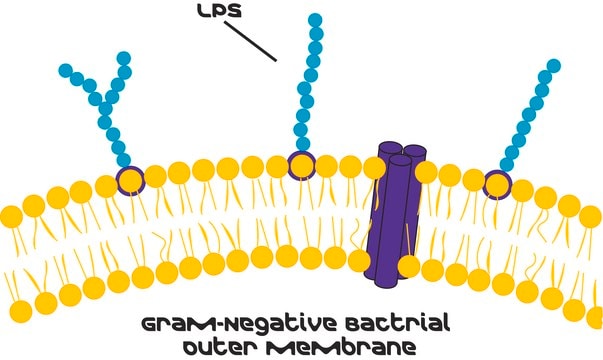
Lipopolysaccharides (LPSs) are characteristic components of the cell wall of Gram-negative bacteria. LPS and its lipid A moiety stimulate cells of the innate immune system by the Toll-like receptor 4 (TLR4), a member of the Toll-like receptor protein family, which recognizes common pathogen-associated molecular-patterns (PAMPs).
Biochem/physiol Actions
Preparation Note
Lipopolysaccharides are supplied as lyophilized, γ-irradiated powders. To reconstitute, add 1 ml sterile balanced salt solution or tissue culture medium to the vial (1 mg) and gently swirl until the powder dissolves. Reconstituted product may be further diluted to desired working concentrations using sterile balanced salt solution or tissue culture medium.
Other Notes
To gain a comprehensive understanding of our extensive range of Lipopolysaccharides for your research, we encourage you to visit our Carbohydrates Category page.
Ta strona może zawierać tekst przetłumaczony maszynowo.
1 of 1
Ta pozycja | |||
|---|---|---|---|
| description suitable for cell culture, BioXtra, γ-irradiated | description Ready Made solution, 1 mg/mL | description purified by phenol extraction | description purified by gel-filtration chromatography |
| technique(s) cell culture | mammalian: suitable | technique(s) - | technique(s) - | technique(s) - |
| biological source Escherichia coli (O127:B8) | biological source Escherichia coli (O127:B8) | biological source Escherichia coli (O127:B8) | biological source Escherichia coli (O127:B8) |
| solubility H2O: 5 mg/mL, slightly hazy | solubility water: soluble | solubility water: soluble | solubility water: soluble |
| Quality Level 200 | Quality Level 200 | Quality Level 200 | Quality Level 200 |
| form lyophilized powder | form buffered aqueous solution | form lyophilized powder | form lyophilized powder |
| storage temp. 2-8°C | storage temp. 2-8°C | storage temp. 2-8°C | storage temp. 2-8°C |
Still not finding the right product?
Explore all of our products under Lipopolysaccharides from Escherichia coli O127:B8
Słowo ostrzegawcze
Danger
Kody zagrożeń
Ostrzeżenia
Hazard Classifications
Acute Tox. 2 Oral
Klasa składowania
6.1A - Combustible acute toxic Cat. 1 and 2 / very toxic hazardous materials
Co się dzieje?
WGK 3
Temperatura zapłonu (°F)
Not applicable
Temperatura zapłonu (°C)
Not applicable
Wybierz jedną z najnowszych wersji:
Masz już ten produkt?
Dokumenty związane z niedawno zakupionymi produktami zostały zamieszczone w Bibliotece dokumentów.
-
Does the γ-irradiation of the powder break the structure of LPS and consequently alter its ability to trigger inflammatory activation?
1 answer-
Helpful?
-
-
How can I determine the shelf life / expiration / retest date of this product?
1 answer-
If this product has an expiration or retest date, it will be shown on the Certificate of Analysis (COA, CofA). If there is no retest or expiration date listed on the product's COA, we do not have suitable stability data to determine a shelf life. For these products, the only date on the COA will be the release date; a retest, expiration, or use-by-date will not be displayed.
For all products, we recommend handling per defined conditions as printed in our product literature and website product descriptions. We recommend that products should be routinely inspected by customers to ensure they perform as expected.
For products without retest or expiration dates, our standard warranty of 1 year from the date of shipment is applicable.
For more information, please refer to the Product Dating Information document: https://www.sigmaaldrich.com/deepweb/assets/sigmaaldrich/marketing/global/documents/418/501/product-dating-information-06-25-mk.pdfHelpful?
-
-
How is shipping temperature determined? And how is it related to the product storage temperature?
1 answer-
Products may be shipped at a different temperature than the recommended long-term storage temperature. If the product quality is sensitive to short-term exposure to conditions other than the recommended long-term storage, it will be shipped on wet or dry-ice. If the product quality is NOT affected by short-term exposure to conditions other than the recommended long-term storage, it will be shipped at ambient temperature. As shipping routes are configured for minimum transit times, shipping at ambient temperature helps control shipping costs for our customers. For more information, please refer to the Storage and Transport Conditions document: https://www.sigmaaldrich.com/deepweb/assets/sigmaaldrich/marketing/global/documents/316/622/storage-transport-conditions-mk.pdf
Helpful?
-
-
Once reconstituted what is the stability at -20C for the LPS product L4516-1M?
1 answer-
Frozen aliquots can be stored up to 2 years. For more information, please see the link below:
https://www.sigmaaldrich.com/technical-documents/protocol/clinical-testing-and-diagnostics-manufacturing/bacteriology/lipopolysaccharidesHelpful?
-
-
Can LPS bind to plastics (ex. 1.5 mL microtube) even when LPS solution is frozen stored at -20℃? I store LPS solution at 0.05mg/mL in -20℃ now.
1 answer-
LSP is less likely to stick to plastics than glass, however very low concentrations (<0.1 mg/mL in water), LPS tends to stick to containers made
of certain types of glass or plastic. To minimize, prepare stock solutions of at least 1 mg/mL. If the LPS concentration is >1 mg/mL, adsorption to the sides of the vial is
negligible. For solutions stored in glass, vortexing for 30 minutes following thaw is recommended to redissolve. This may be useful for dilute solutions in plastic, as well. Surfaces (glass and plastics) may be salinized to reduce adherence.See Sigmacote, SL2:
https://www.sigmaaldrich.com/product/sigma/sl2For additional information, see the link below to review the Lipopolysaccharides product information page:
https://www.sigmaaldrich.com/technical-documents/protocol/clinical-testing-and-diagnostics-manufacturing/bacteriology/lipopolysaccharidesHelpful?
-