
Przejdź do
Zaloguj się, aby wyświetlić ceny organizacyjne i kontraktowe.
Wybierz wielkość
Zmień widok
| Rozmiar/SKU | Dostępność | Cena netto |
|---|---|---|
10 mg | Skontaktuj się z Obsługą Klienta, aby uzyskać informacje na temat dostępności | 382,00 zł |
Informacje o tej pozycji
Wzór empiryczny (zapis Hilla):
C14H11ClN2O
Numer CAS:
Masa cząsteczkowa:
258.70
NACRES:
NA.21
UNSPSC Code:
12352200
eCl@ss:
32150313
Assay:
≥95% (HPLC)
Form:
powder
382,00 zł
Skontaktuj się z Obsługą Klienta, aby uzyskać informacje na temat dostępności
Pomoc techniczna
Potrzebujesz pomocy? Nasz zespół doświadczonych naukowców chętnie Ci pomoże.
Pozwól nam pomócQuality Segment
assay
≥95% (HPLC)
form
powder
color
, Faint green to light yellow brown
solubility
DMSO: soluble mg/mL, clear
storage temp.
-10 to -25°C
SMILES string
ClC(C=CC1=C2N)=CC1=NC3=C2C=C(OC)C=C3
Application
9-Amino-6-chloro-2-methoxyacridine (ACMA) may be used in imaging and labeling applications in biological research, particularly for studying cellular processes and interactions.
Biochem/physiol Actions
9-Amino-6-chloro-2-methoxyacridine (ACMA) is a versatile fluorescent molecule that exhibits pH-sensitive fluorescence, with high intensity at physiological pH and quenching upon protonation, coupled with decreased membrane permeability. 9-ACMA functions as a DNA intercalator, preferentially binding to poly(dA-dT) sequences over poly(dG-dC), with excitation/emission maxima around 410/480 nm, compatible with various UV light sources. ACMA interacts with energized membranes and undergoes fluorescence quenching in response to transmembrane pH gradients. It is extensively employed to monitor cation and anion movement across membranes and to study the proton-pumping activity of various membrane-bound ATPases. ACMA has the capability to induce frameshift mutations as well as transversion and transition mutations. Additionally, it can cause base-pair substitutions in the presence of S9 mix.
Ta strona może zawierać tekst przetłumaczony maszynowo.
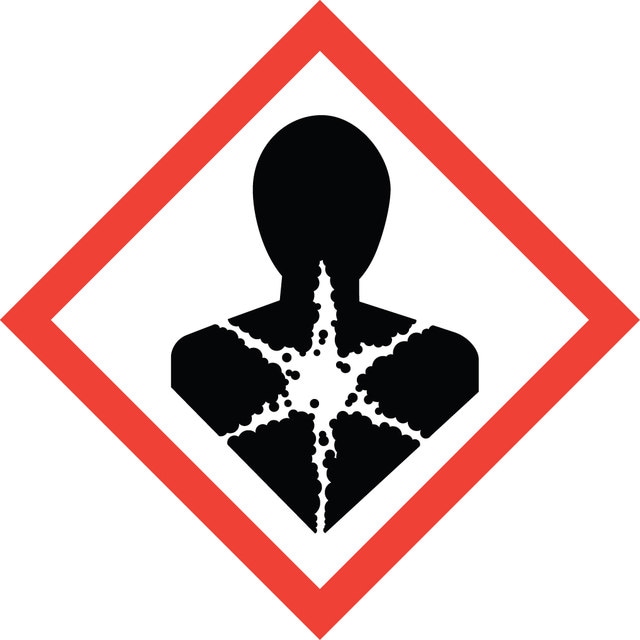

Słowo ostrzegawcze
Warning
Kody zagrożeń
Hazard Classifications
Carc. 2 - Eye Irrit. 2 - Skin Irrit. 2 - STOT SE 3
Narządy docelowe
Respiratory system
Klasa składowania
11 - Combustible Solids
WGK
WGK 3
Temperatura zapłonu (°F)
Not applicable
Temperatura zapłonu (°C)
Not applicable
Wybierz jedną z najnowszych wersji:
Masz już ten produkt?
Dokumenty związane z niedawno zakupionymi produktami zostały zamieszczone w Bibliotece dokumentów.