跳转至内容
Merck

E1895

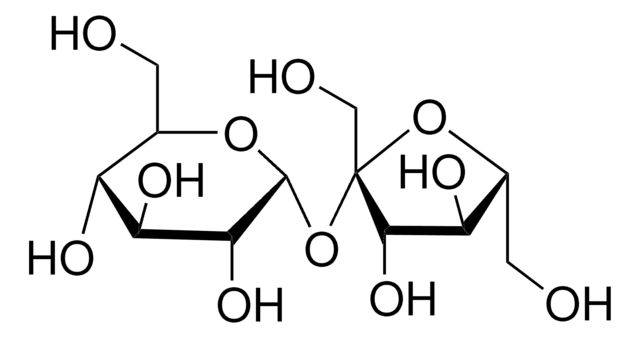
Erlose

≥94% (HPLC)

别名:

α-D-Glc-(1→4)-α-D-Glc-(1→2)-β-D-Fru, α-Maltosyl β-fructofuranoside

登录 查看公司和协议定价

选择尺寸

50 MG

$463.00

$463.00


请联系客服了解存货情况

获取大包装/定制包装报价

关于此项目

经验公式(希尔记法):
C18H32O16
化学文摘社编号:
分子量:
504.44
MDL號碼:
分類程式碼代碼:
12352201
PubChem物質ID:
NACRES:
NA.25

跳至

技术服务
需要帮助?我们经验丰富的科学家团队随时乐意为您服务。
让我们为您提供帮助

生物源

plant

化驗

≥94% (HPLC)

形狀

powder

光學活性

[α]20/D 108.5 to 112.0 °, c = 0.84% (w/v) in water

儲存條件

desiccated

雜質

≤12.5% water (Karl Fischer)

顏色

white to off-white

溶解度

H2O: 50 mg/mL, clear to slightly hazy, colorless to faintly yellow

儲存溫度

−20°C

SMILES 字串

OC[C@H]1O[C@H](O[C@H]2[C@H](O)[C@@H](O)[C@H](O[C@@H]2CO)O[C@]3(CO)O[C@H](CO)[C@@H](O)[C@@H]3O)[C@H](O)[C@@H](O)[C@@H]1O

InChI

1S/C18H32O16/c19-1-5-8(23)10(25)12(27)16(30-5)32-14-7(3-21)31-17(13(28)11(14)26)34-18(4-22)15(29)9(24)6(2-20)33-18/h5-17,19-29H,1-4H2/t5-,6-,7-,8-,9-,10+,11-,12-,13-,14-,15+,16-,17-,18+/m1/s1

InChI 密鑰

FVVCFHXLWDDRHG-KKNDGLDKSA-N

比较类似商品

查看完整比较结果

显示差异

1 of 4

此商品
S4001S8501S5391
biological source

plant

biological source

plant (Stachys tuberifera)

biological source

sugar cane

biological source

sugar cane

assay

≥94% (HPLC)

assay

≥98% (HPLC)

assay

≥99.5% (GC)

assay

≥99.5% (GC)

Quality Level

200

Quality Level

200

Quality Level

300

Quality Level

300

solubility

H2O: 50 mg/mL, clear to slightly hazy, colorless to faintly yellow

solubility

water: 50 mg/mL, clear to very slightly hazy, colorless

solubility

H2O: 0.5 g/mL, clear, colorless to faintly yellow

solubility

H2O: 0.5 g/mL, clear, colorless to faintly yellow

form

powder

form

powder

form

powder

form

powder

storage temp.

−20°C

storage temp.

-

storage temp.

room temp

storage temp.

room temp

應用

Erlose, a triose sugar (trisaccharide), is used in studies on dietary preference and utilization of triose sugars from aphid honeydew by various insects, such as honey bees and ants. Erlose may be used as a reference compound in assays that analyze the sugars of foods such as royal jelly and honey.[1][2]

其他說明

To gain a comprehensive understanding of our extensive range of Oligosaccharides for your research, we encourage you to visit our Carbohydrates Category page.

免責聲明

moisture sensitive

儲存類別代碼

11 - Combustible Solids

水污染物質分類(WGK)

WGK 3

閃點(°F)

Not applicable

閃點(°C)

Not applicable

個人防護裝備

Eyeshields, Gloves, type N95 (US)


历史批次信息供参考:

分析证书(COA)

Lot/Batch Number

没有发现合适的版本?

如果您需要特殊版本,可通过批号或批次号查找具体证书。

已有该产品?

在文件库中查找您最近购买产品的文档。

访问文档库

S Hojo et al.
Infection and immunity, 55(3), 698-703 (1987-03-01)
Resting-cell suspensions of oral microorganisms grown in sucrose were studied for the production of acid from glucosylsucrose and maltosylsucrose. Most oral microorganisms fermented these sugars to only a limited extent. Streptococcus salivarius, however, metabolized glucosylsucrose as well as sucrose. We
Gaëlle Daniele et al.
Food chemistry, 134(2), 1025-1029 (2012-10-31)
A gas chromatographic method was developed to quantify the major and minor sugars of 400 Royal Jellies (RJs). Their contents were compared in relation to the geographical origins and different production methods. A reliable database was established from the analysis
T Taga et al.
Carbohydrate research, 240, 39-45 (1993-02-24)
Erlose [O-beta-D-fructofuranosyl-(1-->2)-O-alpha-D-glucopyranosyl-(1-->4)- alpha-D-glucopyranoside] monohydrate, C18H32O16.H2O, M(r) = 522.45, is orthorhombic, P2(1)2(1)2(1) with a = 30.748 (3), b = 8.757 (1), c = 8.270 (1) A, and Z = 4. The structure was solved by direct methods, and refined to R
Daniela Fischer et al.
The FEBS journal, 273(1), 137-149 (2005-12-22)
Little is known about the structure and function of oligosaccharides in cyanobacteria. In this study, a new class of saccharides from Nostoc was identified by MS and NMR techniques, consisting of alpha-D-glucopyranosyl-(1-->2)-[alpha-D-glucopyranosyl-(1-->2)]n-beta-D-fructofuranosides ranging from the trisaccharide (n = 1) to
Roger Konrad et al.
Journal of insect physiology, 55(12), 1158-1166 (2009-08-25)
Like honey bees (Apis mellifera), non-Apis bees could exploit honeydew as a carbohydrate source. In addition to providing carbohydrates, this may expose them to potentially harmful plant products secreted in honeydew. However, knowledge on honeydew feeding by solitary bees is

Questions

Reviews

No rating value

Active Filters

我们的科学家团队拥有各种研究领域经验,包括生命科学、材料科学、化学合成、色谱、分析及许多其他领域.

联系客户支持