



This product is not tested for salt tolerance, and therefore, data is not available.
DN25

Deoxyribonuclease I from bovine pancreas
lyophilized powder, Protein ≥85 %, ≥400 Kunitz units/mg protein
1 of 3 reviewers took part in a promotion
Synonym(s):
Deoxyribonuclease, DNase I, Deoxyribonucleate 5′-oligonucleotido-hydrolase
Sign In to View Organizational & Contract Pricing.
Select a Size
Change View
| Size/SKU | Availability | Price |
|---|---|---|
10 mg | Estimated to ship TODAYfromSAINT LOUIS | $75.50 |
100 mg | Estimated to ship onOctober 30, 2026fromSAINT LOUIS | $131.00 |
1 g | Estimated to ship TODAYfromSAINT LOUIS | $621.00 |
5 g | Estimated to ship TODAYfromSAINT LOUIS | $2,490.00 |
About This Item
CAS Number:
UNSPSC Code:
12352204
NACRES:
NA.54
EC Number:
232-667-0
MDL number:
EC Number:
Specific activity:
≥400 Kunitz units/mg protein
Biological source:
bovine pancreas
biological source
bovine pancreas
Quality Segment
form
lyophilized powder
specific activity
≥400 Kunitz units/mg protein
mol wt
~31 kDa
composition
Protein, ≥85%
technique(s)
DNA extraction: suitable
input
general use sample(s)
solubility
0.15 M NaCl: soluble 5.0 mg/mL, hazy
suitability
suitable for molecular biology
application(s)
diagnostic assay manufacturing
foreign activity
RNase ≤0.02%
shipped in
wet ice
storage temp.
−20°C
General description
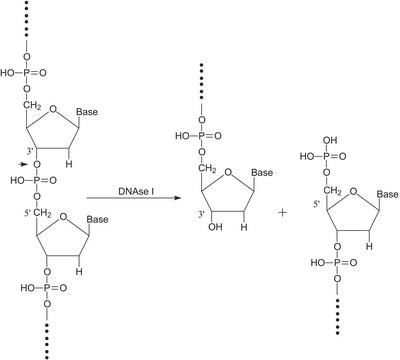
DNase I, or Deoxyribonuclease I, is an endonuclease isolated from bovine pancreas.
- Our DNase I Digests double str and single stranded DNA into oligo and mononucleotides.
- Bovine pancreatic DNase exists as four isozymes, having isoelectric points for A, B, C and D: 5.22, 4.96, 5.06 and 4.78.3. The predominant form is A, with smaller amounts of B and C, and only minor amount of D.
- DNase I structure resembles the structure of to exonuclease III. It includes two central β sheets. Each β sheet is composed of six β-strands. This complex of β sheets is surrounded by extensive loop and α-helical regions. This enzyme shares structural similarity to exonuclease III.
Application
Used for the removal of DNA from protein samples.
- Decreases viscosity providing better yields by removing DNA in primary cell isolation:
- Incorporating labelled bases into DNA: DNA nick
- Radioactive labelling
- Bioprocessing applications: DNA removal
- Eliminating genomic DNA from RNA preparations before RT-PCR
- In vitro transcription
- Nick translation
- DNase footprinting
- Actin regulation of actin polymerization in cells, and cell apoptosis
- UV crosslinking of proteins to nucleic acids
- DNase play a role in the regulation of actin polymerization in cells and is involved in apoptosis process
Biochem/physiol Actions
DNase I is an endonuclease that acts on phosphodiester bonds adjacent to pyrimidines to produce polynucleotides with terminal 5′-phosphates. In the presence of Mg2+, DNAse I cleaves each strand of DNA independently and the cleavage sites are random. Both DNA strands are cleaved at approximately the same site in the presence of Mn2+. Divalent cations such as Mn2+, Ca2+, Co2+, and Zn2+ are activators of the enzyme. A concentration of 5 mM Ca2+ stabilizes the enzyme against proteolytic digestion. The pH optimum is found to be between 7 and 8. DNAse I from bovine pancreas consists of four chromatographically distinguishable components, A, B, C, and D, with their molar ratios being 4:1:1 respectively. Only minor amounts of D are found. 2-Mercaptoethanol, chelators, sodium dodecyl sulfate (SDS) and actin are known to inhibit the enzyme activity.
Features and Benefits
Our Deoxyribonuclease DNAse I,is essentially RNAse free product, which support the product application.
Physical form
Crude preparation, contains calcium chloride
Preparation Note
10 mg/mL solution of DNAse I in 0.15 M NaCl may lose <10% of its activity when stored for a week in aliquots at −20 °C. The same solutions stored in aliquots at 2-8 °C can lose approximately 20% activity. It remains active for up to five hours at 60 °C between pH 5 and 7, and loses activity in <10 minutes at 68 °C. It loses activity at the rate of 6%/hour in acetate buffer (pH 5.0) and tris buffer ((pH 7.2) at 1 mg/mL concentration.
Analysis Note
Protein determined by biuret.
Other Notes
One Kunitz unit will produce a change in A260 of 0.001 per min per mL at pH 5.0 at 25 °C, using DNA, Type I or III, as substrate.
1 of 1
This Item | |||
|---|---|---|---|
| description lyophilized powder, Protein ≥85 %, ≥400 Kunitz units/mg protein | description Type II-S, lyophilized powder, Protein ≥80 %, ≥2,000 units/mg protein | description Type IV, lyophilized powder, ≥2,000 Kunitz units/mg protein | description Type II, lyophilized powder, Protein ≥80 %, ≥2,000 units/mg protein |
| biological source bovine pancreas | biological source bovine pancreas | biological source bovine pancreas | biological source bovine pancreas |
| specific activity ≥400 Kunitz units/mg protein | specific activity ≥2,000 units/mg protein | specific activity ≥2,000 Kunitz units/mg protein | specific activity ≥2,000 units/mg protein |
| technique(s) DNA extraction: suitable | technique(s) DNA purification: suitable | technique(s) DNA purification: suitable | technique(s) DNA extraction: suitable |
| application(s) diagnostic assay manufacturing | application(s) diagnostic assay manufacturing | application(s) diagnostic assay manufacturing | application(s) diagnostic assay manufacturing |
| form lyophilized powder | form lyophilized powder | form lyophilized powder | form lyophilized powder |
| suitability suitable for molecular biology | suitability suitable for molecular biology | suitability suitable for molecular biology | suitability suitable for molecular biology |
Still not finding the right product?
Explore all of our products under Deoxyribonuclease I from bovine pancreas
Signal Word
Danger
Hazard Codes
Precautionary Statements
Hazard Classifications
Resp. Sens. 1
Storage Class
11 - Combustible Solids
Flash Point (°F)
Not applicable
Flash Point (°C)
Not applicable
PPE (personal protective equipment)
Eyeshields, Gloves, type N95 (US)
Choose from one of the most recent versions:
Already Own This Product?
Find documentation for the products that you have recently purchased in the Document Library.
-
What is the salt tolerance of this DNase I?
1 answer-
Helpful?
-
-
I would like to know if this product can be used to eliminate DNA from cells in tissue culture (12 wells chamber slide) before immunofluorescent staining? if it can be used - how?
1 answer-
This product can be used to eliminate DNA from cells in tissue culture. Concentration and incubation time should be optimized based on the specific application.
Helpful?
-
-
HOW CAN I PRESERVE DN25 DILUTED and filtered in culture medium? 4C or -20 C?. It will lose activity?
1 answer-
This product is soluble in 0.15 M NaCl at 5 mg/mL. Solutions prepared at 10 mg/mL in 0.15 M NaCl may lose up to 10% activity when stored for 1 week in aliquots at –20 °C. The same solutions stored in aliquots at 2-8 °C can lose up to 20% activity. Please see the link below to review the product datasheet for additional information:
https://www.sigmaaldrich.com/deepweb/assets/sigmaaldrich/product/documents/233/818/dn25pis-ms.pdfHelpful?
-
-
What is the recommended method for long-term storage of the 1 gram bottle of DN25 in solution?
1 answer-
The user bulletin provides guidance on the storage of DNase I once reconstituted. When stored in aliquots at -20°C, solutions of DNase I at 10 mg/mL in 0.15 M NaCl may lose 10% of activity over a week, while storing the same solutions at 2–8°C can result in a 20% activity loss. Alternatively, maintaining solutions at a minimum concentration of 1 mg protein/mL with 5 mM calcium chloride at -20°C can retain 90% activity for at least a year. Solutions with 0.1 mg protein/mL are less stable and may need gelatin as a stabilizer.
For applications not affected by glycerol, two storage buffer options are available as they do not freeze at -20°C:
• 20 mM sodium acetate (pH 6.5) with 5 mM CaCl2, 0.1 mM phenylmethylsulfonyl fluoride (PMSF), and 50% (v/v) glycerol, containing DNase I at 5 mg/mL.
• 10 mM Tris-HCl (pH 7.5) with 50 mM NaCl, 10 mM MgCl2, 1 mM DTT, and 50% (v/v) glycerol, with DNase I at 2 mg/mL.Helpful?
-
-
Hi I use the DNase during isolation of cells from lung tissue. Do I need to filter the DNase solution before usage?
1 answer-
This is not a sterile product. If sterility is required due to the specific application, solutions may be filter sterilized before use. Please see the link below to review the product datasheet:
https://www.sigmaaldrich.com/deepweb/assets/sigmaaldrich/product/documents/233/818/dn25pis-ms.pdfHelpful?
-
-
I use the DNase when I isolate lung cells from lung. Do I need to filter them before I use? I will culture the isolated lung cells.
1 answer-
Yes, please filter the DNase solution before use in cell culture, preferably with a 0.22 um filter. The powder is not sterilized as provided.
Helpful?
-