
TR0100

Serum Triglyceride Determination Kit
1 kit sufficient for 250 tests
Synonym(s):
Triglyceride and Free Glycerol Kits and Reagents
Sign In to View Organizational & Contract Pricing.
Select a Size
Change View
| Size/SKU | Availability | Price |
|---|---|---|
1 kit | Check Cart for Availability | $2,000.00 |
About This Item
NACRES:
NA.26
UNSPSC Code:
12352202
General description
The Serum Triglyceride Determination Kit is for the quantitative enzymatic measurement of glycerol, true triglycerides, and total triglycerides in serum or plasma at 540 nm. Triglycerides, esters of fatty acids and glycerol,1 do not circulate freely in plasma, but are bound to proteins and transported as macromolecular complexes called lipoproteins.2 Methods for triglyceride determination generally involve enzymatic3 or alkaline4 hydrolysis of triglycerides to glycerol and free fatty acids, followed by either chemical or enzymatic measurement of the glycerol released.
Application
Suitable for the quantitative determination of glycerol, total triglycerides or free triglycerides in serum or plasma
The Serum Triglyceride Determination Kit can be used for the measurement of glycerol, true triglycerides, or total triglycerides in serum or plasma. The procedure involves enzymatic hydrolysis by lipase of the triglycerides to glycerol and free fatty acids. The glycerol produced is then measured by coupled enzyme reactions. Many of the triglyceride reagents which are commercially available, do not differentiate between endogenous glycerol and glycerol derived by hydrolytic action of lipase on glycerides.
Triglycerides are first hydrolyzed by lipoprotein lipase to glycerol and free fatty acids. Glycerol is then phosphorylated by adenosine-5′-triphosphate (ATP) forming glycerol-1-phosphate (G-1-P) and adenosine-5′-diphosphate (ADP) in the reaction catalyzed by glycerol kinase (GK). G-1-P is then oxidized by glycerol phosphate oxidase (GPO) to dihydroxy-acetone phosphate (DAP) and hydrogen peroxide (H2O2). Peroxidase (POD) catalyzes the coupling of H2O2 with 4-aminoantipyrine (4-AAP) and sodium
N-ethyl-N-(3-sulfopropyl) m-anisidine (ESPA) to produce a quinoneimine dye that shows an absorbance maximum at 540 nm. The increase in absorbance at 540 nm is directly proportional to triglyceride concentration of the sample.
Triglycerides are first hydrolyzed by lipoprotein lipase to glycerol and free fatty acids. Glycerol is then phosphorylated by adenosine-5′-triphosphate (ATP) forming glycerol-1-phosphate (G-1-P) and adenosine-5′-diphosphate (ADP) in the reaction catalyzed by glycerol kinase (GK). G-1-P is then oxidized by glycerol phosphate oxidase (GPO) to dihydroxy-acetone phosphate (DAP) and hydrogen peroxide (H2O2). Peroxidase (POD) catalyzes the coupling of H2O2 with 4-aminoantipyrine (4-AAP) and sodium
N-ethyl-N-(3-sulfopropyl) m-anisidine (ESPA) to produce a quinoneimine dye that shows an absorbance maximum at 540 nm. The increase in absorbance at 540 nm is directly proportional to triglyceride concentration of the sample.
The triglyceride and free glycerol kits are for the quantitative determination of glycerol, total triglycerides or free triglycerides.
Biochem/physiol Actions
The Serum Triglyceride Determination Kit can be used for the measurement of glycerol, true triglycerides, or total triglycerides in serum or plasma. The procedure involves enzymatic hydrolysis by lipase of the triglycerides to glycerol and free fatty acids. The glycerol produced is then measured by coupled enzyme reactions. Many of the triglyceride reagents which are commercially available, do not differentiate between endogenous glycerol and glycerol derived by hydrolytic action of lipase on glycerides. Triglycerides are first hydrolyzed by lipoprotein lipase to glycerol and free fatty acids. Glycerol is then phosphorylated by adenosine-5′-triphosphate (ATP) forming glycerol-1-phosphate (G-1-P) and adenosine-5′-diphosphate (ADP) in the reaction catalyzed by glycerol kinase (GK). G-1-P is then oxidized by glycerol phosphate oxidase (GPO) to dihydroxy-acetone phosphate (DAP) and hydrogen peroxide (H2O2). Peroxidase (POD) catalyzes the coupling of H2O2 with 4-aminoantipyrine (4-AAP) and sodium N-ethyl-N-(3-sulfopropyl) m-anisidine (ESPA) to produce a quinoneimine dye that shows an absorbance maximum at 540 nm. The increase in absorbance at 540 nm is directly proportional to triglyceride concentration of the sample.
Packaging
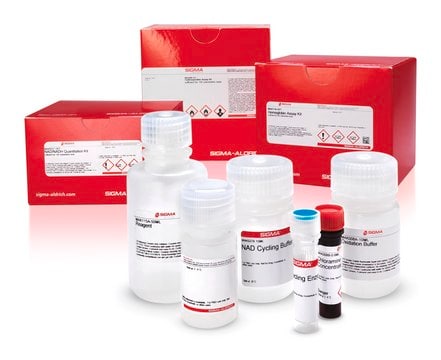
The kit also includes sufficient reagent for an additional 250 free glyceride tests for true triglyceride determination.
Other Notes
In addition to kits, the individual reagents and glycerol standard are available separately when fewer reactions are needed.
1 of 1
This Item | |||
|---|---|---|---|
| description 1 kit sufficient for 250 tests | description 1 kit sufficient for 1000 reactions | description This Rat / Mouse FGF-21 ELISA Kit is used to measure & quantify FGF-21 levels in Metabolism & Inflammation & Immunology research. | description - |
| usage kit sufficient for 250 tests | usage kit sufficient for 1000 reactions | usage - | usage - |
| storage temp. 2-8°C | storage temp. 2-8°C | storage temp. 2-8°C | storage temp. −20°C |
| Quality Level 200 | Quality Level 200 | Quality Level 200 | Quality Level 200 |





signalword
Danger
hcodes
Hazard Classifications
Acute Tox. 4 Oral - Aquatic Acute 1 - Aquatic Chronic 1 - Eye Dam. 1 - Skin Irrit. 2
Storage Class
11 - Combustible Solids
flash_point_f
Not applicable
flash_point_c
Not applicable
Choose from one of the most recent versions:
Already Own This Product?
Find documentation for the products that you have recently purchased in the Document Library.