



If this product has an expiration or retest date, it will be shown on the Certificate of Analysis (COA, CofA). If there is no retest or expiration date listed on the product's COA, we do not have suitable stability data to determine a shelf life. For these products, the only date on the COA will be the release date; a retest, expiration, or use-by-date will not be displayed.
For all products, we recommend handling per defined conditions as printed in our product literature and website product descriptions. We recommend that products should be routinely inspected by customers to ensure they perform as expected.
For products without retest or expiration dates, our standard warranty of 1 year from the date of shipment is applicable.
For more information, please refer to the Product Dating Information document: https://www.sigmaaldrich.com/deepweb/assets/sigmaaldrich/marketing/global/documents/418/501/product-dating-information-06-25-mk.pdf
71725

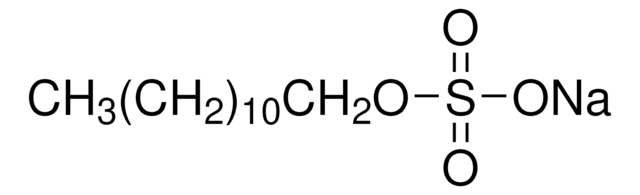
Sodium dodecyl sulfate

BioUltra, Molecular Biology, ≥99.0% (GC)
Synonym(s):
Dodecyl sodium sulfate, Dodecyl sulfate sodium salt, Lauryl sulfate sodium salt, SDS, Sodium lauryl sulfate
Select a Size
$140.00
$230.00
$893.00
About This Item
Skip To
Product Name
Sodium dodecyl sulfate, BioUltra, Molecular Biology, ≥99.0% (GC)
InChI key
DBMJMQXJHONAFJ-UHFFFAOYSA-M
InChI
1S/C12H26O4S.Na/c1-2-3-4-5-6-7-8-9-10-11-12-16-17(13,14)15;/h2-12H2,1H3,(H,13,14,15);/q;+1/p-1
SMILES string
[Na+].CCCCCCCCCCCCOS([O-])(=O)=O
grade
Molecular Biology
description
anionic
product line
BioUltra
assay
≥99.0% (GC)
form
powder
mol wt
micellar avg mol wt 18,000
Quality Level
greener alternative product characteristics
Catalysis
Learn more about the Principles of Green Chemistry.
sustainability
Greener Alternative Product
aggregation number
62
impurities
DNases, none detected
RNases, none detected
insoluble matter, passes filter test
phosphatases, none detected
proteases, none detected
loss
≤3% loss on drying, 20 °C (HV)
CMC
7-10 mM (20-25°C)
mp
204-207 °C (lit.)
transition temp
cloud point >100 °C
solubility
H2O: 0.1 M at 20 °C, clear, colorless
density
0.455 g/cm3
anion traces
chloride (Cl-): ≤200 mg/kg
phosphate (PO43-): ≤1 mg/kg
cation traces
Al: ≤5 mg/kg
Ba: ≤5 mg/kg
Bi: ≤5 mg/kg
Ca: ≤10 mg/kg
Cd: ≤5 mg/kg
Co: ≤5 mg/kg
Cr: ≤5 mg/kg
Cu: ≤5 mg/kg
Fe: ≤5 mg/kg
K: ≤200 mg/kg
Li: ≤5 mg/kg
Mg: ≤5 mg/kg
Mn: ≤5 mg/kg
Mo: ≤5 mg/kg
Ni: ≤5 mg/kg
Pb: ≤5 mg/kg
Sr: ≤5 mg/kg
Zn: ≤5 mg/kg
λ
0.1 M in H2O
UV absorption
λ: 260 nm Amax: 0.04
λ: 280 nm Amax: 0.02
HLB
40
suitability
suitable for electrophoresis
greener alternative category
Looking for similar products? Visit Product Comparison Guide
1 of 4
This Item | L6026 | 428023 | 62862 |
|---|---|---|---|
| grade for molecular biology | grade - | grade Molecular Biology | grade - |
| suitability suitable for electrophoresis | suitability - | suitability - | suitability - |
| form powder | form powder | form solid | form - |
| assay ≥99.0% (GC) | assay ≥99.0% (GC) | assay ≥99% | assay ≥90% ((Assay)) |
| aggregation number 62 | aggregation number 62 | aggregation number - | aggregation number - |
| CMC 7-10 mM (20-25°C) | CMC 7-10 mM (20-25°C) | CMC - | CMC - |
Application
- as an ionic surfactant in polystyrene (PS) particle suspension for surfactant-based experiments
- in phosphate-buffered saline as a component of lysis buffer to homogenize myometrium and leiomyoma tissue
- as a component of lysis buffer to dissolve formazans
- as a component of high-salt nuclear extraction buffer
Biochem/physiol Actions
Features and Benefits
- Suitable for molecular biology and biochemical research
- BioUltra grade for your sensitive applications
- Free from DNase, RNase, NICKase and protease
- Tested for trace levels of Anions and Cations
- Tested to confirm low levels of heavy metal contamination, ensuring suitability for various applications
- Undergoes hydrolysis at high temperatures, especially in acidic medium
General description
In protein biochemistry, SDS plays a pivotal role in protein extraction and SDS-PAGE (sodium dodecyl sulfate-polyacrylamide gel electrophoresis). Its ability to denature proteins by disrupting their secondary and tertiary structures allows for their uniform migration during gel electrophoresis, enabling the separation and analysis of proteins based on their molecular weight. This technique has become an indispensable tool for identifying and characterizing proteins in biological samples.
Beyond its role in protein analysis, SDS also finds utility in nucleic acid extraction and various hybridization techniques. Its detergent properties aid in the lysis of cells and the release of nucleic acids, facilitating their subsequent purification and analysis. Additionally, SDS is employed in hybridization techniques to promote the annealing of complementary nucleic acid strands, enabling the detection and analysis of specific DNA or RNA sequences.
Other Notes
comparable product
signalword
Danger
Hazard Classifications
Acute Tox. 4 Inhalation - Acute Tox. 4 Oral - Aquatic Chronic 3 - Eye Dam. 1 - Flam. Sol. 2 - Skin Irrit. 2 - STOT SE 3
target_organs
Respiratory system
Storage Class
4.1B - Flammable solid hazardous materials
wgk
WGK 2
flash_point_f
338.0 °F
flash_point_c
170 °C
ppe
Eyeshields, Faceshields, Gloves, type P3 (EN 143) respirator cartridges
Choose from one of the most recent versions:
Already Own This Product?
Find documentation for the products that you have recently purchased in the Document Library.
Related Content
-
How can I determine the shelf life / expiration / retest date of this product?
1 answer-
Helpful?
-
-
How is shipping temperature determined? And how is it related to the product storage temperature?
1 answer-
Products may be shipped at a different temperature than the recommended long-term storage temperature. If the product quality is sensitive to short-term exposure to conditions other than the recommended long-term storage, it will be shipped on wet or dry-ice. If the product quality is NOT affected by short-term exposure to conditions other than the recommended long-term storage, it will be shipped at ambient temperature. As shipping routes are configured for minimum transit times, shipping at ambient temperature helps control shipping costs for our customers. For more information, please refer to the Storage and Transport Conditions document: https://www.sigmaaldrich.com/deepweb/assets/sigmaaldrich/marketing/global/documents/316/622/storage-transport-conditions-mk.pdf
Helpful?
-
Active Filters
Our team of scientists has experience in all areas of research including Life Science, Material Science, Chemical Synthesis, Chromatography, Analytical and many others.
Contact Technical Service