Passa al contenuto
Merck

05-1049

Anti-Met (extracellular) Antibody, clone 4F8.2

clone 4F8.2, from mouse

Sinonimo/i:

HGF receptor, HGF/SF receptor, Met proto-oncogene tyrosine kinase, SF receptor, Scatter factor receptor, met proto-oncogene, met proto-oncogene (hepatocyte growth factor receptor), oncogene MET

Autenticatiper visualizzare i prezzi riservati alla tua organizzazione & contrattuali

Scegli un formato

100 μG
CHF 391.00

CHF 391.00


Per conoscere la disponibilità, visualizza il carrello
Per il tuo target è disponibile un anticorpo ricombinante privo di conservanti. Prova ZRB1858

Richiedi un ordine in blocco

Informazioni su questo articolo

Codice UNSPSC:
12352203
eCl@ss:
32160702
NACRES:
NA.41

Vai a

Servizio Tecnico
Hai bisogno di aiuto? Il nostro team di scienziati qualificati è a tua disposizione.
Permettici di aiutarti

Origine biologica

mouse

Livello qualitativo

Coniugato

unconjugated

Forma dell’anticorpo

purified antibody

Tipo di anticorpo

primary antibodies

Clone

4F8.2, monoclonal

Reattività contro le specie

human

tecniche

immunohistochemistry: suitable (paraffin)
western blot: suitable

Isotipo

IgG2bκ

N° accesso NCBI

N° accesso UniProt

Condizioni di spedizione

wet ice

modifica post-traduzionali bersaglio

unmodified

Informazioni sul gene

human ... MET(4233)

Categorie correlate

Confronta articoli simili

Visualizza il confronto per intero

Mostra le differenze

1 of 4

Questo articolo
07-81007-807SAB4501868
antibody form

purified antibody

antibody form

affinity purified immunoglobulin

antibody form

affinity purified immunoglobulin

antibody form

affinity isolated antibody

biological source

mouse

biological source

rabbit

biological source

rabbit

biological source

rabbit

species reactivity

human

species reactivity

mouse, human

species reactivity

human

species reactivity

human

clone

4F8.2, monoclonal

clone

polyclonal

clone

polyclonal

clone

polyclonal

Gene Information

human ... MET(4233)

Gene Information

human ... MET(4233)
mouse ... Met(17295)
rat ... Met(24553)

Gene Information

human ... MET(4233)

Gene Information

human ... MET(4233)

UniProt accession no.

P08581

UniProt accession no.

P08581

UniProt accession no.

P08581

UniProt accession no.

P08581

Descrizione generale

170 kDa
The proto-oncogene Met (c-Met, HGF/SF Receptor, HGFR) is a receptor tyrosine kinase that is activated upon Hepatocyte Growth Factor (HGF) binding. This stimulates the autophosphorylation on Tyr1234/Tyr1235 which leads to pleiotropic downstream signaling events in epithelial cells that stimulate multiple cellular processes including cell proliferation, growth, differentiation, cell migration/ invasion, and tumorigenesis. These effects are mediated by SH2 domain-containing proteins that bind to the C-terminal tail of c-Met. Chronic stimulation of Met on cancer cells is thought to play a role in metastasis and dysregulation of c-Met activity is directly associated with oncogenesis, making it an important cancer target.

Immunogeno

Epitope: Extracelluar domain (N-term)
GST-fusion protein corresponding to amino acids 80-434 of human Met.

Applicazioni

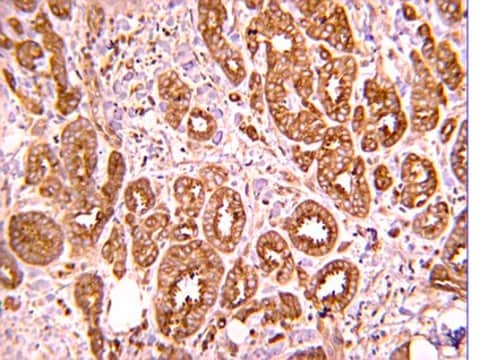
Detect Met (extracellular) using this Anti-Met (extracellular) Antibody, clone 4F8.2 validated for use in IH(P) & WB.
Research Category
Signaling
Research Sub Category
Growth Factors & Receptors
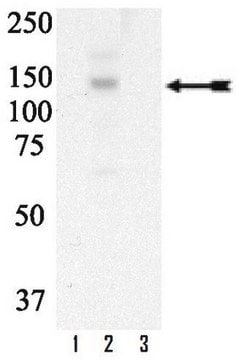
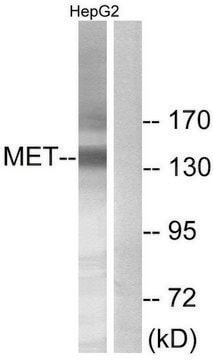
Western Blot Analysis:
This lot detected Met at 1:1,000 dilution in HEK293 cell lysate resolved via SDS-PAGE and transferred to PVDF.

Immunohistochemistry Analysis :

Azioni biochim/fisiol

Detects Met on its extracellular domain.

Stato fisico

Format: Purified
Protein G Purified
Purified mouse monoclonal in 0.1M Tris-Glycine (pH7.4), 150mM NaCl with 0.05% NaN3.

Nota sulla preparazione

Stable for 1 year at 2-8°C from date of receipt.
Handling Recommendations: Upon receipt, and prior to removing the cap, centrifuge the vial and gently mix the solution.

Risultati analitici

Routinely evaluated by Western Blot.

Western Blot Analysis:
This lot detected Met at 1:1,000 dilution in HEK293 cell lysate resolved via SDS-PAGE and transferred to PVDF.

Altre note

Concentration: Please refer to the Certificate of Analysis for the lot-specific concentration.
Replaces: 05-237

Esclusione di responsabilità

Unless otherwise stated in our catalog or other company documentation accompanying the product(s), our products are intended for research use only and are not to be used for any other purpose, which includes but is not limited to, unauthorized commercial uses, in vitro diagnostic uses, ex vivo or in vivo therapeutic uses or any type of consumption or application to humans or animals.

Non trovi il prodotto giusto?  

Prova il nostro Motore di ricerca dei prodotti.

Codice della classe di stoccaggio

12 - Non Combustible Liquids

Classe di pericolosità dell'acqua (WGK)

WGK 1

Punto d’infiammabilità (°F)

Not applicable

Punto d’infiammabilità (°C)

Not applicable


Certificati d'analisi (COA)

Cerca il Certificati d'analisi (COA) digitando il numero di lotto/batch corrispondente. I numeri di lotto o di batch sono stampati sull'etichetta dei prodotti dopo la parola ‘Lotto’ o ‘Batch’.

Possiedi già questo prodotto?

I documenti relativi ai prodotti acquistati recentemente sono disponibili nell’Archivio dei documenti.

Visita l’Archivio dei documenti

Charles Finsterwald et al.
The European journal of neuroscience, 34(7), 1053-1061 (2011-09-08)
Acquisition of a mature dendritic morphology is critical for neural information processing. In particular, hepatocyte growth factor (HGF) controls dendritic arborization during brain development. However, the cellular mechanisms underlying the effects of HGF on dendritic growth remain elusive. Here, we
Ilia Atanelishvili et al.
PloS one, 11(9), e0162357-e0162357 (2016-09-02)
Pulmonary fibrosis represents the terminal stage of a diverse group of lung diseases including scleroderma associated interstitial lung disease. The molecular mechanisms underlying the pathogenesis of lung fibrosis are not well understood and there is a great need for more
Christopher C Phelps et al.
Infection and immunity, 86(10) (2018-08-01)
Listeria monocytogenes is a facultative intracellular pathogen that infects a wide variety of cells, causing the life-threatening disease listeriosis. L. monocytogenes virulence factors include two surface invasins, InlA and InlB, known to promote bacterial uptake by host cells, and the
Nolan L Boyd et al.
Tissue engineering. Part A, 19(1-2), 211-223 (2012-09-14)
The microvasculature is principally composed of two cell types: endothelium and mural support cells. Multiple sources are available for human endothelial cells (ECs) but sources for human microvascular mural cells (MCs) are limited. We derived multipotent mesenchymal progenitor cells from

Questions

Reviews

No rating value

Active Filters

Il team dei nostri ricercatori vanta grande esperienza in tutte le aree della ricerca quali Life Science, scienza dei materiali, sintesi chimica, cromatografia, discipline analitiche, ecc..

Contatta l'Assistenza Tecnica