Direkt zum Inhalt
Merck

47733-U

2-Hexanon

analytical standard

Synonym(e):

Butyl-methylketon

Anmelden zur Ansicht der Organisations- und Vertragspreise.

Größe auswählen

Preise und Verfügbarkeit sind derzeit nicht verfügbar.

Über diesen Artikel

Lineare Formel:
CH3(CH2)3COCH3
CAS-Nummer:
Molekulargewicht:
100.16
UNSPSC Code:
77101502
NACRES:
NA.24
PubChem Substance ID:
EC Number:
209-731-1
Beilstein/REAXYS Number:
1737676
MDL number:

Fortfahren mit

Technischer Dienst
Benötigen Sie Hilfe? Unser Team von erfahrenen Wissenschaftlern ist für Sie da.
Unterstützung erhalten

Produktname

2-Hexanon, analytical standard

InChI key

QQZOPKMRPOGIEB-UHFFFAOYSA-N

InChI

1S/C6H12O/c1-3-4-5-6(2)7/h3-5H2,1-2H3

SMILES string

CCCCC(C)=O

grade

analytical standard

agency

ASTM® D5580

vapor pressure

10 mmHg ( 39 °C)

CofA

current certificate can be downloaded

packaging

pkg of 5 mL

technique(s)

HPLC: suitable
gas chromatography (GC): suitable

refractive index

n20/D 1.401 (lit.)

bp

127 °C (lit.)

mp

−57 °C (lit.)

density

0.812 g/mL at 25 °C (lit.)

application(s)

cleaning products
cosmetics
food and beverages
personal care
petroleum

format

neat

storage temp.

2-30°C

Quality Level

Suchen Sie nach ähnlichen Produkten? Aufrufen Leitfaden zum Produktvergleich

Ähnliche Artikel vergleichen

Vollständigen Vergleich anzeigen

Unterschiede anzeigen

1 of 4

Dieser Artikel
02473103004W329002
2-Hexanon analytical standard

Supelco

02473

2-Hexanon

application(s)

cleaning products
cosmetics
food and beverages
personal care
petroleum

application(s)

cleaning products
cosmetics
environmental
food and beverages
personal care

application(s)

-

application(s)

flavors and fragrances

technique(s)

HPLC: suitable, gas chromatography (GC): suitable

technique(s)

HPLC: suitable, gas chromatography (GC): suitable

technique(s)

-

technique(s)

-

format

neat

format

neat

format

-

format

-

Quality Level

100

Quality Level

100

Quality Level

100

Quality Level

400

grade

analytical standard

grade

analytical standard

grade

reagent grade

grade

-

storage temp.

2-30°C

storage temp.

-

storage temp.

-

storage temp.

-

Application

2-Hexanone may be used as an analytical reference standard for the quantification of the analyte in biological samples using liquid chromatography−tandem mass spectrometry (LC−MS−MS).[1]
Refer to the product′s Certificate of Analysis for more information on a suitable instrument technique. Contact Technical Service for further support.

General description

2-Hexanone is a colorless to pale yellow liquid with sharp odor belonging to the class of ketones. It is obtained as a waste product of coal gasification, oil shale operations and wood pulping. It is widely used as a solvent in industry.[2]

Legal Information

ASTM is a registered trademark of American Society for Testing and Materials

signalword

Danger

Hazard Classifications

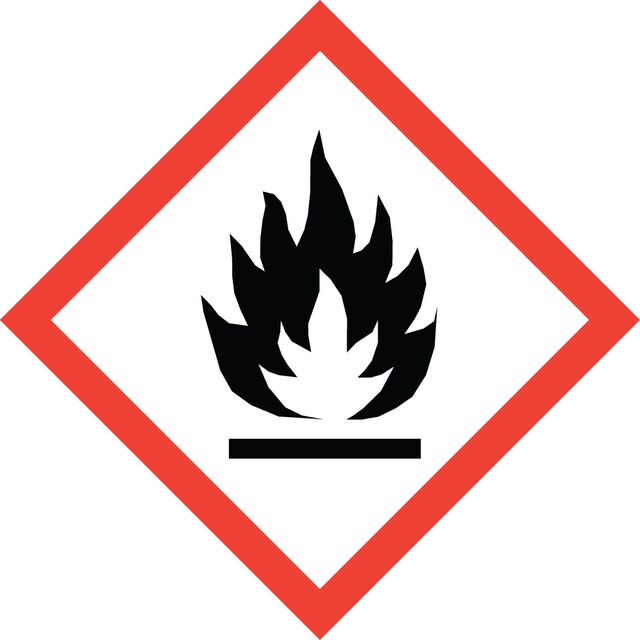
Flam. Liq. 3 - Repr. 2 - STOT RE 1 - STOT SE 3

target_organs

Central nervous system

Lagerklasse

3 - Flammable liquids

wgk

WGK 1

flash_point_f

73.4 °F - closed cup

flash_point_c

23 °C - closed cup

ppe

Eyeshields, Faceshields, Gloves, type ABEK (EN14387) respirator filter


Hier finden Sie alle aktuellen Versionen:

Analysenzertifikate (COA)

Lot/Batch Number

Die passende Version wird nicht angezeigt?

Wenn Sie eine bestimmte Version benötigen, können Sie anhand der Lot- oder Chargennummer nach einem spezifischen Zertifikat suchen.

Besitzen Sie dieses Produkt bereits?

In der Dokumentenbibliothek finden Sie die Dokumentation zu den Produkten, die Sie kürzlich erworben haben.

Die Dokumentenbibliothek aufrufen

Handbook of Chemicals and Safety (2016)
Application of liquid chromatography-mass spectrometry to biomonitoring of exposure to industrial chemicals
Manini P, et al.
Toxicology Letters, 162(2-3), 202-210 (2006)
Y Lolin
Human toxicology, 8(4), 293-300 (1989-07-01)
1. The main neurological disorders associated with chronic VSA are peripheral neuropathy, cerebellar disease, chronic encephalopathy and dementia. Apart from peripheral neuropathy, the clinical features are non-specific, evidence for solvent-related toxicity is in most cases circumstantial and there is no
J W Griffin
Neurobehavioral toxicology and teratology, 3(4), 437-444 (1981-01-01)
The neurotoxicity of hexacarbon solvents has become apparent only recently, but an extensive literature has already developed as a result of the clinical and epidemiological implications of the human disease, and the advantages of small animal models of hexacarbon neurotoxicity
Bo Sahlberg et al.
The Science of the total environment, 444, 433-440 (2013-01-03)
There are few studies on associations between airborne microbial exposure, formaldehyde, plasticizers in dwellings and the symptoms compatible with the sick building syndrome (SBS). As a follow-up of the European Community Respiratory Health Survey (ECRHS II), indoor measurements were performed

Fragen

Bewertungen

Kein Beurteilungswert

Aktive Filter

Unser Team von Wissenschaftlern verfügt über Erfahrung in allen Forschungsbereichen einschließlich Life Science, Materialwissenschaften, chemischer Synthese, Chromatographie, Analytik und vielen mehr..

Setzen Sie sich mit dem technischen Dienst in Verbindung