Skip to Content
Merck

538205

Isobutyraldehyde

dry, 98%

Synonym(s):

2-Methylpropanal, 2-Methylpropionaldehyde

Sign In to View Organizational & Contract Pricing

Select a Size

Pricing and availability is not currently available.

About This Item

Linear Formula:
(CH3)2CHCHO
CAS Number:
Molecular Weight:
72.11
Beilstein:
605330
EC Number:
MDL number:
UNSPSC Code:
12352100
PubChem Substance ID:
NACRES:
NA.22

Skip To

Technical Service
Need help? Our team of experienced scientists is here for you.
Let Us Assist

vapor density

2.5 (vs air)

vapor pressure

66 mmHg ( 4.4 °C)

Assay

98%

autoignition temp.

384 °F

expl. lim.

10 %, 25 °F
2 %, 32 °F

refractive index

n20/D 1.374 (lit.)

bp

63 °C (lit.)

mp

−65 °C (lit.)

solubility

60 g/L at 25 °C

density

0.79 g/mL at 25 °C (lit.)

functional group

aldehyde

storage temp.

2-8°C

SMILES string

[H]C(=O)C(C)C

InChI

1S/C4H8O/c1-4(2)3-5/h3-4H,1-2H3

InChI key

AMIMRNSIRUDHCM-UHFFFAOYSA-N

Looking for similar products? Visit Product Comparison Guide

Compare Similar Items

View Full Comparison

Show Differences

1 of 4

This Item
W222003240788W222011
assay

98%

assay

≥98%

assay

≥99%

assay

96%

Quality Level

200

Quality Level

400

Quality Level

200

Quality Level

400

solubility

60 g/L at 25 °C

solubility

60 g/L at 25 °C

solubility

water: soluble 11g/100mL at 20 °C(lit.), acetone: miscible(lit.), benzene: miscible(lit.), carbon disulfide: miscible(lit.), chloroform: miscible(lit.), diethyl ether: miscible(lit.), ethanol: miscible(lit.), toluene: miscible(lit.)

solubility

60 g/L at 25 °C

refractive index

n20/D 1.374 (lit.)

refractive index

n20/D 1.374 (lit.)

refractive index

n20/D 1.374 (lit.)

refractive index

n20/D 1.374 (lit.)

density

0.79 g/mL at 25 °C (lit.)

density

0.79 g/mL at 25 °C (lit.)

density

0.79 g/mL at 25 °C (lit.)

density

0.79 g/mL at 25 °C (lit.)

mp

−65 °C (lit.)

mp

−65 °C (lit.)

mp

−65 °C (lit.)

mp

−65 °C (lit.)

General description

Isobutyraldehyde is an α,α-disubstituted aldehyde.[1] It is an important raw material for the manufacture of various industrially important chemicals. It may be produced from CO2 and overexpression of ribulose 1,5-bisphosphate carboxylase/oxygenase employing genetically engineered strain of Synechococcus elongatus PCC7942.[2] Enantioenriched γ-nitroaldehydes are obtained from the conjugate addition reaction between isobutyraldehyde with nitroalkenes in the presence of chiral organocatalysts.[3]

Application

Isobutyraldehyde may be used in the synthesis of the following compounds:
  • N-cyclohrxyl-α-dimethylaminoisovalerarnide[1]
  • N′-cyclohexyl-N,N-dimethyl-α-dimethylaminoisovaleramidine[1]
  • α-acetoxy-N-cyclohexylisovaleramide[1]
  • acetic anhydride[1]
  • N-cyclohexyl-a-formyloxyisovaleramide[1]
  • cyclic carbonates[4]
  • hydroxypivaldehyde, which is useful for the preparation of neopentyl glycol (NPG)[5]
It may also be employed for the microbial synthesis of isobutanol.[6]

Pictograms

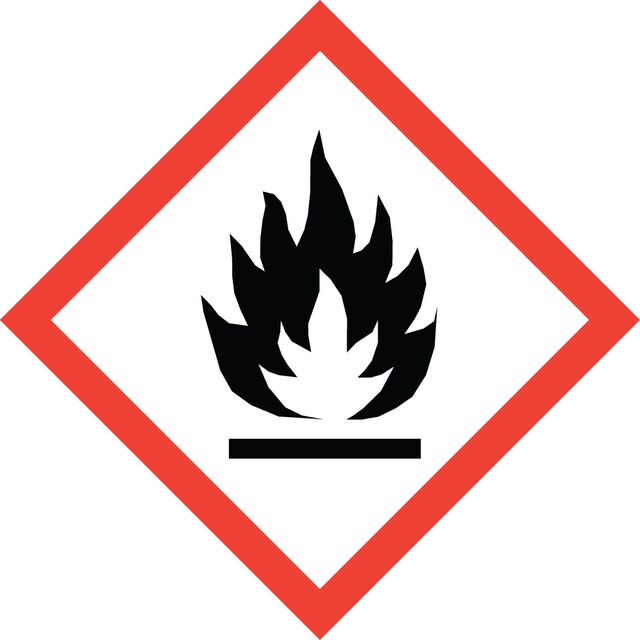
FlameExclamation mark

Signal Word

Danger

Hazard Statements

Hazard Classifications

Eye Irrit. 2 - Flam. Liq. 2

Storage Class Code

3 - Flammable liquids

WGK

WGK 1

Flash Point(F)

-11.2 °F - closed cup

Flash Point(C)

-24 °C - closed cup

Personal Protective Equipment

dust mask type N95 (US), Eyeshields, Gloves

Choose from one of the most recent versions:

Certificates of Analysis (COA)

Lot/Batch Number

Don't see the Right Version?

If you require a particular version, you can look up a specific certificate by the Lot or Batch number.

Already Own This Product?

Find documentation for the products that you have recently purchased in the Document Library.

Visit the Document Library

Enantioselective Michael addition of isobutyraldehyde to nitroalkenes organocatalyzed by chiral primary amine-guanidines.
Avila A, et al.
Tetrahedron Asymmetry, 25(5), 462-467 (2014)
Cross-Aldol condensation of isobutyraldehyde and formaldehyde using phase transfer catalyst.
Hashmi A.
Journal of Saudi Chemical Society (2013)
Reactions of cyclohexylisonitrile and isobutyraldehyde with various nucleophiles and catalysts.
McFarland JW.
The Journal of Organic Chemistry, 28(9), 2179-2181 (1963)
Xiang Liu et al.
Journal of biotechnology, 164(2), 188-195 (2012-09-15)
We have determined the X-ray crystal structures of the NADH-dependent alcohol dehydrogenase LlAdhA from Lactococcus lactis and its laboratory-evolved variant LlAdhA(RE1) at 1.9Å and 2.5Å resolution, respectively. LlAdhA(RE1), which contains three amino acid mutations (Y50F, I212T, and L264V), was engineered
Bettina M Pause et al.
Psychophysiology, 40(2), 209-225 (2003-06-25)
The aim of the present study was to investigate the similarities and differences in the olfactory and visual processing of emotional stimuli in healthy subjects and in patients with major depressive disorder (MDD). Twenty-five inpatients were investigated after admission to

Questions

Reviews

No rating value

Active Filters

Our team of scientists has experience in all areas of research including Life Science, Material Science, Chemical Synthesis, Chromatography, Analytical and many others.

Contact Technical Service