
27487

Citric acid
BioUltra, anhydrous, ≥99.5% (T)
Select a Size
About This Item
Skip To
Product Name
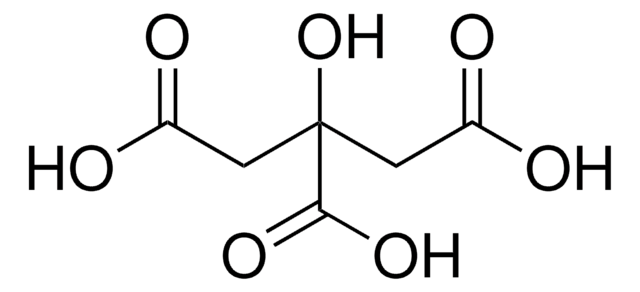
Citric acid, BioUltra, anhydrous, ≥99.5% (T)
InChI
1S/C6H8O7/c7-3(8)1-6(13,5(11)12)2-4(9)10/h13H,1-2H2,(H,7,8)(H,9,10)(H,11,12)
InChI key
KRKNYBCHXYNGOX-UHFFFAOYSA-N
SMILES string
OC(=O)CC(O)(CC(O)=O)C(O)=O
grade
biotech. grade
product line
BioUltra
assay
≥99.5% (T)
form
powder or crystals
expl. lim.
8 %, 65 °F
technique(s)
cell culture | hybridoma: suitable
impurities
insoluble matter, passes filter test
ign. residue
≤0.05% (as SO4)
loss
≤0.5% loss on drying, 110 °C
pH
1.0-2.0 (25 °C, 1 M in H2O)
pKa
(1) 3.13, (2) 4.76, (3) 6.4
mp
153-159 °C (lit.)
solubility
H2O: 1 M at 20 °C, clear, colorless
anion traces
chloride (Cl-): ≤5 mg/kg
oxalate (C2O42-): ≤0.05%
phosphate (PO43-): ≤5 mg/kg
sulfate (SO42-): ≤20 mg/kg
tartrate (C4H4O62-): ≤0.20%
cation traces
Al: ≤5 mg/kg
As: ≤0.1 mg/kg
Ba: ≤5 mg/kg
Bi: ≤5 mg/kg
Ca: ≤10 mg/kg
Cd: ≤5 mg/kg
Co: ≤5 mg/kg
Cr: ≤5 mg/kg
Cu: ≤5 mg/kg
Fe: ≤5 mg/kg
K: ≤50 mg/kg
Li: ≤5 mg/kg
Mg: ≤5 mg/kg
Mn: ≤5 mg/kg
Mo: ≤5 mg/kg
Na: ≤50 mg/kg
Ni: ≤5 mg/kg
Pb: ≤5 mg/kg
Sr: ≤5 mg/kg
Zn: ≤5 mg/kg
λmax
260 nm (Amax: ≤0.20)
280 nm (Amax: ≤0.10)
λ
1 M in H2O
UV absorption
λ: 260 nm Amax: 0.20
λ: 280 nm Amax: 0.10
Quality Level
Gene Information
human ... SRC(6714)
Looking for similar products? Visit Product Comparison Guide
Related Categories
1 of 4
This Item | 251275 | C2404 | W230618 |
|---|---|---|---|
| assay ≥99.5% (T) | assay ≥99.5% | assay ≥97% (GC) | assay ≥99.5% |
| Quality Level 200 | Quality Level 200 | Quality Level 200 | Quality Level 400 |
| form powder or crystals | form crystals | form powder | form powder or granules |
| pH 1.0-2.0 (25 °C, 1 M in H2O) | pH - | pH 1.8 (25 °C, 50 g/L) | pH - |
| solubility H2O: 1 M at 20 °C, clear, colorless | solubility - | solubility water: 50 mg/mL, clear to very slightly hazy, colorless | solubility water: 383 g/L at 25 °C |
| cation traces Al: ≤5 mg/kg, Ba: ≤5 mg/kg, Ca: ≤10 mg/kg, Co: ≤5 mg/kg, Cu: ≤5 mg/kg, K: ≤50 mg/kg, Mg: ≤5 mg/kg, Mo: ≤5 mg/kg, Ni: ≤5 mg/kg, Sr: ≤5 mg/kg, As: ≤0.1 mg/kg, Cd: ≤5 mg/kg, Fe: ≤5 mg/kg, Mn: ≤5 mg/kg, Pb: ≤5 mg/kg, Bi: ≤5 mg/kg, Li: ≤5 mg/kg, Zn: ≤5 mg/kg, Cr: ≤5 mg/kg, Na: ≤50 mg/kg | cation traces Fe: ≤3 ppm, Pb: ≤2 ppm | cation traces - | cation traces As: ≤3.0 ppm, Cd: ≤1.0 ppm, Hg: ≤1.0 ppm, Pb: ≤0.5 ppm |
Application
- Enhancing soil microbiomes: Citric acid has been applied to modify soil bacterial communities in saline mudflats, demonstrating its utility in environmental biotechnology for sustainable ecosystem management (Liu et al., 2024).
- Biodegradable packaging in food industry: In food chemistry, citric acid is used in conjunction with polyvinyl alcohol for developing antimicrobial packaging, highlighting its potential in food safety and preservation (Xu et al., 2024).
- Nanomaterial synthesis for engineering applications: Citric acid serves as a key component in the eco-friendly synthesis of hybrid nanomaterials for supercapacitors, underpinning its role in advancing materials science and engineering (Teixeira et al., 2024).
- Environmental science and pollution control: Research utilizes citric acid to study the co-transport of pharmaceuticals and nanoparticles in environmental systems, aiding in the understanding of contaminant dynamics and mitigation strategies (Cui et al., 2024).
- Food science and technology: Citric acid is employed in the formulation of vegan gummies, indicating its versatility in food product development and its impact on textural properties (Rawat et al., 2024).
Disclaimer

signalword
Warning
hcodes
Hazard Classifications
Eye Irrit. 2 - STOT SE 3
target_organs
Respiratory system
Storage Class
11 - Combustible Solids
wgk
WGK 1
flash_point_f
Not applicable
flash_point_c
Not applicable
ppe
dust mask type N95 (US), Eyeshields, Gloves
Choose from one of the most recent versions:
Already Own This Product?
Find documentation for the products that you have recently purchased in the Document Library.
Active Filters
Our team of scientists has experience in all areas of research including Life Science, Material Science, Chemical Synthesis, Chromatography, Analytical and many others.
Contact Technical Service