

The temperature used for standard tissue processing historically has been room temperature. Temperature can affect the rate of fixation, and modern tissue processors may use elevated temperatures to reduce processing time without adverse effects on tissue morphology. Cold fixation is common in electron microscopy when using glutaraldehyde as a fixative.
1.00496

Formaldehyde solution 4%, buffered, pH 6.9
(approx. 10% Formalin solution) for histology
Synonim(y):
Formaline solution, Methanal solution, Methyl aldehyde solution
Zaloguj się, aby wyświetlić ceny organizacyjne i kontraktowe.
Wybierz wielkość
Zmień widok
| Rozmiar/SKU | Dostępność | Cena netto |
|---|---|---|
350 mL | Przewidywany termin wysyłki05 listopada 2026zKuehne + Nagel Sp. z o.o. | 174,00 zł |
700 mL | Przewidywany termin wysyłki05 listopada 2026zKuehne + Nagel Sp. z o.o. | 347,00 zł |
5 L | Przewidywany termin wysyłki05 listopada 2026zKuehne + Nagel Sp. z o.o. | 438,00 zł |
10 L | Przewidywany termin wysyłki09 listopada 2026zKuehne + Nagel Sp. z o.o. | 683,00 zł |
10 L | Przewidywany termin wysyłki09 listopada 2026zKuehne + Nagel Sp. z o.o. | 683,00 zł |
Informacje o tej pozycji
NACRES:
NA.21
UNSPSC Code:
41116124
Bp:
100 °C/1013 hPa
174,00 zł
Przewidywany termin wysyłki05 listopada 2026Szczegóły
Pomoc techniczna
Potrzebujesz pomocy? Nasz zespół doświadczonych naukowców chętnie Ci pomoże.
Pozwól nam pomócQuality Segment
form
liquid
IVD
for in vitro diagnostic use
concentration
3.8-4.2% (acidimetric)
color
colorless
pH
6.7-7.1 ( in H2O)
bp
100 °C/1013 hPa
mp
-92 °C
density
1.017 g/cm3 at 20 °C
application(s)
diagnostic assay manufacturing
hematology
histology
tissue diagnostics
storage temp.
15-25°C
General description
Formaldehyde (HCOH) is one of the most familiar and effective fixatives. Formaldehyde fixation is suitable for nearly all types of histological tissue, as well as calcified deposits, bone, cartilage, nervous system specimens. The fixation of the histological specimen material of human or animal origin is commonly performed in a 4% or 10% Formaldehyde solution. Chemically, the 4 % Formaldehyde solution equals a 10 % Formalin solution. This Formaldehyde solution 4% is a ready-to-use working solution that is stabilized with phosphate buffer to protect tissue structures. The development of formic acid will be effective prevented. It is an IVD registered and CE certified product and can be applied for diagnostical purposes. For more details, please see instructions for use (IFU). The IFU can be downloaded from this webpage.
Ta strona może zawierać tekst przetłumaczony maszynowo.
Słowo ostrzegawcze
Danger
Kody zagrożeń
Hazard Classifications
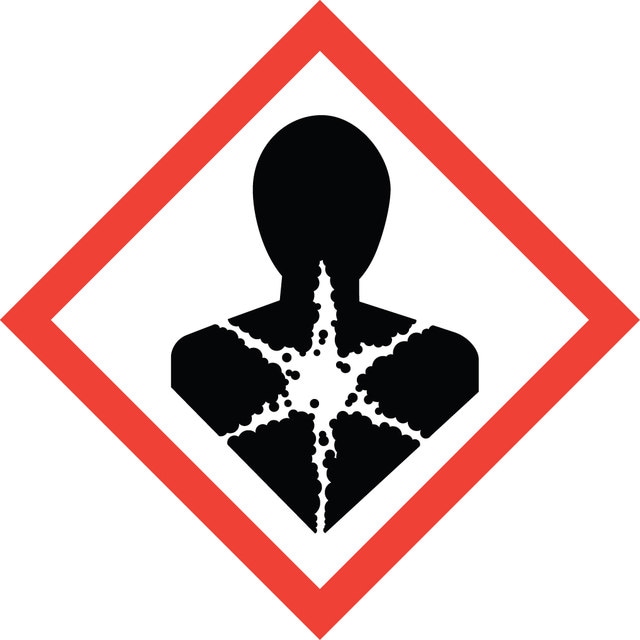
Acute Tox. 4 Inhalation - Acute Tox. 4 Oral - Carc. 1B - Muta. 2 - Skin Sens. 1
Klasa składowania
6.1D - Non-combustible acute toxic Cat.3 / toxic hazardous materials or hazardous materials causing chronic effects
WGK
WGK 3
Temperatura zapłonu (°F)
Not applicable
Temperatura zapłonu (°C)
Not applicable
Wykazy regulacyjne
Wykazy regulacyjne dotyczą głównie produktów chemicznych. Można w nich podawać ograniczoną liczbę informacji na temat produktów niechemicznych. Brak wpisu oznacza, że żaden ze składników nie znajduje się w wykazie. Użytkownik odpowiada za zagwarantowanie bezpiecznego i zgodnego z prawem stosowania produktu.
50-00-0 + 67-56-1
CAS No.
Wybierz jedną z najnowszych wersji:
Masz już ten produkt?
Dokumenty związane z niedawno zakupionymi produktami zostały zamieszczone w Bibliotece dokumentów.
-
Is it okay to fix an entire tissue with 4% PFA at 37°C overnight using product 1004960700 without altering its morphology?
1 answer-
Helpful?
-
-
Do 4% formaldehyde or 10% formalin solutions contain traces of methanol?
1 answer-
Product 1004960700 and all other formaldehyde or formalin solutions contain methanol to prevent the formaldehyde from reforming as a polymer or escaping as a gas. If a methanol-free solution is required, paraformaldehyde powders or crystals can be purchased and prepared into methanol-free solutions, although these solutions are unstable and should be prepared fresh daily or kept for only short periods of time.
Helpful?
-