Przejdź do zawartości
Merck

46067

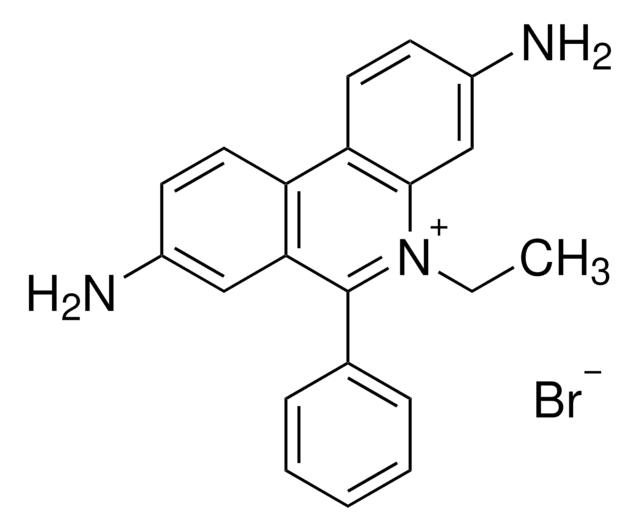
Ethidium bromide solution

suitable for fluorescence, ~1% in H2O

Synonim(y):

3,8-Diamino-5-ethyl-6-phenylphenanthridinium bromide, EtBr, Homidium bromide

Zaloguj się, aby wyświetlić ceny organizacyjne i kontraktowe.

Wybierz wielkość

Nie można obecnie kupić produktu 46067. Skontaktuj się z zespołem ds. pomocy technicznej

Informacje o tej pozycji

Wzór empiryczny (zapis Hilla):
C21H20BrN3
Numer CAS:
Masa cząsteczkowa:
394.31
UNSPSC Code:
12161505
NACRES:
NA.32
PubChem Substance ID:
MDL number:
Beilstein/REAXYS Number:
3642536

Przejdź do

Pomoc techniczna
Potrzebujesz pomocy? Nasz zespół doświadczonych naukowców chętnie Ci pomoże.
Pozwól nam pomóc

InChI

1S/C21H19N3.BrH/c1-2-24-20-13-16(23)9-11-18(20)17-10-8-15(22)12-19(17)21(24)14-6-4-3-5-7-14;/h3-13,23H,2,22H2,1H3;1H

SMILES string

[Br-].CC[n+]1c(-c2ccccc2)c3cc(N)ccc3c4ccc(N)cc14

InChI key

ZMMJGEGLRURXTF-UHFFFAOYSA-N

concentration

~1% in H2O

fluorescence

λex 480 nm; λem 620 nm in H2O, λex 518 nm; λem 605 nm (bound to DNA), λex 530 nm; λem 600 nm in 50 mM phosphate buffer pH 7.0 (upon binding to DNA)

suitability

suitable for fluorescence

storage temp.

2-8°C

Quality Level

Szukasz podobnych produktów? Odwiedź Przewodnik dotyczący porównywania produktów

Porównaj podobne pozycje

Wyświetl pełne porównanie

Pokaż różnice

1 of 4

Ta pozycja
E1385E1510E7637
grade

for fluorescence

grade

for molecular biology

grade

for molecular biology

grade

for molecular biology

fluorescence

λex 480 nm; λem 620 nm in H2O, λex 530 nm; λem 600 nm in 50 mM phosphate buffer pH 7.0 (upon binding to DNA), λex 518 nm; λem 605 nm (bound to DNA)

fluorescence

-

fluorescence

-

fluorescence

λex 360 nm; λem 590 nm in PBS, λex 526 nm; λem 605 nm (10 mM TBE; pH 8.0;), λex 526 nm; λem 605 nm in aqueous buffer

concentration

~1% in H2O

concentration

500 μg/mL in H2O

concentration

10 mg/mL in H2O

concentration

-

Quality Level

100

Quality Level

200

Quality Level

200

Quality Level

200

storage temp.

2-8°C

storage temp.

-

storage temp.

-

storage temp.

-

Application

Ethidium bromide (EtBr) is the most commonly used nucleic acid stain for PAGE or agarose gel electrophoresis. The fluorescence of EtBr increases 21-fold upon binding to double-stranded RNA and 25-fold on binding double-stranded DNA so that destaining the background is not necessary with a low stain concentration (10 μg/ml). Ethidium bromide has been used in a number of fluorimetric assays for nucleic acids. It has been shown to bind to single-stranded DNA (although not as strongly) and triple-stranded DNA. Because of its ability to bind to DNA, EtBr is an inhibitor of DNA polymerase.

Biochem/physiol Actions

Ethidium bromide intercalates double-stranded DNA and RNA and acts as a frameshift mutagen. It can also be used in conjunction with acridine orange to differentiate between viable, apoptotic and necrotic cells.

Preparation Note

For staining a gel after electrophoresis, dilute a sample of the stock solution to 0.5 μg/ml with water and incubate the gel for 15-30 min. Destaining is usually not needed but can be carried out in water for 15 min if decreased background is necessary. The DNA bands can then be detected on a UV light box (254 nm wavelength). Ethidium bromide can also be incorporated into the gel and running buffer at 0.5 μg/ml and visualized immediately after electrophoresis.
Ta strona może zawierać tekst przetłumaczony maszynowo.

related product

Numer produktu
Opis
Cennik

pictograms

Skull and crossbonesHealth hazard

signalword

Danger

hcodes

Hazard Classifications

Acute Tox. 3 Inhalation - Muta. 2

Klasa składowania

6.1D - Non-combustible acute toxic Cat.3 / toxic hazardous materials or hazardous materials causing chronic effects

wgk

nwg

flash_point_f

Not applicable

flash_point_c

Not applicable

ppe

Eyeshields, Faceshields, Gloves, type ABEK (EN14387) respirator filter


Wybierz jedną z najnowszych wersji:

Certyfikaty analizy (CoA)

Lot/Batch Number

Nie widzisz odpowiedniej wersji?

Jeśli potrzebujesz konkretnej wersji, możesz wyszukać konkretny certyfikat według numeru partii lub serii.

Masz już ten produkt?

Dokumenty związane z niedawno zakupionymi produktami zostały zamieszczone w Bibliotece dokumentów.

Odwiedź Bibliotekę dokumentów

Wenfang Peng et al.
Nucleic acids research, 43(1), 406-417 (2014-12-17)
CRISPR-Cas systems provide a small RNA-based mechanism to defend against invasive genetic elements in archaea and bacteria. To investigate the in vivo mechanism of RNA interference by two type III-B systems (Cmr-α and Cmr-β) in Sulfolobus islandicus, a genetic assay
Alexandra C I Depelsenaire et al.
The Journal of investigative dermatology, 134(9), 2361-2370 (2014-04-10)
Vaccines delivered to the skin by microneedles-with and without adjuvants-have increased immunogenicity with lower doses than standard vaccine delivery techniques such as intramuscular or intradermal injection. However, the mechanisms underlying this skin-mediated "adjuvant" effect are not clear. Here, we show
Ulrich Braunschweig et al.
Genome research, 24(11), 1774-1786 (2014-09-27)
Alternative splicing (AS) of precursor RNAs is responsible for greatly expanding the regulatory and functional capacity of eukaryotic genomes. Of the different classes of AS, intron retention (IR) is the least well understood. In plants and unicellular eukaryotes, IR is
Patrick Seitz et al.
PLoS genetics, 10(1), e1004066-e1004066 (2014-01-07)
The DNA uptake of naturally competent bacteria has been attributed to the action of DNA uptake machineries resembling type IV pilus complexes. However, the protein(s) for pulling the DNA across the outer membrane of Gram-negative bacteria remain speculative. Here we
Ashish Mehta et al.
PloS one, 9(7), e103485-e103485 (2014-07-30)
Genetically unmodified cardiomyocytes mandated for cardiac regenerative therapy is conceivable by "foot-print free" reprogramming of somatic cells to induced pluripotent stem cells (iPSC). In this study, we report generation of foot-print free hiPSC through messenger RNA (mRNA) based reprograming. Subsequently

Powiązane treści

Nancy-520 for DNA Detection and Quantitation

Questions

Reviews

No rating value

Active Filters

Nasz zespół naukowców ma doświadczenie we wszystkich obszarach badań, w tym w naukach przyrodniczych, materiałoznawstwie, syntezie chemicznej, chromatografii, analityce i wielu innych dziedzinach.

Skontaktuj się z zespołem ds. pomocy technicznej