Passa al contenuto
Merck

H6878

8-Hydroxyquinoline

Sinonimo/i:

8-Quinolinol, 8-Hydroxyquinoline, 8-Oxychinolin, Oxine

Autenticati per visualizzare i prezzi riservati alla tua organizzazione & contrattuali

Scegli un formato


Informazioni su questo articolo

Formula empirica (notazione di Hill):
C9H7NO
Numero CAS:
Peso molecolare:
145.16
Beilstein:
114512
Numero CE:
Numero MDL:
Codice UNSPSC:
12352005
ID PubChem:
NACRES:
NA.21
Servizio Tecnico
Hai bisogno di aiuto? Il nostro team di scienziati qualificati è a tua disposizione.
Permettici di aiutarti
Servizio Tecnico
Hai bisogno di aiuto? Il nostro team di scienziati qualificati è a tua disposizione.
Permettici di aiutarti

Saggio

≥98.5%

Livello qualitativo

Stato

powder

Punto di fusione

72.5-74.0 °C

Spettro attività antibiotica

fungi

Modalità d’azione

DNA synthesis | interferes
enzyme | inhibits

Stringa SMILE

Oc1cccc2cccnc12

InChI

1S/C9H7NO/c11-8-5-1-3-7-4-2-6-10-9(7)8/h1-6,11H
MCJGNVYPOGVAJF-UHFFFAOYSA-N

Cerchi prodotti simili? Visita Guida al confronto tra prodotti

Descrizione generale

Chemical structure: quinolone

Applicazioni

Used as a lipophilic monoprotic bidentate chelating agent.

Avvertenze

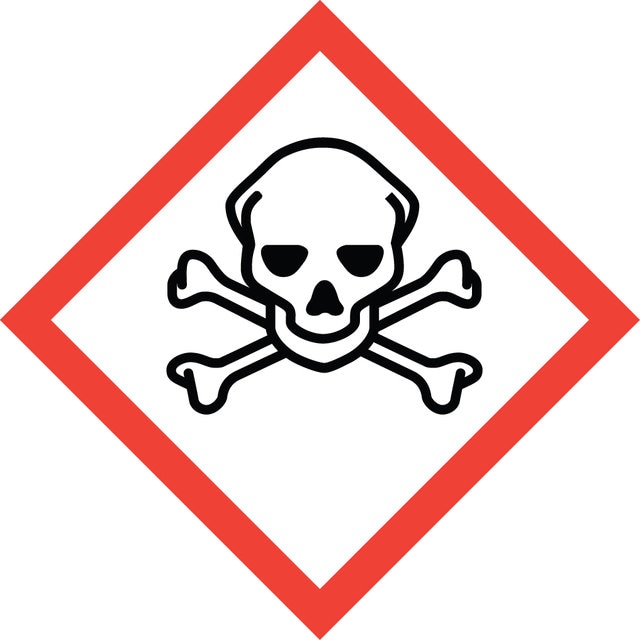
Danger

Indicazioni di pericolo

Classi di pericolo

Acute Tox. 3 Oral - Aquatic Acute 1 - Aquatic Chronic 1 - Eye Dam. 1 - Repr. 1B - Skin Sens. 1

Codice della classe di stoccaggio

6.1C - Combustible acute toxic Cat.3 / toxic compounds or compounds which causing chronic effects

Classe di pericolosità dell'acqua (WGK)

WGK 3

Punto d’infiammabilità (°F)

Not applicable

Punto d’infiammabilità (°C)

Not applicable

Dispositivi di protezione individuale

dust mask type N95 (US), Eyeshields, Faceshields, Gloves


Scegli una delle versioni più recenti:

Certificati d'analisi (COA)

Lot/Batch Number

Non trovi la versione di tuo interesse?

Se hai bisogno di una versione specifica, puoi cercare il certificato tramite il numero di lotto.

Possiedi già questo prodotto?

I documenti relativi ai prodotti acquistati recentemente sono disponibili nell’Archivio dei documenti.

Visita l’Archivio dei documenti

Pawel Strzelczyk et al.
Scientific reports, 10(1), 17516-17516 (2020-10-17)
The mechanism of catalysis by the L-glutaminase-asparaginase from Pseudomonas 7A (PGA) was investigated using structural, mass spectrometry, and kinetic data. We had previously proposed mechanism of hydrolysis of L-Asn by the type II L-asparaginase from E. coli (EcAII), but that
María Isabel Fernández-Bachiller et al.
Journal of medicinal chemistry, 53(13), 4927-4937 (2010-06-16)
Tacrine and PBT2 (an 8-hydroxyquinoline derivative) are well-known drugs that inhibit cholinesterases and decrease beta-amyloid (Abeta) levels by complexation of redox-active metals, respectively. In this work, novel tacrine-8-hydroxyquinoline hybrids have been designed, synthesized, and evaluated as potential multifunctional drugs for
Michael Riedelberger et al.
Cell host & microbe, 27(3), 454-466 (2020-02-23)
Type I interferons (IFNs-I) fulfil multiple protective functions during pathogenic infections, but they can also cause detrimental effects and enhance immunopathology. Here, we report that IFNs-I promote the dysregulation of iron homeostasis in macrophages during systemic infections with the intracellular
David M Rubush et al.
Journal of the American Chemical Society, 134(33), 13554-13557 (2012-08-09)
The desymmetrization of p-peroxyquinols using a Brønsted acid-catalyzed acetalization/oxa-Michael cascade was achieved in high yields and selectivities for a variety of aliphatic and aryl aldehydes. Mechanistic studies suggest that the reaction proceeds through a dynamic kinetic resolution of the peroxy
Bhimashankar Mitkari et al.
Experimental neurology, 239, 158-162 (2012-10-13)
Cell therapies from various sources have been under intense research in stroke. Efficient homing of the cells to the injured brain without complications is necessary to realize the therapeutic potential of cell therapy. Intra-arterial (IA) infusion of cells bypasses the

Il team dei nostri ricercatori vanta grande esperienza in tutte le aree della ricerca quali Life Science, scienza dei materiali, sintesi chimica, cromatografia, discipline analitiche, ecc..

Contatta l'Assistenza Tecnica