


If this product has an expiration or retest date, it will be shown on the Certificate of Analysis (COA, CofA). If there is no retest or expiration date listed on the product's COA, we do not have suitable stability data to determine a shelf life. For these products, the only date on the COA will be the release date; a retest, expiration, or use-by-date will not be displayed.
For all products, we recommend handling per defined conditions as printed in our product literature and website product descriptions. We recommend that products should be routinely inspected by customers to ensure they perform as expected.
For products without retest or expiration dates, our standard warranty of 1 year from the date of shipment is applicable.
For more information, please refer to the Product Dating Information document: https://www.sigmaaldrich.com/deepweb/assets/sigmaaldrich/marketing/global/documents/418/501/product-dating-information-06-25-mk.pdf
E1510

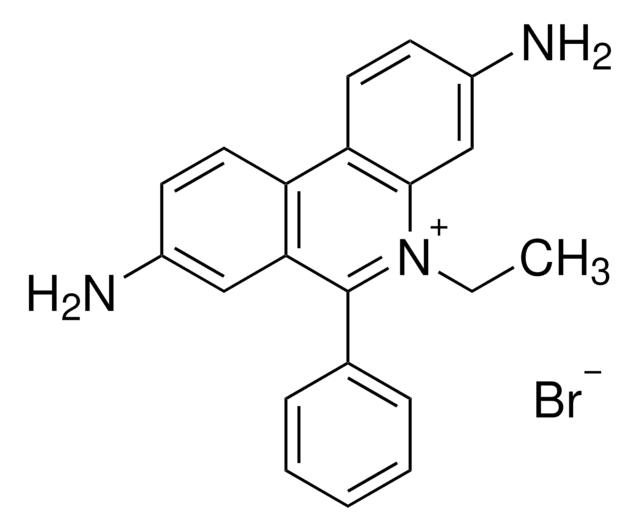
Bromuro di etidio
BioReagent, Molecular Biology, 10 mg/mL in H2O
Sinonimo/i:
3,8-diamino-5-etil-6-fenilfenantridinio bromuro, Bromuro di omidio, EtBr
Scegli un formato
CHF 109.00
Informazioni su questo articolo
Vai a
Grado
Molecular Biology
Nome Commerciale
BioReagent
Concentrazione
10 mg/mL in H2O
tecniche
electrophoresis: suitable
Compatibilità
suitable for gel electrophoresis
Stringa SMILE
[Br-].CC[n+]1c(-c2ccccc2)c3cc(N)ccc3c4ccc(N)cc14
InChI
1S/C21H19N3.BrH/c1-2-24-20-13-16(23)9-11-18(20)17-10-8-15(22)12-19(17)21(24)14-6-4-3-5-7-14;/h3-13,23H,2,22H2,1H3;1H
ZMMJGEGLRURXTF-UHFFFAOYSA-N
Cerchi prodotti simili? Visita Guida al confronto tra prodotti
1 of 4
Questo articolo | E1385 | E7637 | 46067 |
|---|---|---|---|
| technique(s) electrophoresis: suitable | technique(s) electrophoresis: suitable | technique(s) electrophoresis: suitable | technique(s) - |
| suitability suitable for gel electrophoresis | suitability suitable for gel electrophoresis | suitability suitable for gel electrophoresis | suitability - |
| grade for molecular biology | grade for molecular biology | grade for molecular biology | grade for fluorescence |
| concentration 10 mg/mL in H2O | concentration 500 μg/mL in H2O | concentration - | concentration ~1% in H2O |
| Quality Level 200 | Quality Level 200 | Quality Level 200 | Quality Level 100 |
| product line BioReagent | product line BioReagent | product line BioReagent | product line - |
Applicazioni
Azioni biochim/fisiol
Nota sulla preparazione
Prodotti correlati
Prodotto comparabile
Avvertenze
Danger
Indicazioni di pericolo
Consigli di prudenza
Classi di pericolo
Acute Tox. 3 Inhalation - Muta. 2
Codice della classe di stoccaggio
6.1D - Non-combustible acute toxic Cat.3 / toxic hazardous materials or hazardous materials causing chronic effects
Classe di pericolosità dell'acqua (WGK)
nwg
Punto d’infiammabilità (°F)
Not applicable
Punto d’infiammabilità (°C)
Not applicable
Scegli una delle versioni più recenti:
Possiedi già questo prodotto?
I documenti relativi ai prodotti acquistati recentemente sono disponibili nell’Archivio dei documenti.
Protocolli
GenElute™ Bacterial Genomic DNA Kit protocol describes a simple and convenient way for the isolation of pure genomic DNA from bacteria.
The GenElute™ Blood Genomic DNA Kit Protocol provides a simple and convenient way to isolate pure genomic DNA from fresh or aged whole blood.
The GenElute Mammalian Genomic DNA Purification Kit Protocol describes the isolation of pure, high molecular weight DNA from a variety of mammalian sources.
Das Protokoll für das GenElute™-Kit für bakterielle genomische DNA beschreibt eine einfache und praktische Möglichkeit für die Isolation von reiner genomischer DNA aus Bakterien.
Contenuto correlato
Ethidium bromide is a well-known and widely used fluorescent dye in biotechnology research.
Ethidiumbromid ist ein bekannter und verbreitet eingesetzter fluoreszierender Farbstoff für die biotechnologische Forschung.
-
How can I determine the shelf life / expiration / retest date of this product?
1 answer-
Helpful?
-
-
How is shipping temperature determined? And how is it related to the product storage temperature?
1 answer-
Products may be shipped at a different temperature than the recommended long-term storage temperature. If the product quality is sensitive to short-term exposure to conditions other than the recommended long-term storage, it will be shipped on wet or dry-ice. If the product quality is NOT affected by short-term exposure to conditions other than the recommended long-term storage, it will be shipped at ambient temperature. As shipping routes are configured for minimum transit times, shipping at ambient temperature helps control shipping costs for our customers. For more information, please refer to the Storage and Transport Conditions document: https://www.sigmaaldrich.com/deepweb/assets/sigmaaldrich/marketing/global/documents/316/622/storage-transport-conditions-mk.pdf
Helpful?
-
Active Filters
Il team dei nostri ricercatori vanta grande esperienza in tutte le aree della ricerca quali Life Science, scienza dei materiali, sintesi chimica, cromatografia, discipline analitiche, ecc..
Contatta l'Assistenza Tecnica