


If this product has an expiration or retest date, it will be shown on the Certificate of Analysis (COA, CofA). If there is no retest or expiration date listed on the product's COA, we do not have suitable stability data to determine a shelf life. For these products, the only date on the COA will be the release date; a retest, expiration, or use-by-date will not be displayed.
For all products, we recommend handling per defined conditions as printed in our product literature and website product descriptions. We recommend that products should be routinely inspected by customers to ensure they perform as expected.
For products without retest or expiration dates, our standard warranty of 1 year from the date of shipment is applicable.
For more information, please refer to the Product Dating Information document: https://www.sigmaaldrich.com/deepweb/assets/sigmaaldrich/marketing/global/documents/418/501/product-dating-information-06-25-mk.pdf
53827-U

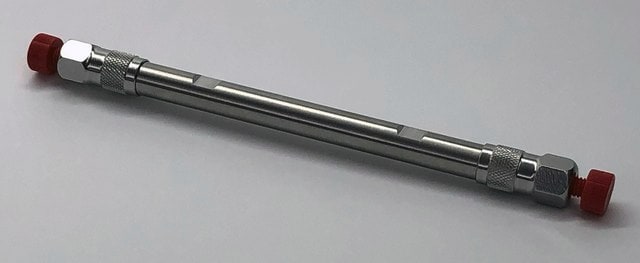
Colonna per HPLC Ascentis® Express C18, 2,7 μm
L × I.D. 10 cm × 4.6 mm, pk of 1 ea
Sinonimo/i:
Colonna per HPLC Core-shell (SPP) Fused Core C18
Scegli un formato
Informazioni su questo articolo
Vai a
Materiali
stainless steel column
agenzia
suitable for USP L1
Nome Commerciale
Ascentis®
Caratteristiche
endcapped
Confezionamento
pk of 1 ea
Parametri
60 °C temp. range
600 bar max. pressure (9000 psi)
tecniche
HPLC: suitable
LC/MS: suitable
Lungh. × D.I.
10 cm × 4.6 mm
Area superficiale
135 m2/g
Impurezze
<5 ppm metals
Matrice
Fused-Core particle platform
superficially porous particle
Gruppo funzionale matrice
C18 (octadecyl) phase
Dimensione particelle
2.7 μm
Dimensione pori
90 Å
pH di lavoro
2-9
Tecnica di separazione
reversed phase
Cerchi prodotti simili? Visita Guida al confronto tra prodotti
1 of 4
Questo articolo | 582711-U | 53829-U | 50630-U |
|---|---|---|---|
| separation technique reversed phase | separation technique reversed phase | separation technique reversed phase | separation technique - |
| L × I.D. 10 cm × 4.6 mm | L × I.D. 5 cm × 1 mm | L × I.D. 15 cm × 4.6 mm | L × I.D. 10 cm × 1.5 mm |
| matrix active group C18 (octadecyl) phase | matrix active group C18 (octadecyl) phase | matrix active group C18 (octadecyl) phase | matrix active group C18 (octadecyl) phase |
| particle size 2.7 μm | particle size 2.7 μm | particle size 2.7 μm | particle size std dev 2.7 μm |
| agency suitable for USP L1 | agency suitable for USP L1 | agency suitable for USP L1 | agency suitable for USP L1 |
| matrix Fused-Core particle platform, superficially porous particle | matrix Fused-Core particle platform, superficially porous particle | matrix Fused-Core particle platform, superficially porous particle | matrix Fused-Core particle platform |
Descrizione generale
Per ulteriori informazioni su questa nuova tecnologia, si rimanda alla pagina Ascentis Express
Applicazioni
Analisi UHPLC/MS dell′olio di mais con la colonna Ascentis® Express C30 confrontata con Ascentis® Express C18
Analisi UHPLC del paracetamolo e delle sue impurezze con la colonna Ascentis® Express C18, 2,7 μm
Analisi HPLC dei parabeni con la colonna Ascentis®Express C18, 2,7 μm
Note legali
Prodotti correlati
used together
Codice della classe di stoccaggio
11 - Combustible Solids
Classe di pericolosità dell'acqua (WGK)
WGK 3
Punto d’infiammabilità (°F)
Not applicable
Punto d’infiammabilità (°C)
Not applicable
Scegli una delle versioni più recenti:
Possiedi già questo prodotto?
I documenti relativi ai prodotti acquistati recentemente sono disponibili nell’Archivio dei documenti.
Articoli
Derivatization of Aliphatic Amines - Results from the Supelco Ascentis Express column show higher peak resolution, and improved peak shapes than typical chromatograms.
Chromatograms
-
How can I determine the shelf life / expiration / retest date of this product?
1 answer-
Helpful?
-
-
How is shipping temperature determined? And how is it related to the product storage temperature?
1 answer-
Products may be shipped at a different temperature than the recommended long-term storage temperature. If the product quality is sensitive to short-term exposure to conditions other than the recommended long-term storage, it will be shipped on wet or dry-ice. If the product quality is NOT affected by short-term exposure to conditions other than the recommended long-term storage, it will be shipped at ambient temperature. As shipping routes are configured for minimum transit times, shipping at ambient temperature helps control shipping costs for our customers. For more information, please refer to the Storage and Transport Conditions document: https://www.sigmaaldrich.com/deepweb/assets/sigmaaldrich/marketing/global/documents/316/622/storage-transport-conditions-mk.pdf
Helpful?
-
-
What solution should be used to wash the Ascentis C18, 2.7um particle column?
1 answer-
The recommended cleaning solution for reversed phase C18 columns is typically a mixture of the organic solvent used in the mobile phase and water. To remove impurities, it is advisable to reverse the column flow. Begin by flushing the column with HPLC grade water to eliminate the buffer, followed by a wash with a 40:60 or 50:50 ratio of the mobile phase solvent (methanol or ACN).
Helpful?
-
-
Is there anything special I need to do to my HPLC system to use Ascentis Express?
1 answer-
Nothing special is required to use Ascentis Express HPLC columns. To obtain the full benefits of Ascentis Express, one should minimize dispersion in the HPLC system (tubing, detector flow cell) as well as confirm the detector response system is set at a fast level. For more information, request Guidelines for Optimizing Systems for Ascentis Express Columns (T407102).
Helpful?
-
-
What flow rate should I use with Ascentis® Express HPLC Columns?
1 answer-
Based on the minimum in the van Deemter curves, higher flows than 5um particle columns are required in order to maximize Ascentis Express column efficiency. The suggested starting point for flow rate for Ascentis Express columns: 1.6 mL/min for 4.6 mm ID; 0.8 mL/min for 3.0 mm ID; and 0.4mL/min for 2.1 mm ID.
Helpful?
-
-
What is the Department of Transportation shipping information for this product?
1 answer-
Transportation information can be found in Section 14 of the product's (M)SDS.To access the shipping information for this material, use the link on the product detail page for the product.
Helpful?
-
-
Can I use Ascentis Express on any type of HPLC system?
1 answer-
Ascentis Express HPLC columns are capable of use on standard HPLC systems as well as UHPLC systems. Columns are packed in high pressure hardware capable of withstanding the pressures used in UHPLC systems.
Helpful?
-
-
How can I measure my instrument bandwidth (IBW) and determine what Ascentis® Express HPLC Columns can be used with minimal efficiency loss created by too much internal instrument volume?
1 answer-
The Guide to Dispersion Measurement has simple instructions on how to measure IBW and can be found at sigma-aldrich.com/express.
Helpful?
-
-
Can Ascentis® Express HPLC Columns be used for LC-MS?
1 answer-
Express Fused-Core™ particles were designed with LC-MS in mind. Even extremely short column lengths exhibit sufficient plate counts to show high resolving power. The flat van Deemter plots permit resolution to be maintained at very high flow rates to maximize sample throughput. All Ascentis stationary phases have been evaluated for MS compatibility during their development, and the Express phases are no exception. You can expect extremely low column bleed and background while maintaining longest possible column lifetime. A bonus of Ascentis Express columns for high throughput UHPLC and LC-MS is that they are extremely rugged and highly resistant to plugging, a very common failure mode for competitor columns.
Helpful?
-
-
What is the carbon load for Ascentis® Express C18 HPLC Columns?
1 answer-
Carbon load which is commonly referred to as %Carbon is misleading and not meaningful for Ascentis® Express. Since Fused-Core™ particle is unique in the sense that it has a solid core and porous shell, the %Carbon number can not be compared to traditional porous particles. The carbon coverage for Ascentis® Express C18 is 3.5 micromoles/meter-squared
Helpful?
-
Active Filters
Il team dei nostri ricercatori vanta grande esperienza in tutte le aree della ricerca quali Life Science, scienza dei materiali, sintesi chimica, cromatografia, discipline analitiche, ecc..
Contatta l'Assistenza Tecnica