



This product has been cited as being a better tissue adhesive than poly-L-lysine. Maddox PH, Jenkins D., 3-Aminopropyltriethoxysilane (APES): a new advance in section adhesion. J Clin Pathol., 40(10):1256-7 (1987).
A3648

(3-Aminopropyl)triethoxysilan
≥98%
Synonym(e):
APTS, 3-Triethoxysilylpropylamin, APTES
Anmelden zur Ansicht der Organisations- und Vertragspreise.
Über diesen Artikel
Lineare Formel:
H2N(CH2)3Si(OC2H5)3
CAS-Nummer:
Molekulargewicht:
221.37
UNSPSC Code:
12171500
NACRES:
NA.47
PubChem Substance ID:
EC Number:
213-048-4
Beilstein/REAXYS Number:
1754988
MDL number:
Fortfahren mit
Technischer Dienst
Benötigen Sie Hilfe? Unser Team von erfahrenen Wissenschaftlern ist für Sie da.
Unterstützung erhaltenProduktname
(3-Aminopropyl)triethoxysilan, ≥98%
InChI key
WYTZZXDRDKSJID-UHFFFAOYSA-N
InChI
1S/C9H23NO3Si/c1-4-11-14(12-5-2,13-6-3)9-7-8-10/h4-10H2,1-3H3
SMILES string
CCO[Si](CCCN)(OCC)OCC
assay
≥98%
form
liquid
pH
11 (20 °C, 20 g/L)
bp
217 °C/760 mmHg (lit.)
mp
220-222 °C
density
0.946 g/mL at 25 °C (lit.)
application(s)
diagnostic assay manufacturing
hematology
histology
storage temp.
room temp
Quality Level
Suchen Sie nach ähnlichen Produkten? Aufrufen Leitfaden zum Produktvergleich
Verwandte Kategorien
1 of 4
Dieser Artikel | 440140 | 741442 | 50059 |
|---|---|---|---|
| assay ≥98% | assay 99% | assay ≥98.0% | assay ≥97.0% (GC) |
| form liquid | form liquid | form liquid | form - |
| storage temp. room temp | storage temp. - | storage temp. - | storage temp. - |
| mp 220-222 °C | mp - | mp - | mp - |
| density 0.946 g/mL at 25 °C (lit.) | density 0.946 g/mL at 25 °C (lit.) | density 0.929 g/mL at 25 °C, 0.946 g/mL at 25 °C (lit.) | density 1.004 g/mL at 20 °C (lit.) |
| bp 217 °C/760 mmHg (lit.) | bp 217 °C/760 mmHg (lit.) | bp 217 °C/760 mmHg (lit.) | bp - |
Application
Biochem/physiol Actions
(3-Aminopropyl)triethoxysilan bildet ein Aminopropylderivat von Glas, das als Adsorbens in der Affinitätschromatographie verwendet wird. Es wird für die Zubereitung von positiv geladenen Objektträgern verwendet, die sich für den Einsatz in verschiedenen immunhistochemischen und in-situ-Hybridisierungsverfahren eignen.[4]
signalword
Danger
hcodes
Hazard Classifications
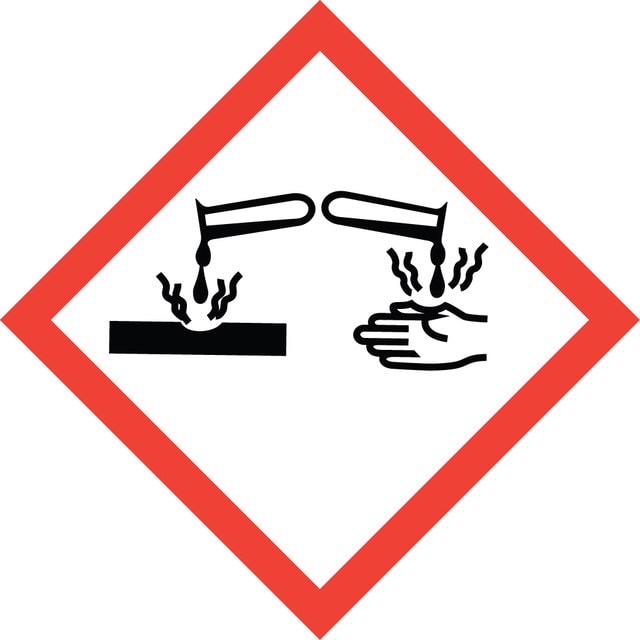
Acute Tox. 4 Oral - Eye Dam. 1 - Skin Corr. 1B - Skin Sens. 1
Lagerklasse
8A - Combustible corrosive hazardous materials
wgk
WGK 1
flash_point_f
199.4 °F - closed cup
flash_point_c
93 °C - closed cup
ppe
Faceshields, Gloves, Goggles, type ABEK (EN14387) respirator filter
Hier finden Sie alle aktuellen Versionen:
Besitzen Sie dieses Produkt bereits?
In der Dokumentenbibliothek finden Sie die Dokumentation zu den Produkten, die Sie kürzlich erworben haben.
Real-time observation of a single DNA digestion by lambda exonuclease under a fluorescence microscope field.
Matsuura S, et al.
Nucleic Acids Research, 29, E79-E79 (2001)
Apoptosis and survival of osteoblast-like cells are regulated by surface attachment.
Grigoriou V, et al.
The Journal of Biological Chemistry, 280, 1733-1739 (2005)
Isabelle Bonnet et al.
Nucleic acids research, 36(12), 4118-4127 (2008-06-12)
The restriction endonuclease EcoRV can rapidly locate a short recognition site within long non-cognate DNA using 'facilitated diffusion'. This process has long been attributed to a sliding mechanism, in which the enzyme first binds to the DNA via nonspecific interaction
Sri Ram Krishna Vedula et al.
Nature communications, 6, 6111-6111 (2015-01-23)
The closure of gaps within epithelia is crucial to maintain its integrity during biological processes such as wound healing and gastrulation. Depending on the distribution of extracellular matrix, gap closure occurs through assembly of multicellular actin-based contractile cables or protrusive
H Delanoë-Ayari et al.
Proceedings of the National Academy of Sciences of the United States of America, 101(8), 2229-2234 (2004-02-26)
Physicists have studied the aggregation of adhesive proteins, giving a central role to the elastic properties of membranes, whereas cell biologists have put the emphasis on the cytoskeleton. However, there is a dramatic lack of experimental studies probing both contributions
-
How does Product A3648, (3-Aminopropyl)triethoxysilane, compare to poly-L-lysine for binding tissue to glass surfaces?
1 Antwort-
Hilfreich?
-
-
Can I buy glass slides already treated with Product A3648, (3-Aminopropyl)triethoxysilane?
1 Antwort-
Yes. Silane Prep slides, Product No. S4651, are produced using A3648. These slides have an expiration period of 24 months.
Hilfreich?
-
-
Can the coating made from product A3648, (3-Aminopropyl)triethoxysilane, be removed?
1 Antwort-
For Product A3648, (3-Aminopropyl)triethoxysilane, the siliconized coating can be removed by an overnight treatment with 10-20% (w/v) aqueous or alcoholic potassium hydroxide or sodium hydroxide solutions. It may also be possible to remove the coating by physical abrasion, i.e., scrubbing or vigorously brushing the glass surface. Autoclaving will not destroy the coating.
Hilfreich?
-
-
Can Product A3648, (3-Aminopropyl)triethoxysilane, be used to coat controlled pore glass?
1 Antwort-
To coat controlled-pore glass beads for affinity chromatography, the following method is recommended:1. Treat 1 g of clean beads with 20 mL of a 10% aqueous A3648 (pH 3 to 4) at 75 °C for 2 hours.2. Filter the beads to remove the solution and dry overnight in a 115 °C oven. See: J. Dairy Sci., 73, 2720-2730 (1990).
Hilfreich?
-
-
What is the concentration of the (3-Aminopropyl)triethoxysilane, commonly known as APTES?
1 Antwort-
The (3-Aminopropyl)triethoxysilane, which is a neat liquid, is 4.3 M. This is based on a density of 0.946 g/mL and a molecular weight of 221.37.
Hilfreich?
-
-
What is the Department of Transportation shipping information for this product?
1 Antwort-
Transportation information can be found in Section 14 of the product's (M)SDS.To access the shipping information for this material, use the link on the product detail page for the product.
Hilfreich?
-
Aktive Filter
Unser Team von Wissenschaftlern verfügt über Erfahrung in allen Forschungsbereichen einschließlich Life Science, Materialwissenschaften, chemischer Synthese, Chromatographie, Analytik und vielen mehr..
Setzen Sie sich mit dem technischen Dienst in Verbindung