Skip to Content
Merck

31630-M

Silver nitrate

puriss. p.a., ACS reagent, reag. ISO, reag. Ph. Eur., ≥99.8%

Synonym(s):

Nitric acid silver(I) salt

Sign In to View Organizational & Contract Pricing.

Select a Size

25 G

HUF 46,000.00

250 G

HUF 307,000.00

HUF 46,000.00


Please contact Customer Service for Availability

Request a Bulk Order

About This Item

Linear Formula:
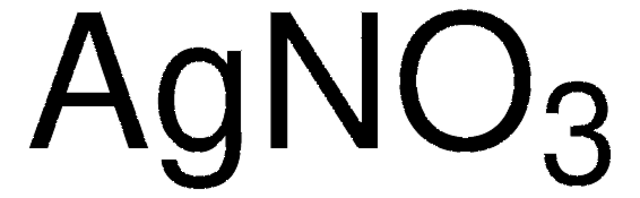
AgNO3
CAS Number:
Molecular Weight:
169.87
EC Number:
MDL number:
UNSPSC Code:
12352302
PubChem Substance ID:
NACRES:
NA.21
Assay:
≥99.8%
Form:
solid

Skip To

Technical Service
Need help? Our team of experienced scientists is here for you.
Let Us Assist

grade

ACS reagent
puriss. p.a.

Quality Level

Agency

USP/NF
reag. ISO
reag. Ph. Eur.

vapor density

5.8 (vs air)

Assay

≥99.8%

form

solid

impurities

≤0.01% subst. not precipitated by HCl (as SO4)

mp

212 °C (dec.) (lit.)

anion traces

chloride (Cl-): ≤5 ppm
nitrite (NO2-): ≤500 ppm
sulfate (SO42-): ≤0.002%

cation traces

Cd: ≤0.0001%
Cu: ≤0.0002%
Fe: ≤0.0002%
Mn: ≤5 mg/kg
Pb: ≤0.001%
Zn: ≤0.0001%

SMILES string

[O-][N+]([O-])=O.[Ag+]

InChI

1S/Ag.NO3/c;2-1(3)4/q+1;-1

InChI key

SQGYOTSLMSWVJD-UHFFFAOYSA-N

Looking for similar products? Visit Product Comparison Guide

Compare Similar Items

View Full Comparison

Show Differences

1 of 4

This Item
209139S6506204390
form

solid

form

solid

form

solid

form

crystalline, solid

assay

≥99.8%

assay

≥99.0%

assay

≥99.0% (titration)

assay

99.9999% trace metals basis

Quality Level

100

Quality Level

200

Quality Level

100

Quality Level

200

grade

ACS reagent, puriss. p.a.

grade

ACS reagent

grade

-

grade

-

impurities

≤0.01% subst. not precipitated by HCl (as SO4)

impurities

Free acid, passes test, ≤0.01% not HCl pptd.

impurities

-

impurities

≤1.5 ppm Trace Metal Analysis

cation traces

Cd: ≤0.0001%, Fe: ≤0.0002%, Pb: ≤0.001%, Cu: ≤0.0002%, Zn: ≤0.0001%, Mn: ≤5 mg/kg

cation traces

Cu: ≤2 ppm, Fe: ≤2 ppm, Pb: ≤0.001%

cation traces

-

cation traces

-

General description

Lee-Meisel method has been proposed for the preparation of silver colloids for surface-enhanced Raman scattering (SERS), via AgNO3 reduction with sodium citrate.[1] It has been reported as an antagonist of ethylene.

Application

Silver nitrate may be employed as stain to study the osteogenic differentiation of fetal human mesenchymal stem/progenitor cells (MSCs).[2] It may be used in the preparation of highly sensitive silver colloids for surface-enhanced Raman scattering (SERS) studies.[1]

Disclaimer

The product is not intended for use as a biocide under global biocide regulations, including but not limited to US EPA′s Federal Insecticide Fungicide and Rodenticide Act, European Biocidal Products Regulation, Canada’s Pest Management Regulatory Agency, Turkey’s Biocidal Products Regulation, Korea’s Consumer Chemical Products and Biocide Safety Management Act (K-BPR) and others.

Signal Word

Danger

Hazard Statements

Hazard Classifications

Aquatic Acute 1 - Aquatic Chronic 1 - Eye Dam. 1 - Met. Corr. 1 - Ox. Sol. 2 - Repr. 1B - Skin Corr. 1A

Storage Class Code

5.1B - Oxidizing hazardous materials

WGK

WGK 3

Flash Point(F)

Not applicable

Flash Point(C)

Not applicable


Choose from one of the most recent versions:

Certificates of Analysis (COA)

Lot/Batch Number

Don't see the Right Version?

If you require a particular version, you can look up a specific certificate by the Lot or Batch number.

Already Own This Product?

Find documentation for the products that you have recently purchased in the Document Library.

Visit the Document Library

D D Songstad et al.
Plant cell reports, 7(4), 262-265 (1988-06-01)
The effect of the ethylene antagonists norbornadiene and silver nitrate and the ethylene precursor l-aminocyclopropane-l-carboxylic acid (ACC) on Zea mays plant regeneration was studied. A 12-fold increase in plant regeneration, as measured by number of plants obtained per gram fresh
C Campagnoli et al.
Blood, 98(8), 2396-2402 (2001-10-06)
Human mesenchymal stem/progenitor cells (MSCs) have been identified in adult bone marrow, but little is known about their presence during fetal life. MSCs were isolated and characterized in first-trimester fetal blood, liver, and bone marrow. When 10(6) fetal blood nucleated

Questions

Reviews

No rating value

Active Filters

Our team of scientists has experience in all areas of research including Life Science, Material Science, Chemical Synthesis, Chromatography, Analytical and many others.

Contact Technical Service