Przejdź do zawartości
Merck

148520

4-Chlorocatechol

97%

Zaloguj się, aby wyświetlić ceny organizacyjne i kontraktowe.

Wybierz wielkość

1 G

551,00 zł

551,00 zł


Skontaktuj się z Obsługą Klienta, aby uzyskać informacje na temat dostępności

Zamów zamówienie zbiorcze

Informacje o tej pozycji

Wzór liniowy:
ClC6H3(OH)2
Numer CAS:
Masa cząsteczkowa:
144.56
NACRES:
NA.22
PubChem Substance ID:
UNSPSC Code:
12352100
EC Number:
218-381-9
MDL number:

Przejdź do

Pomoc techniczna
Potrzebujesz pomocy? Nasz zespół doświadczonych naukowców chętnie Ci pomoże.
Pozwól nam pomóc

Nazwa produktu

4-Chlorocatechol, 97%

InChI key

WWOBYPKUYODHDG-UHFFFAOYSA-N

InChI

1S/C6H5ClO2/c7-4-1-2-5(8)6(9)3-4/h1-3,8-9H

SMILES string

Oc1ccc(Cl)cc1O

assay

97%

mp

90-94 °C (lit.)

functional group

chloro

Quality Level

Porównaj podobne pozycje

Wyświetl pełne porównanie

Pokaż różnice

1 of 4

Ta pozycja
144940135585547093
assay

97%

assay

97%

assay

99%

assay

97%

Quality Level

100

Quality Level

100

Quality Level

100

Quality Level

100

mp

90-94 °C (lit.)

mp

151-154 °C (lit.)

mp

238-241 °C (lit.)

mp

110-115 °C (lit.)

functional group

chloro

functional group

carboxylic acid, chloro

functional group

carboxylic acid, chloro

functional group

chloro

General description

4-chlorocatechol was a major degradation product of 4-chloro-2-aminophenol (4C2AP)[1]. The degradation of 4-chlorocatechol was catalyzed by cphA-I enzyme[2].
Ta strona może zawierać tekst przetłumaczony maszynowo.

pictograms

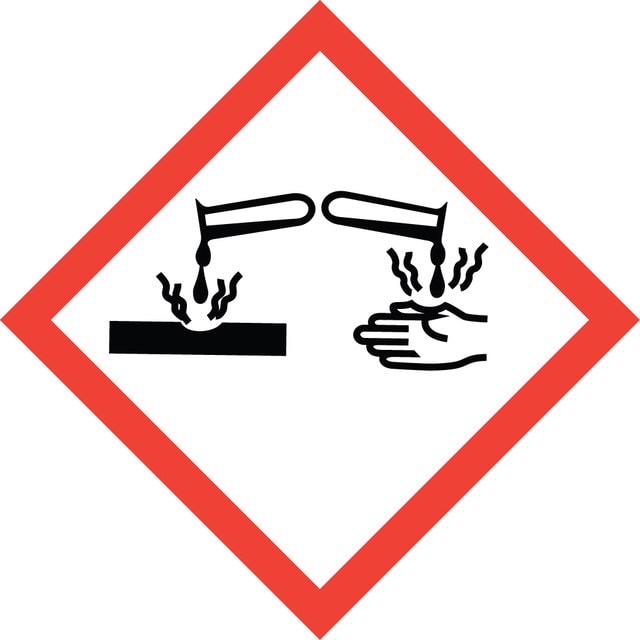
Corrosion

signalword

Danger

hcodes

Hazard Classifications

Skin Corr. 1B

Klasa składowania

8A - Combustible corrosive hazardous materials

wgk

WGK 3

flash_point_f

Not applicable

flash_point_c

Not applicable

ppe

Eyeshields, Faceshields, Gloves, type P3 (EN 143) respirator cartridges


Wybierz jedną z najnowszych wersji:

Certyfikaty analizy (CoA)

Lot/Batch Number

Nie widzisz odpowiedniej wersji?

Jeśli potrzebujesz konkretnej wersji, możesz wyszukać konkretny certyfikat według numeru partii lub serii.

Masz już ten produkt?

Dokumenty związane z niedawno zakupionymi produktami zostały zamieszczone w Bibliotece dokumentów.

Odwiedź Bibliotekę dokumentów

J K Kim et al.
Chemosphere, 69(5), 689-696 (2007-07-03)
The presence and impact of hydroxyl radicals generated via the catalytic decomposition of H(2)O(2) over heterogeneous copper catalysts were investigated by using two detection methods, an electron spin resonance-spin trapping method and a chemical probe method. Detection of the (5,5-dimethyl-1-pyrroline-N-oxide)-OH
A Farrell et al.
Biodegradation, 10(5), 353-362 (2000-06-28)
A mixed microbial community, specially designed to degrade a wide range of substituted aromatic compounds, was examined for its ability to degrade mono-chlorophenols as sole carbon source in aerobic batch cultures. The mixed culture degraded 2-, 3-, and 4-chlorophenol (1.56
Yingxun Du et al.
Journal of hazardous materials, 139(1), 108-115 (2006-07-28)
The role of oxygen in the degradation pathway of 4-CP by Fenton system was investigated in this paper. The degradation of 4-CP, changes of Fenton reagent's concentration and formation of the intermediates in Fenton/O2 system were respectively compared with those
M Klemba et al.
Applied and environmental microbiology, 66(8), 3255-3261 (2000-08-05)
The tcbR-tcbCDEF gene cluster, coding for the chlorocatechol ortho-cleavage pathway in Pseudomonas sp. strain P51, has been cloned into a Tn5-based minitransposon. The minitransposon carrying the tcb gene cluster and a kanamycin resistance gene was transferred to Pseudomonas putida KT2442
X Guan et al.
Analytical chemistry, 72(11), 2423-2427 (2000-06-17)
A sensitive and selective sensing system for chlorocatechols (3-chlorocatechol and 4-chlorocatechol) was developed based on Pseudomonas putida bacteria harboring the plasmid pSMM50R-B'. In this plasmid, the regulatory protein of the clc operon, ClcR, controls the expression of the reporter enzyme

Questions

Reviews

No rating value

Active Filters

Nasz zespół naukowców ma doświadczenie we wszystkich obszarach badań, w tym w naukach przyrodniczych, materiałoznawstwie, syntezie chemicznej, chromatografii, analityce i wielu innych dziedzinach.

Skontaktuj się z zespołem ds. pomocy technicznej