

This product is not a certified reference material, nor has it been tested for use in HPLC/MS. As Triton X-100 is typically avoided in Mass Spectrometry, there is no analytical standard currently that is qualified for this application. The end user would have to determine suitability for use in HPLC/MS. However, this material is referenced in an LC/MS publication by Shimadzu. Please see the link below to review:
https://www.shimadzu.com/an/sites/shimadzu.com.an/files/pim/pim_document_file/technical/white_papers/13844/apo21759.pdf
Przejdź do
X100

Triton™ X-100
laboratory grade
Synonim(y):
t-Octylphenoxypolyethoxyethanol, Polyethylene glycol tert-octylphenyl ether
Zaloguj się, aby wyświetlić ceny organizacyjne i kontraktowe.
Wybierz wielkość
Zmień widok
| Rozmiar/SKU | Dostępność | Cena netto |
|---|---|---|
5 mL | Dostępne do wysyłki DZISIAJzSchnelldorf Distribution | 221,00 zł |
100 mL | Dostępne do wysyłki DZISIAJzSchnelldorf Distribution | 399,00 zł |
500 mL | Dostępne do wysyłki DZISIAJzSchnelldorf Distribution | 518,00 zł |
1 L | Dostępne do wysyłki DZISIAJzSchnelldorf Distribution | 714,00 zł |
1 gal | Dostępne do wysyłki DZISIAJzSchnelldorf Distribution | 2110,00 zł |
5 gal | Przewidywany termin wysyłki03 lutego 2027zSchnelldorf Distribution | 8200,00 zł |
Informacje o tej pozycji
Wzór liniowy:
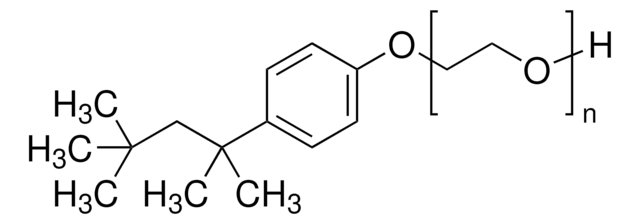
t-Oct-C6H4-(OCH2CH2)xOH, x= 9-10
Numer CAS:
UNSPSC Code:
12161900
NACRES:
NA.21
PubChem Substance ID:
MDL number:
Beilstein/REAXYS Number:
2315025
Pomoc techniczna
Potrzebujesz pomocy? Nasz zespół doświadczonych naukowców chętnie Ci pomoże.
Pozwól nam pomócbiological source
synthetic
Quality Segment
grade
laboratory grade
description
non-ionic
form
liquid
mol wt
micellar avg mol wt 80,000, average mol wt 625
aggregation number
100-155
CMC
0.2-0.9 mM (20-25°C)
mp
6 °C (43 °F)
transition temp
cloud point 65 °C, pour point ~7 °C
solubility
water: 0.1 mL/mL, clear to slightly hazy, colorless to faintly yellow
HLB
13.5
application(s)
advanced drug delivery
SMILES string
CC(C)(C)CC(C)(C)c1ccc(OCCOCCOCCOCCOCCOCCOCCO)cc1
InChI
1S/C28H50O8/c1-27(2,3)24-28(4,5)25-6-8-26(9-7-25)36-23-22-35-21-20-34-19-18-33-17-16-32-15-14-31-13-12-30-11-10-29/h6-9,29H,10-24H2,1-5H3
InChI key
HNLXNOZHXNSSPN-UHFFFAOYSA-N
General description
Triton™ X-100 is a common non-ionic surfactant and emulsifier which is often used in biochemical applications to solubilize proteins. It is considered a comparatively mild detergent, non-denaturing, and is reported in numerous references as a routinely added reagent. It is utilized for lysing cells to extract protein and cellular organelles. It can also permeabilize the living cell membrane for transfection.
Triton X-100 has hemolytic property and is used for DNA extraction.
Application
Biochem/physiol Actions
Widely used non-ionic surfactant for recovery of membrane components under mild non-denaturing conditions.
Features and Benefits
- Ideal for Cell Biology and Biochemical research applications
- Non-ionic nondenaturing detergent
- Superior wetting agent and emulsifier
- Highly versatile surfactant
Other Notes
For additional information on our range of Biochemicals, please complete this form.
Legal Information
Triton is a trademark of The Dow Chemical Company or an affiliated company of Dow
Ta strona może zawierać tekst przetłumaczony maszynowo.
1 of 1
Ta pozycja | |||
|---|---|---|---|
| description laboratory grade | description Molecular Biology | description BioXtra | description peroxide- and carbonyl-free |
| form liquid | form liquid | form liquid | form liquid |
| grade laboratory grade | grade Molecular Biology | grade - | grade - |
| aggregation number 100-155 | aggregation number 100-155 | aggregation number 100-155 | aggregation number 100-155 |
| application(s) advanced drug delivery | application(s) hematology | application(s) advanced drug delivery | application(s) - |
| mol wt average mol wt 625, micellar avg mol wt 80,000 | mol wt micellar avg mol wt 80,000, average mol wt 625 | mol wt micellar avg mol wt 80,000, average mol wt 625 | mol wt micellar avg mol wt 80,000, average mol wt 625 |
| mp 6 °C (43 °F) | mp 6 °C | mp - | mp - |
Still not finding the right product?
Explore all of our products under Triton™ X-100
Słowo ostrzegawcze
Danger
Klasa składowania
10 - Combustible liquids
Temperatura zapłonu (°F)
483.8 °F - closed cup
Temperatura zapłonu (°C)
251 °C - closed cup
PPE (środki ochrony indywidualnej)
Eyeshields, Faceshields, Gloves, type ABEK (EN14387) respirator filter, type N95 (US)
Kody zagrożeń
Hazard Classifications
Acute Tox. 4 Oral - Aquatic Acute 1 - Aquatic Chronic 1 - ED ENV 1 - Eye Dam. 1 - Skin Irrit. 2
Wykazy regulacyjne
Wykazy regulacyjne dotyczą głównie produktów chemicznych. Można w nich podawać ograniczoną liczbę informacji na temat produktów niechemicznych. Brak wpisu oznacza, że żaden ze składników nie znajduje się w wykazie. Użytkownik odpowiada za zagwarantowanie bezpiecznego i zgodnego z prawem stosowania produktu.
9036-19-5
CAS No.
9036-19-5
CAS No.
Wybierz jedną z najnowszych wersji:
Masz już ten produkt?
Dokumenty związane z niedawno zakupionymi produktami zostały zamieszczone w Bibliotece dokumentów.
-
Salve Questo è uno standard Certificato oppure un materiale di riferimento? Posso usarlo come standard per retta di taratura in HPLC_MS?
1 answer-
Helpful?
-
-
How can I determine the shelf life / expiration / retest date of this product?
1 answer-
If this product has an expiration or retest date, it will be shown on the Certificate of Analysis (COA, CofA). If there is no retest or expiration date listed on the product's COA, we do not have suitable stability data to determine a shelf life. For these products, the only date on the COA will be the release date; a retest, expiration, or use-by-date will not be displayed.
For all products, we recommend handling per defined conditions as printed in our product literature and website product descriptions. We recommend that products should be routinely inspected by customers to ensure they perform as expected.
For products without retest or expiration dates, our standard warranty of 1 year from the date of shipment is applicable.
For more information, please refer to the Product Dating Information document: https://www.sigmaaldrich.com/deepweb/assets/sigmaaldrich/marketing/global/documents/418/501/product-dating-information-06-25-mk.pdfHelpful?
-
-
What kind of change will be observed if heat up to 55C? Will it attack stacked Al and Ti metal layer? Can it mix with diluted nitric acid to etch Cu/NiV?
1 answer-
Heating this product to 55°C may lead to changes in viscosity, solubility, or performance characteristics. There is no indication that this product can attack aluminum and titanium metal layers. This product is generally compatible with diluted nitric acid. While no specific incompatibility is reported, the combination may alter the properties of both the surfactant and the acid, potentially affecting the performance of either in applications such as cleaning or etching. Additionally, it is important to consider the concentration and the potential for foaming or other reactions during mixing.
Helpful?
-
-
Is this product nuclease-free?
1 answer-
The product is not tested for RNase or DNase. Please see the link below to review Triton X-100 product options that include RNase and DNase testing:
https://www.sigmaaldrich.com/product/compare?term=triton%20x-100%20nuclease&focus=products&page=1&perpage=30&sort=relevance&type=product&products=T8787%3ASIGMA%3Asial%2C648466%3AMM%3Asial&returnUrl=%2Fsearch%2Ftriton-x-100-nucleaseHelpful?
-
-
How long is Triton X-100 stable at -80 degrees in buffer?
1 answer-
At -80°C, Triton X-100 is generally stable, but the stability can depend on the specific buffer conditions and the concentration of the detergent. In most cases, Triton X-100 remains effective at low temperatures, but it is advisable to avoid repeated freeze-thaw cycles, as these can lead to changes in the detergent's properties and effectiveness. Please note that the shelf life after opening is dependent upon various factors which might affect the stability and, therefore, it is not guaranteed and needs to be determined by the end user.
Helpful?
-
-
If a sterilization of Triton X-100 or its dilutions (maximum 10% of Triton X-100 in the total volume) is needed to remove DNAse and RNAse, what's the best approach?
1 answer-
Autoclaving undiluted Triton X-100 is generally not recommended for sterilization. However, dilute solutions, up to 10%, may be autoclaved. At certain
concentrations, solutions may become cloudy, but dispersible above the cloud point. The solution will clarify with stirring upon cooling. Note that DNAse and RNAse-free products are currently available. Please see the links below to review these product options:
https://www.sigmaaldrich.com/product/sigma/t8787
https://www.sigmaaldrich.com/product/mm/648466
https://www.sigmaaldrich.com/product/sigma/93443Helpful?
-
-
How is shipping temperature determined? And how is it related to the product storage temperature?
1 answer-
Products may be shipped at a different temperature than the recommended long-term storage temperature. If the product quality is sensitive to short-term exposure to conditions other than the recommended long-term storage, it will be shipped on wet or dry-ice. If the product quality is NOT affected by short-term exposure to conditions other than the recommended long-term storage, it will be shipped at ambient temperature. As shipping routes are configured for minimum transit times, shipping at ambient temperature helps control shipping costs for our customers. For more information, please refer to the Storage and Transport Conditions document: https://www.sigmaaldrich.com/deepweb/assets/sigmaaldrich/marketing/global/documents/316/622/storage-transport-conditions-mk.pdf
Helpful?
-
-
What are the storage conditions for the Triton 100x? It's not in the COA
1 answer-
This product may be be stored in room temperature.
Helpful?
-
-
Will heating Triton to reduce its viscosity have any negative impact on the product? Does heating negatively affect the activity of Triton?
1 answer-
Triton X-100 can be frozen, thawed, and used. However, caution is advised when heating it above 50°C, as discoloration may occur. This note indicates that excessive heating can lead to some form of change in Triton X-100. It would be reasonable to assume that the recommended working range is from ambient temperature to 50°C (or slightly lower). If your process requires heating the solution to temperatures higher than 50°C, it is recommended to add Triton X-100 only after the temperature has dropped below 50°C or lower. If you need to work at temperatures exceeding 50°C, it is advisable to conduct solution stability studies to assess potential damage or breakdown of Triton X-100.
Helpful?
-
-
Is a concentration of 8x10^-5 mol/L of Triton X-100 harmful to metal (steel/aluminum) and silicon equipment when submerged in water?
1 answer-
The laboratory has not specifically tested the corrosive properties of Triton X-100 on metal. However, according to a publication titled "Triton X-100 and Sodium Lauryl Sulfate Surfactants as Environmentally Friendly Corrosion Inhibitors for Steel in 0.5 M H2SO4" in Advances in Analytical Chemistry, Triton X-100 appears to act as a corrosion inhibitor for steel.
Helpful?
-