
If this product has an expiration or retest date, it will be shown on the Certificate of Analysis (COA, CofA). If there is no retest or expiration date listed on the product's COA, we do not have suitable stability data to determine a shelf life. For these products, the only date on the COA will be the release date; a retest, expiration, or use-by-date will not be displayed.
For all products, we recommend handling per defined conditions as printed in our product literature and website product descriptions. We recommend that products should be routinely inspected by customers to ensure they perform as expected.
For products without retest or expiration dates, our standard warranty of 1 year from the date of shipment is applicable.
For more information, please refer to the Product Dating Information document: https://www.sigmaaldrich.com/deepweb/assets/sigmaaldrich/marketing/global/documents/418/501/product-dating-information-06-25-mk.pdf
472301

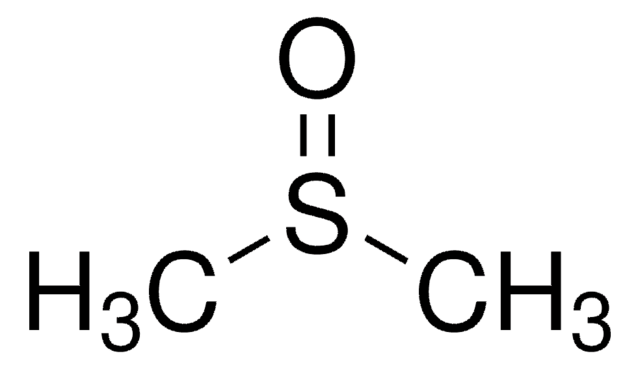
Dimethyl sulfoxide
ACS reagent, ≥99.9%
Synonim(y):
DMSO
Wybierz wielkość
290,00 zł
918,00 zł
1200,00 zł
3800,00 zł
5310,00 zł
5830,00 zł
6510,00 zł
Informacje o tej pozycji
Przejdź do
Nazwa produktu
Dimethyl sulfoxide, ACS reagent, ≥99.9%
InChI key
IAZDPXIOMUYVGZ-UHFFFAOYSA-N
InChI
1S/C2H6OS/c1-4(2)3/h1-2H3
SMILES string
CS(C)=O
grade
ACS reagent
vapor density
2.7 (vs air)
vapor pressure
0.42 mmHg ( 20 °C)
assay
≥99.9%
form
liquid
autoignition temp.
573 °F
expl. lim.
42 %, 63 °F
dilution
(for analytical testing)
impurities
≤0.001 meq/g Titr. acid
≤0.1% water
evapn. residue
≤0.01%
color
clear colorless
refractive index
n20/D 1.479 (lit.)
bp
189 °C (lit.)
mp
16-19 °C (lit.)
density
1.10 g/mL (lit.)
Quality Level
Szukasz podobnych produktów? Odwiedź Przewodnik dotyczący porównywania produktów
1 of 4
Ta pozycja | 41640-M | D5879 | 317275 |
|---|---|---|---|
| grade ACS reagent | grade ACS reagent, puriss. p.a. | grade - | grade - |
| assay ≥99.9% | assay ≥99.9% (GC) | assay ≥99.5% | assay ≥99% (GC) |
| Quality Level 200 | Quality Level - | Quality Level 200 | Quality Level 100 |
| form liquid | form liquid | form liquid | form liquid |
| refractive index n20/D 1.479 (lit.) | refractive index n20/D 1.479 (lit.) | refractive index n20/D 1.479 (lit.) | refractive index n20/D 1.479 (lit.) |
| density 1.10 g/mL (lit.) | density 1.10 g/mL (lit.) | density 1.10 g/mL (lit.) | density 1.10 g/mL (lit.) |
Application
- in the preparation of ethyl 4-[18F]fluorobenzoate.[1]
- in the culture medium for 3-(4,5-dimethylthiazol-2-yl)-2,5-diphenyl-tetrazolium bromide (MTT) assay.[2]
- as a solvent in chemical synthesis.
- to dissolve and prepare stock solutions of small molecules, drugs, and chemical compounds for various assays and experiments.
Disclaimer
General description
Premium ACS Solvents: Our solvents meet or exceed the stringent standards set by the American Chemical Society, ensuring high quality and reliability for your laboratory applications.
Replicable and Publishable Results: Designed for consistency, our solvents deliver results that can be reliably reproduced, making them ideal for research that requires publication.
Versatile Applications: Suitable for routine chemical synthesis, drying, purification, and critical labware cleaning, our solvents cater to a wide range of research needs in the laboratory.
Other Notes
Dimethyl Sulfoxide Miscibility/Immiscibility Table
Klasa składowania
10 - Combustible liquids
wgk
WGK 1
flash_point_f
188.6 °F - closed cup
flash_point_c
87 °C - closed cup
Wybierz jedną z najnowszych wersji:
Masz już ten produkt?
Dokumenty związane z niedawno zakupionymi produktami zostały zamieszczone w Bibliotece dokumentów.
Produkty
Mówi się, że substancje są ze sobą mieszalne, jeśli rozpuszczają się, tworząc jednolity roztwór. Dodaj do zakładek lub pobierz naszą tabelę mieszalności dla popularnych rozpuszczalników laboratoryjnych.
Substances are said to be miscible in one another if they dissolve to form a uniform solution. Bookmark or download our miscibility table for common lab solvents.
-
How can I determine the shelf life / expiration / retest date of this product?
1 answer-
Helpful?
-
-
How is shipping temperature determined? And how is it related to the product storage temperature?
1 answer-
Products may be shipped at a different temperature than the recommended long-term storage temperature. If the product quality is sensitive to short-term exposure to conditions other than the recommended long-term storage, it will be shipped on wet or dry-ice. If the product quality is NOT affected by short-term exposure to conditions other than the recommended long-term storage, it will be shipped at ambient temperature. As shipping routes are configured for minimum transit times, shipping at ambient temperature helps control shipping costs for our customers. For more information, please refer to the Storage and Transport Conditions document: https://www.sigmaaldrich.com/deepweb/assets/sigmaaldrich/marketing/global/documents/316/622/storage-transport-conditions-mk.pdf
Helpful?
-
-
I know that this substance is of 2 types, with smell and without smell. What type is this?
1 answer-
This is a high purity DMSO. While odor is not a tested specification, high purity products are expected to be odorless. A disagreeable odor is due to the sulfur moiety in the material. DMSO may also contain small amounts of un-reacted Dimethyl Sulfide (DMS). This DMS is generally contributes to a disagreeable odor.
Helpful?
-
-
Can I use this DMSO for cell freezing?Is it sterile
1 answer-
While DMSO is commonly used as a cryoprotectant in cell freezing, this product has not been tested for use in cell culture. This product is also not sterile. See the links below to review the sterile, cell culture tested DMSO product options:
D2438, DMSO, sterile-filtered, BioPerformance Certified, meets EP & USP testing specifications, suitable for hybridoma
https://www.sigmaaldrich.com/product/sigma/d2438D2650, sterile-filtered, Bioreagent, suitable for hybridoma
https://www.sigmaaldrich.com/product/sigma/d2650Helpful?
-
-
Where does DMSO come from?
1 answer-
DMSO is known to have been isolated from tree bark in the past. It is now a commericially synthesized solvent.
Helpful?
-
-
What is the DMSO dissolved in?
1 answer-
DMSO is not dissolved in any solvent. It is a pure chemical compound that is a liquid at room temperature.
Helpful?
-
-
Does DMSO have any synthetic utility?
1 answer-
DMSO has been used to oxidize thiols and disulfides to sulfonic acids, hydrolysis of epoxides, thioalkylation of phenols, and oxidation of primary alcohols and halides, and esters of primary alcohols to aldehydes.
Helpful?
-
-
What is the molarity of DMSO?
1 answer-
DMSO will have a molarity of 14.1M, based on a density of 1.1 g/mL and a molecular weight of 78.13 g/mol.
Helpful?
-
-
Is Dimethyl sulfoxide a sterile product?
1 answer-
No, this product is not considered sterile. Product Nos. D2560 and D2438 are sterile-filtered.
Helpful?
-
-
What is the Department of Transportation shipping information for this product?
1 answer-
Transportation information can be found in Section 14 of the product's (M)SDS.To access the shipping information for this material, use the link on the product detail page for the product.
Helpful?
-
Active Filters
Nasz zespół naukowców ma doświadczenie we wszystkich obszarach badań, w tym w naukach przyrodniczych, materiałoznawstwie, syntezie chemicznej, chromatografii, analityce i wielu innych dziedzinach.
Skontaktuj się z zespołem ds. pomocy technicznej