

製造商/商標名
Novagen®
儲存條件
OK to freeze
一般說明
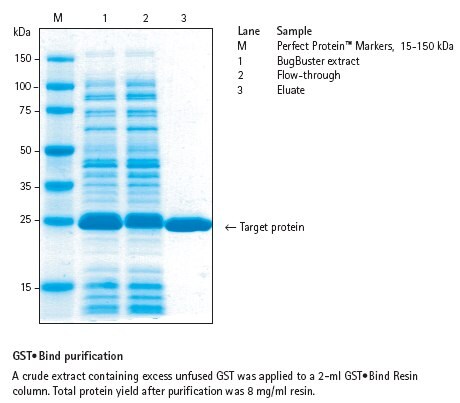
其他說明
•10,000 UBenzonase Nuclease, purity >90%
•10 mlGST•Bind Resin
•pkg/4Chromatography Columns
•2 x 100 ml10X GST Bind/Wash Buffer
•40 ml10X Glutathione Reconstitution Buffer
•1 gGlutathione, Reduced
法律資訊
免責聲明
訊號詞
Warning
危險聲明
危險分類
Flam. Liq. 3
儲存類別代碼
3 - Flammable liquids
閃點(°F)
96.8 °F
閃點(°C)
36 °C
分析證明 (COA)
輸入產品批次/批號來搜索 分析證明 (COA)。在產品’s標籤上找到批次和批號,寫有 ‘Lot’或‘Batch’.。
相關內容
Traditionally, protein purification from E. coli consists of four distinct phases: harvest, bacterial cell lysis, lysate clarification and protein purification. Bacterial lysis typically requires several time-consuming, hands-on steps, such as freeze/thaw cycles and sonication. These harsh lysis techniques may negatively impact protein quality and contribute to sample-to-sample variability. To maintain protein activity and integrity, detergent-based lysis buffers are routinely used to avoid mechanical protein extraction methods. Regardless of the lysis method used, centrifugation is traditionally required to pellet unwanted cell debris and permit recovery of the clarified lysate. The final step, purification, is frequently performed using affinity media specific for expressed epitope tags. Agarose-based media have typically been used, either as a slurry in microcentrifuge tubes or packed into gravity-driven or spin columns. While easier to manipulate, columns are greatly affected by lysate consistency and carryover of cell debris, which can lead to clogging of the column frits.
Active Filters
我們的科學家團隊在所有研究領域都有豐富的經驗,包括生命科學、材料科學、化學合成、色譜、分析等.
聯絡技術服務