

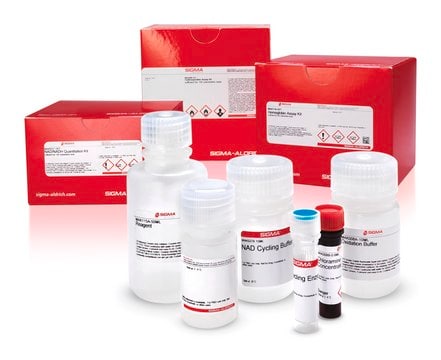

It is recommended to refer to the protocol for appropriate usage and sample amounts. According to step 3 in the Assay reaction section, transferring 10 µL of samples into separate wells is advised.
用途
sufficient for 100 tests (Ultraviolet)
檢測方法
colorimetric
相關疾病
cardiovascular diseases; genitourinary disorders; aging/geriatric diseases; orthopedic diseases
運輸包裝
dry ice
儲存溫度
−20°C
基因資訊
human ... CKB(1152), CKM(1158)
mouse ... CKB(12709), CKM(12715)
rat ... CKB(24264), CKM(24265)
1 of 4
本產品 | MAK066 | MAK055 | MAK121 |
|---|---|---|---|
| Gene Information human ... CKB(1152), CKM(1158) | Gene Information human ... LDHA(3939), LDHB(3945) | Gene Information human ... GOT1(2805) | Gene Information - |
| usage sufficient for 100 tests (Ultraviolet) | usage sufficient for 500 colorimetric tests | usage sufficient for 100 colorimetric tests | usage sufficient for 100 colorimetric or fluorometric tests |
| detection method colorimetric | detection method colorimetric | detection method colorimetric | detection method colorimetric, fluorometric |
| storage temp. −20°C | storage temp. −20°C | storage temp. −20°C | storage temp. −20°C |
| shipped in dry ice | shipped in - | shipped in - | shipped in dry ice |
| relevant disease(s) cardiovascular diseases; genitourinary disorders; aging/geriatric diseases; orthopedic diseases | relevant disease(s) hematological disorder; cancer | relevant disease(s) gastrointestinal diseases; cardiovascular diseases | relevant disease(s) - |
一般說明
肌酸激酶(CK),又称磷酸肌酸激酶,是催化一个磷酸基团从ATP转移到肌酸,产生磷酸肌酸的酶,磷酸肌酸是肌肉和脑组织的重要能量储备。CK是一种由B(大脑)和M(肌肉)亚基组成的二聚体蛋白。现已发现三种同工酶,即:CK-MM、CK-MB和CK-BB。在心肌梗塞、横纹肌溶解、肌营养不良和肾功能衰竭等各种病理状况下,CK水平升高。
應用
适用于检测各种样品中(如血清和血浆)的肌酸激酶活性。本试剂盒可用于研究各种化合物对肌酸激酶活性的影响。
生化/生理作用
通过偶联酶反应确定肌酸激酶活性,在340 nm处测量反应产生的NADPH,结果与样品中的CK活性成比例。在此反应中,磷酸肌酸和ADP转化为肌酸和ATP。己糖激酶将产生的ATP用于磷酸化葡萄糖,生成葡萄糖-6-磷酸;在葡萄糖-6-磷酸脱氢酶存在的情况下,NADP氧化葡萄糖-6-磷酸,生成NADPH和6-磷酸-D-葡萄糖酸。一个单位的CK指pH 6.0时,每分钟将1.0μmole磷酸盐从磷酸肌酸转移到ADP的酶量。 该试剂盒的线性范围为30-1,800 单位/L CK活性。
特點和優勢
兼容高通量的操作系统。
相關產品
P2RX7 Purinoceptor: A Therapeutic Target for Ameliorating the Symptoms of Duchenne Muscular Dystrophy
Sinadinos A
PLoS Medicine null
Gary R Hunter et al.
Medicine and science in sports and exercise, 49(12), 2414-2421 (2017-07-25)
Resting energy expenditure (REE) increases after an intense exercise; however, little is known concerning mechanisms. The purpose of this study was to determine effects of a single bout of moderate-intensity continuous (MIC) aerobic exercise, or high-intensity interval (HII) exercise on
Marcus Waskiw-Ford et al.
Nutrients, 12(4) (2020-04-16)
Leucine-enriched essential amino acids (LEAAs) acutely enhance post-exercise myofibrillar protein synthesis (MyoPS), which has been suggested to be important for muscle repair and recovery. However, the ability of LEAAs to concurrently enhance MyoPS and muscle damage recovery in free-living humans
Evaluation of White Sesame Seed Oil on Glucose Control and Biomarkers of Hepatic, Cardiac, and Renal Functions in Male Sprague-Dawley Rats with Chemically Induced Diabetes
Aslam F, et al.
Journal of Medicinal Food, 448-57 null
HANAC Col4a1 Mutation in Mice Leads to Skeletal Muscle Alterations due to a Primary Vascular Defect
Guiraud S, et al.
The American Journal of Pathology, 505-516 null
相關內容
Instructions
-
How much mouse blood/plasma would you recommend using for successful measurement?
1 answer-
Helpful?
-
-
How can I determine the shelf life / expiration / retest date of this product?
1 answer-
If this product has an expiration or retest date, it will be shown on the Certificate of Analysis (COA, CofA). If there is no retest or expiration date listed on the product's COA, we do not have suitable stability data to determine a shelf life. For these products, the only date on the COA will be the release date; a retest, expiration, or use-by-date will not be displayed.
For all products, we recommend handling per defined conditions as printed in our product literature and website product descriptions. We recommend that products should be routinely inspected by customers to ensure they perform as expected.
For products without retest or expiration dates, our standard warranty of 1 year from the date of shipment is applicable.
For more information, please refer to the Product Dating Information document: https://www.sigmaaldrich.com/deepweb/assets/sigmaaldrich/marketing/global/documents/418/501/product-dating-information-06-25-mk.pdfHelpful?
-
-
How is shipping temperature determined? And how is it related to the product storage temperature?
1 answer-
Products may be shipped at a different temperature than the recommended long-term storage temperature. If the product quality is sensitive to short-term exposure to conditions other than the recommended long-term storage, it will be shipped on wet or dry-ice. If the product quality is NOT affected by short-term exposure to conditions other than the recommended long-term storage, it will be shipped at ambient temperature. As shipping routes are configured for minimum transit times, shipping at ambient temperature helps control shipping costs for our customers. For more information, please refer to the Storage and Transport Conditions document: https://www.sigmaaldrich.com/deepweb/assets/sigmaaldrich/marketing/global/documents/316/622/storage-transport-conditions-mk.pdf
Helpful?
-
-
How long are the provided solutions stable for when stored at -20C? Does the assay lose efficacy through repeated freeze/thaw cycles of the assay solutions?
1 answer-
The unopened kit is expiration dated on a batch-by-batch basis and the certificate of analysis for a specific lot would need to be reviewed for this information. Please review the "product documentation" section of the website to pull a sample CoA or to input the lot number for the received lot.
https://www.sigmaaldrich.com/product/sigma/MAK116#product-documentation
There is no data available on the amount of freeze/thaws this kit can withstand. It is expected that repeated freeze/thaws of enzyme and substrate solution could affect the activity. Therefore, it would be advised to aliquot multiple small volumes of the kit reagents for one-time use to avoid repeated freeze/thaw cycles.
Helpful?
-
-
What is the required cell count for this procedure, and at what cell concentration is the supernatant obtained?
1 answer-
For preparing cell samples for use with MAK116, the Creatine Kinase Activity Assay Kit, the vendor recommends using the cell lysate for the assay. The number of cells to use will depend on the CK activity of the cells, and the final CK activity of the sample used for the assay should be within 5 to 300 U/L creatine kinase (the linear detection range in a 96-well plate assay). Here's an example of a sample preparation protocol for adherent or suspension cells:
1. Harvest the required number of cells for each assay, with an initial recommendation of two million or 2 x 10^6 cells.
2. Wash the cells with cold PBS and resuspend them in 400 µL PBS on ice.
3. Lyse the cells by homogenization (10-20 passes in a Dounce homogenizer on ice) or by sonication (preferably performed in an ice-water bath). The degree of cell lysis can be checked under a microscope.
4. Centrifuge the homogenate at 14,000 g for 10 minutes and transfer the clear supernatant into a clean tube.
5. Conduct a pilot test of the sample at different dilutions. Choose a dilution with readings within the range of the calibrator for further assays. Most samples can be stored at -80°C if not assayed immediately.Helpful?
-
-
Can this kit be used on an adherent cell line (rat species)?
1 answer-
Creatine kinase is generally found in muscle tissue or in plasma. The MAK116 has been published in the scientific literature for samples such as rat serum, plasma and tissue. There are not any articles referring specifically to rat adherent cell lines. Further research and development for this kit would be necessary to validate for this application. The insert does provide instructions for working with adherent cell lysate.
https://www.sigmaaldrich.com/deepweb/assets/sigmaaldrich/product/documents/355/268/mak116bul.pdfHelpful?
-
-
Regarding the creatine kinase assay, will this detect CK activity from other mammalian species such as bovine?
1 answer-
Yes, this kit is suitable for determining CK levels in mammalian samples.
Helpful?
-
Active Filters
我們的科學家團隊在所有研究領域都有豐富的經驗,包括生命科學、材料科學、化學合成、色譜、分析等.
聯絡技術服務