



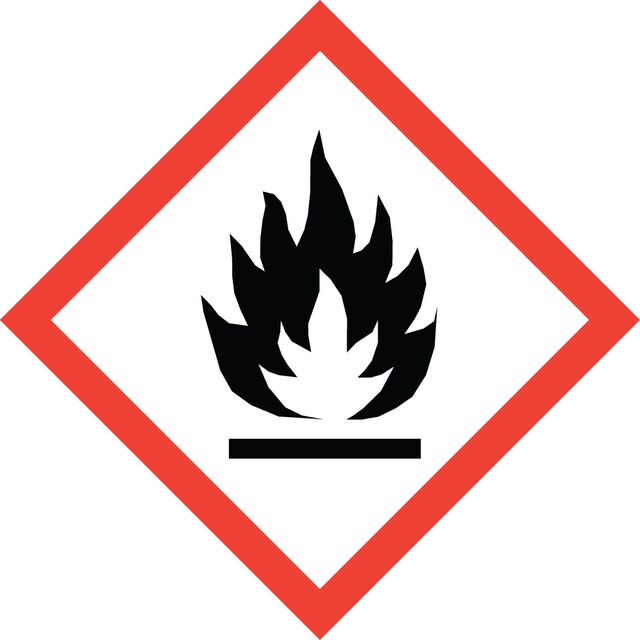




Transportation information can be found in Section 14 of the product's (M)SDS.To access the shipping information for this material, use the link on the product detail page for the product.
用途
kit sufficient for 1,000 tests
包裝
pkg of 1 kit
儲存條件
dry at room temperature
λmax
570 nm
應用
cell analysis
detection
檢測方法
colorimetric
儲存溫度
2-8°C
1 of 4
本產品 | CGD1 | TOX8 | TOX4 |
|---|---|---|---|
| usage 1 kit sufficient for 1,000 tests | usage - | usage 1 kit sufficient for 2,000 tests | usage 1 kit sufficient for 1,000 tests |
| packaging pkg of 1 kit | packaging pkg of 1 kit | packaging pkg of 1 kit | packaging pkg of 1 kit |
| storage condition dry at room temperature | storage condition - | storage condition dry at room temperature | storage condition dry at room temperature |
| λmax 570 nm | λmax - | λmax - | λmax 540 nm |
cytotoxicity assay substrate, MTT dye based, colorimetric determination, 570 nM detection | - | cytotoxicity assay substrate, tetrazolium dye based, fluroescence determination, 600 nM detection | cytotoxicity assay substrate, colorimetric determination, 540 nM detection |
| application(s) cell analysis | application(s) cell analysis | application(s) cell analysis | application(s) cell analysis |
一般說明
本试剂盒旨在利用活细胞的线粒体活性功能通过比色法测定细胞数/细胞活力。MTT法是一种简便、准确、结果可重复的方法。关键组分是(3-[4,5-二甲基-2-噻唑基]-2,5-二苯基溴化四唑) 或MTT。溶于无酚红的培养基或平衡盐溶液中的MTT溶液呈浅黄色。其四唑环可被活细胞的线粒体脱氢酶剪切而产生不溶于水溶液的紫色甲臜晶体。在570nm波长处测量转化染料的吸光度。
應用
生化/生理作用
将MTT转化成水不溶性的有色甲臜衍生物,然后用酸性异丙醇溶解。
訊號詞
Danger
危險分類
Aquatic Acute 1 - Aquatic Chronic 2 - Eye Dam. 1 - Flam. Liq. 2 - Muta. 2 - Skin Corr. 1 - STOT SE 3
標靶器官
Central nervous system, Respiratory system
儲存類別代碼
3 - Flammable liquids
閃點(°F)
53.6 °F
閃點(°C)
12 °C
J Carmichael et al.
Cancer research, 47(4), 936-942 (1987-02-15)
Drug sensitivity assays were performed using a variation of a colorimetric [3-(4,5-dimethylthiazol-2-yl)-2,5-diphenyltetrazolium bromide (MTT)] assay on V79, CHO-AuxB1, CHRC5, NCI-H460, and NCI-H249 cell lines following optimization of experimental conditions for each cell line. Results from this assay were compared with
Human renal organic anion transporter 1-dependent uptake and toxicity of mercuric-thiol conjugates in Madin-Darby canine kidney cells
Aslamkhan AG, et al.
Molecular Pharmacology, 63(3), 590-596 (2003)
Dalia Chávez-García et al.
Journal of biomedical materials research. Part B, Applied biomaterials, 108(6), 2396-2406 (2020-02-06)
Luminescent lanthanide downconversion nanoparticles (DCNPs) provide a combination of high luminescence intensity, sharp emission peaks with narrow bandwidth and a large Stokes' shift, leading to high-performance biomedical applications mainly for imaging. The purpose of this study is to present a
Off-resonance plasmonic enhanced femtosecond laser optoporation and transfection of cancer cells
Baumgart J, et al.
Biomaterials, 33(7), 2345-2350 (2012)
Srijayaprakash B Uppada et al.
International journal of nanomedicine, 9, 43-53 (2014-01-07)
Oligonucleotides homologous to 3'-telomere overhang (T-oligos) trigger inherent telomere-based DNA damage responses mediated by p53 and/or ATM and induce senescence or apoptosis in various cancerous cells. However, T-oligo has limited stability in vivo due to serum and intracellular nucleases. To
文章
以細胞為基礎的細胞增殖 (BrdU、MTT、WST1)、細胞活力和細胞毒性實驗,應用於癌症、神經科學和幹細胞研究。
以細胞為基礎的細胞增殖 (BrdU、MTT、WST1)、細胞活力和細胞毒性實驗,應用於癌症、神經科學和幹細胞研究。
品質控制指導方針,以維持高品質、經驗證且無污染的細胞培養物。免費下載 ECACC 手冊。
Cell based assays for cell proliferation (BrdU, MTT, WST1), cell viability and cytotoxicity experiments for applications in cancer, neuroscience and stem cell research.
-
What is the Department of Transportation shipping information for this product?
1 answer-
Helpful?
-
-
What is the difference between product CGD1, Cell Growth Determination Kit and product TOX1, In Vitro Toxicology Assay Kit?
1 answer-
Product CGD1 and TOX1 are both MTT based assays. The major difference between product CGD1 and TOX1 is that TOX1 contains 10 % Triton X-100 in the solubilization solution for better lysis of the cells and solubilization of the MTT. If there is complete cell lysis, the results obtained with both kits would be the same. The MTT in this kit is a solution, whereas the TOX1 assay kit contains the MTT as a powder that is solubilized before use.
Helpful?
-
-
Is the MTT assay quantitative?
1 answer-
The MTT asay is a method to assess cell viability. This assay is a semiquantitative assay. The assay is used to compare the viability changes in treated cells to untreated cells. The absorbance is indicative of the cell number. The higher the absorbance, the greater the number of viable cells present. Most researchers compare the absorbance of the two samples as a ratio (ABS treated cells/ABS untreated cells) to get a fold increase/decrease in cell number.
Helpful?
-
Active Filters
我們的科學家團隊在所有研究領域都有豐富的經驗,包括生命科學、材料科學、化學合成、色譜、分析等.
聯絡技術服務